


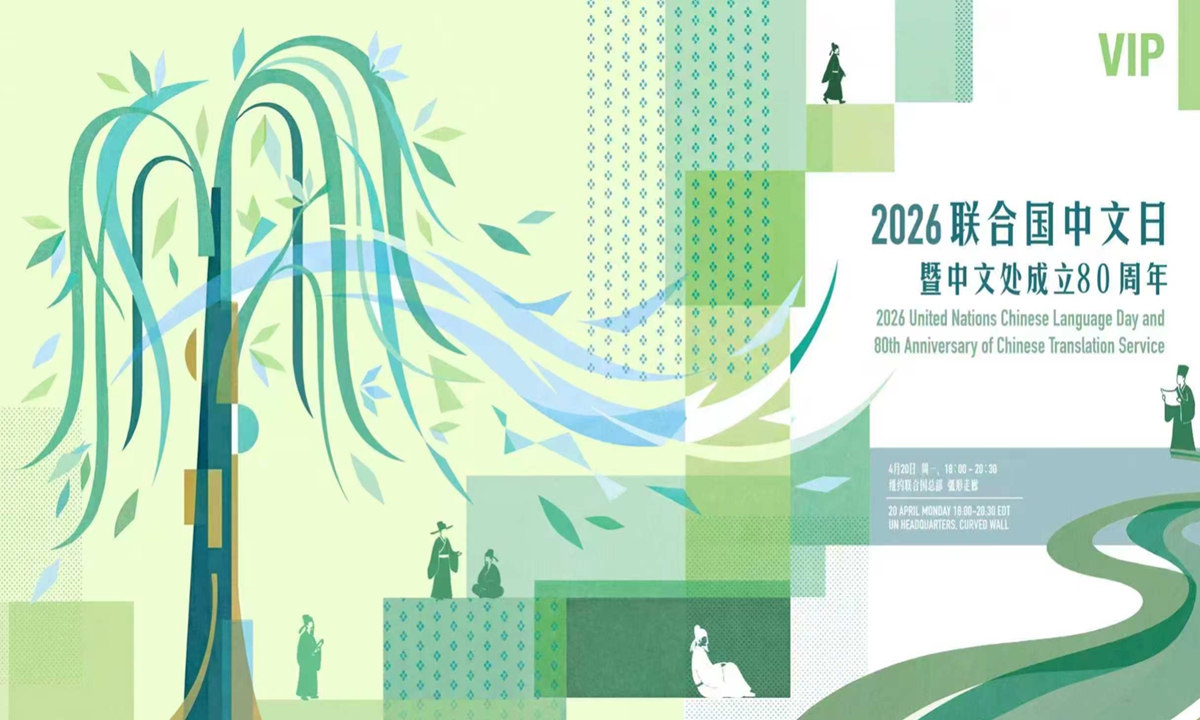
A poster for the 2026 United Nations Chinese Language Day and 80th Anniversary of Chinese Translation Service Photo: Screenshot from the UN official website
A series of cultural events have been held in multiple locations worldwide to mark the 2026 United Nations Chinese Language Day. On Monday, a special celebration commemorating both the Chinese Language Day and the 80th anniversary of the Chinese Language Service will be held at the United Nations Headquarters.
The celebration, jointly organized by the Chinese Book Club at the UN, the Chinese Translation Service, and the Chinese Language Teaching Unit, will be held in the Delegates Entrance Hall. Activities will include guided exhibition tours, cultural performances, and interactive experiences showcasing elements of China's intangible cultural heritage.
The celebration aims to promote the richness of the Chinese language and culture, while highlighting the contributions of Chinese language professionals within the UN system.
The UN has six official languages: Arabic, Chinese, English, French, Russian and Spanish. To highlight linguistic and cultural diversity and promote the equal use of these languages, the UN Department of Global Communications launched UN Language Days in 2010. It designated April 20 — coinciding with Grain Rain in the traditional Chinese calendar — as Chinese Language Day, in honor of Cangjie, the "ancestor of Chinese characters."
In addition, special lectures and cultural experience activities will be held at the UN on April 21 to further promote exchanges and mutual learning between the Chinese language and the world's diverse cultures, the UN's official website announced.
In recent days, various locations around the world have held vibrant celebrations to mark this year's UN Chinese Language Day. According to the Xinhua News Agency, in Warsaw, Poland, nearly 200 Chinese and Polish students gathered at SWPS University for performances and exchanges under the theme of cultural exchange between China and the West. In Sofia, Bulgaria, the Confucius Institute organized a Chinese singing contest and inaugurated a peony culture center on Saturday local time.
In Addis Ababa, Ethiopia, and Lusaka, Zambia, universities and Confucius Institutes also presented songs, dances, and cultural performances to highlight the growing global appeal of the Chinese language. Similar events in Nairobi, Kenya, and Rio de Janeiro, Brazil, emphasized dialogue among civilizations and the role of Chinese in sparking colorful dreams.
Earlier, a celebration titled Chinese Language Shining Civilizations was held at the UN headquarters in New York to mark the UN Chinese Language Day. At the end of its report, the UN noted that in today's world, where globalization and digitalization are deeply intertwined, Chinese is continuously gaining new vitality.
At the intersection of technological empowerment and cultural heritage, the Chinese language not only connects the past with the future, but also facilitates communication among civilizations and contributes to a new chapter of multilateralism, the report said.
Wang Deyan, director of the Chinese Language Department at the School of Liberal Arts and Law of North China University of Technology, expressed support. He told the Global Times on Sunday that the widespread global celebrations of UN Chinese Language Day highlight the status of Chinese as an official global language and reflect the growing influence of the Chinese language and culture.
Wang further noted that the Chinese Language Day is not only a celebration of language and culture, but also an important example of China promoting exchanges and mutual learning among civilizations, participating in global cultural governance, and contributing to a more just and inclusive international order. Amid profound global changes unseen in a century, cultural connection through language is more enduring than confrontation and division.
"At a time when global trust and understanding deficits are intensifying, language and culture serve as the most accessible and non-confrontational means of communication. Chinese cultural elements such as calligraphy, intangible cultural heritage, and creative products going global are not merely displays, but a subtle way of conveying Chinese values and wisdom, presenting a multidimensional and authentic image of China, easing misunderstandings, and bringing a sense of inclusiveness to a tense international climate," Wang said.
From another perspective, the global discourse system has long been imbalanced. Through language promotion, the Chinese Language Day also shares traditional concepts such as harmony, coexistence, and the pursuit of common good, offering an alternative perspective in global cultural discourse and helping foster a more equitable, diverse, and inclusive cultural landscape in line with the vision of a shared future for humanity, said the expert.