


Along the coast of Yancheng, Jiangsu Province in East China lies what many call a "paradise for migratory birds." Each year, millions of birds from around the world stop here to rest, molt, and overwinter, drawing roughly one million visitors who follow in their wake.
This is the Tiaozini wetlands, situated in the Dongtai Coastal Economic Zone of Yancheng, Jiangsu Province. As an important part of the Yellow Sea Wetlands, one of the world's largest intertidal wetland systems, the Tiaozini wetlands cover an area of 86,000 hectares and serve as a key node along the East Asian-Australasian Flyway.
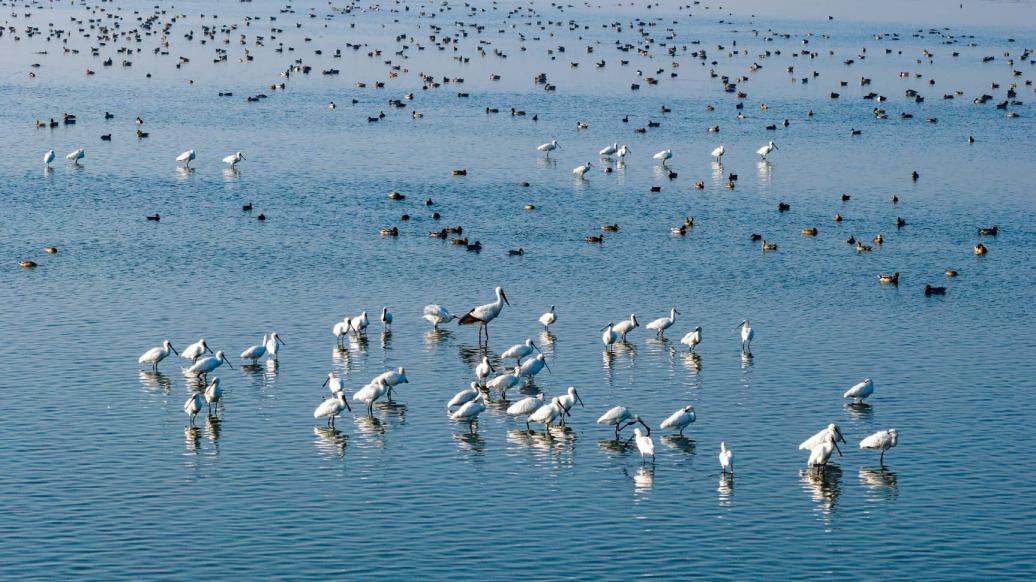
Black-faced spoonbills forage in the Tiaozini wetlands in Dongtai, Yancheng, East China's Jiangsu Province. (Photo: Wang Xuzhong/People's Daily)
In recent years, local authorities have implemented measures such as shoreline restoration, ecological governance, and the creation of high-tide roosting sites for migratory birds, steadily expanding the "circle of feathered friends."
This commitment to harmonious coexistence between humans and nature has spurred the growth of bird-watching tourism. The region is now pursuing a high-quality development path that successfully links ecological protection with tourism growth and increased local prosperity.
Each April, the wetlands come alive as spring migration begins. At a monitoring center, wetland manager Zhang Hailong tracks bird movements and breeding patterns. "In recent years, we've introduced smart monitoring systems," he explained. "At what we call the '720 Highland,' we've installed 13 panoramic cameras equipped with AI-powered bird recognition, allowing us to monitor bird activities around the clock."
What exactly is the "720 Highland?" "During the twice-daily high tides, the mudflats are submerged, and birds that feed there need a place to rest," said Du Hua, head of the administrative committee of the Dongtai Coastal Economic Zone.
Starting in 2020, workers began transforming a 720-mu (about 48 hectares) former fishpond into an elevated roosting site by reshaping the terrain and restoring wetland ecology, following the principle of prioritizing natural recovery with moderate human intervention. The site effectively serves as a "tarmac" for migratory birds, a fixed high-tide refuge. In the autumn of that year, it hosted as many as 58,000 waterbirds in a single day.
In 2022, restoration efforts expanded to Chuanshui Bay in the northern part of Tiaozini, where aquaculture ponds were converted back into wetlands, creating a larger version of the original habitat. The improved ecosystem has attracted not only large numbers of waterbirds but also wildlife such as milu deer and hares. By December 2025, the Tiaozini area had recorded 420 bird species, including 23 under first-class state-level protection and 74 under second-class state-level protection.
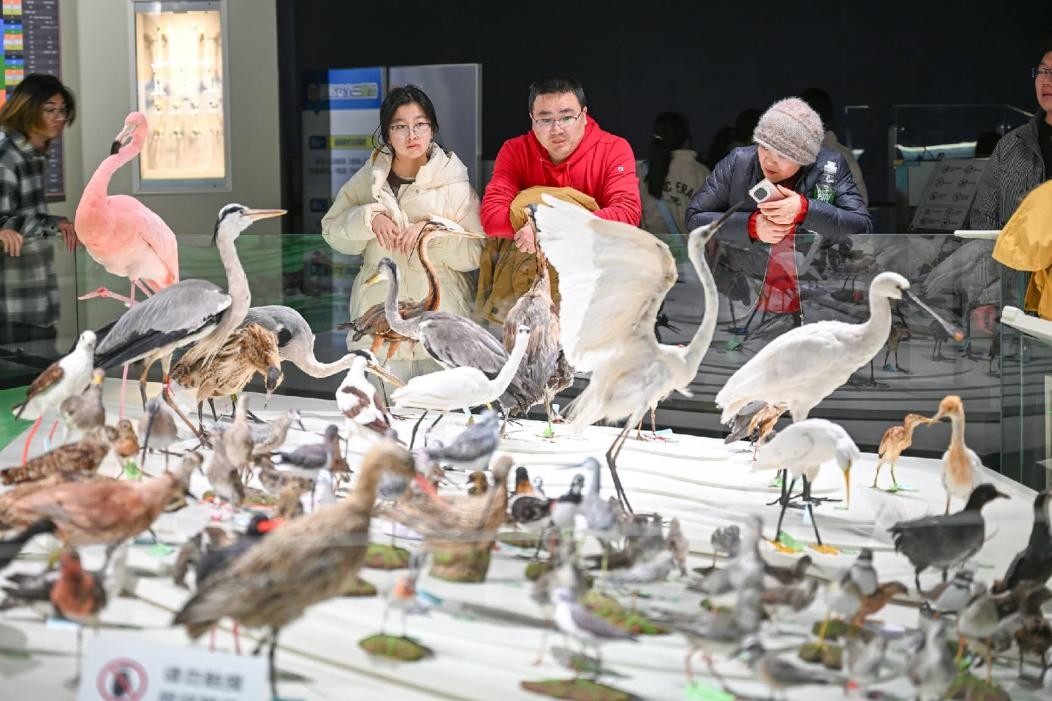
People visit the China Yellow Sea Wetlands Museum in Yancheng, East China's Jiangsu Province. (Photo: Wei Qiyuan/People's Daily)
A sightseeing bus service operates regularly along a coastal tourism highway, traveling into the depths of the Tiaozini wetlands and stopping beside a lake-like expanse. Amid interweaving bird calls of varying pitches, large flocks of waterbirds can be seen foraging and moving back and forth.
"That one with the spoon-shaped bill and black face is the black-faced spoonbill. And the elegant black-and-white bird with the upturned bill is the pied avocet," said bird guide Ding Jianming, effortlessly identifying species for 20 families participating in a bird-watching study tour.
Nearby, a science exhibition hall offers visitors a deeper understanding of coastal evolution through videos and specimen displays.
Stepping outside at low tide, visitors were treated to a spectacular scene: flocks of birds taking off from the "720 Highland" and flying toward the exposed mudflats to feed.
"It's breathtaking," said Pan Jing, a tourist from Nanjing, capital of Jiangsu Province. "I discovered this hidden gem last autumn and brought my whole family here this spring."
"The Yellow Sea mudflats have become a 'goldmine' for eco-tourism," said Chang Wei, deputy director of the administrative committee of the Dongtai Coastal Economic Zone.
Leveraging its ecological assets, the region is diversifying its offerings. It has established a professional bird-watching system, including curated routes, high-powered binoculars, trained interpreters, and expert bird guides, as well as immersive virtual reality and 3D experiences. Concurrently, it is expanding eco-tourism formats by introducing bird-watching competitions, photography tours, and sporting events such as wetland cycling races, triathlons and half marathons. This blend of nature, culture, and sports shifts the focus from simple sightseeing to multi-dimensional experiences.
The result is a year-round tourism calendar: bird-watching in spring, coastal foraging in summer, photography camps in autumn, and flamingo spotting in winter. Today, Tiaozini attracts around 1 million visitors annually.
As bird-watching tourism takes off, local communities are also reaping the benefits.
Badou village in Jianggang township, just north of Tiaozini, is now a lush and picturesque destination. Sixty-four-year-old Kong Xiangjin comes from a long line of fishermen. In 2021, he renovated an unused house and opened a guesthouse called "Old Fisherman's Inn," which has since enjoyed steadily growing business.
A few years ago, the village also set up a tourism company. In addition to livestream e-commerce, it has introduced souvenir gift boxes featuring local delicacies such as marinated shrimp and raw pickled crab.
More recently, it has developed creative cultural products inspired by the wetlands, such as canvas bags themed on local clams, power banks modeled after mud snails, and T-shirts featuring the endangered spoon-billed sandpiper.
"Eco-tourism has opened up a new path for boosting rural incomes," says Liu Jun, Party head of Jianggang township. With homestays as a key driver, the township has expanded related industries including local dining, cultural merchandise, and specialty agricultural products.
Today, more than 1,500 people in the township are engaged in tourism, and in 2025, the township welcomed over 100,000 visitors, generating more than five million yuan ($733,327) in additional income for local residents.