


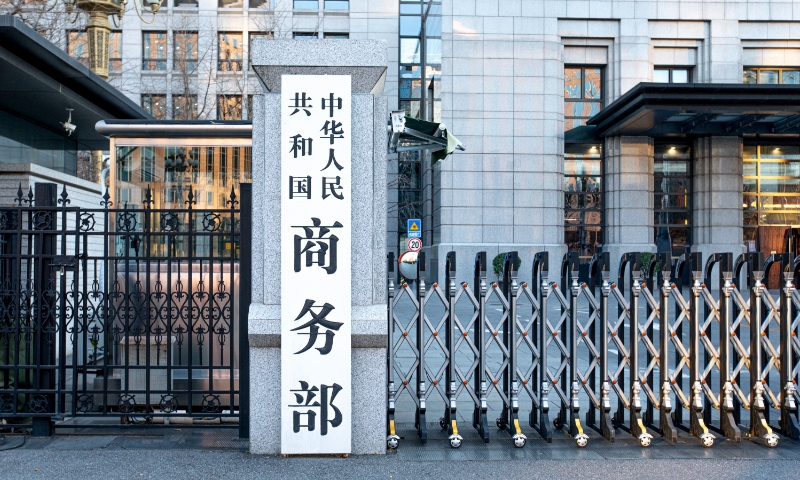
The Ministry of Commerce of China (File photo: VCG)
The EU's draft Cybersecurity Act, under the pretext of cybersecurity and supply chain security, represents a typical practice of politicizing trade issues and security overreach, a spokesperson of China's Ministry of Commerce (MOFCOM) said on Monday.
The remarks were made in response to a media inquiry regarding the European Commission (EC)'s draft revision of the EU Cybersecurity Act. The MOFCOM spokesperson said that on April 17, the ministry formally submitted its comments to the EC on the draft revision of the EU Cybersecurity Act, expressing China's serious concerns and official position.
China believes that the draft, under the pretext of cybersecurity and supply chain security, introduces highly subjective and arbitrary "non-technical risk" factors. In particular, it establishes lists of "countries of cybersecurity concern" and "high-risk suppliers," and excludes listed countries and suppliers from EU-related supply chains across 18 sectors, including energy, transport, and information and communications technology. China considers this a typical case of politicizing trade issues and security overreach.
In the comments submitted to the European side, China stated that the draft contains multiple issues, according to the spokesperson.
First, it is suspected of violating core World Trade Organization (WTO) principles such as most-favored-nation treatment and national treatment. It is also inconsistent with several WTO agreements, including the General Agreement on Tariffs and Trade 1994, the General Agreement on Trade in Services, the Agreement on Subsidies and Countervailing Measures, and the Agreement on Technical Barriers to Trade, as well as the EU's own commitments on services trade liberalization.
Second, it is believed to go beyond the legal mandate of the EU and encroach on the exclusive authority of member states in managing national security affairs.
Third, it is expected to cause substantive damage to China-EU economic and trade relations, severely disrupt global industrial and supply chains, and ultimately hinder the EU's own digital and green transformation process.
In its comments, China suggested that the European side delete provisions in the draft concerning "countries of cybersecurity concern" and "non-technical risks," and remove or substantially revise the criteria for identifying "high-risk suppliers" as well as the related restrictive measures, said the spokesperson.
China also expressed the hope that the EU will give full attention to and carefully consider China's comments and proposed revisions, strictly adhere to WTO rules, avoid adopting discriminatory restrictive measures, and help maintain the stability and smooth functioning of China-EU and global industrial and supply chains, said the spokesperson.
China will closely monitor progress in the revision of the draft and stands ready to engage in dialogue and communication with the European side on this matter, the MOFCOM spokesperson said, noting that if the EU insists on enacting the proposal into law and adopts discriminatory treatment against Chinese enterprises, China will be compelled to take necessary countermeasures.
China hopes that the EU will not underestimate its firm determination to safeguard national interests and the legitimate rights and interests of its enterprises, and to prevent a setback in China-EU economic and trade relations, the ministry spokesperson noted.
Jian Junbo, director of the Center for China-Europe Relations at Fudan University's Institute of International Studies, told the Global Times that the EU's draft cybersecurity law's reference to "high-risk suppliers" has drawn attention. Once such designations are applied, related digital and network products could face restrictions, indicating that the provision may go beyond purely technical considerations, the expert said.
Jian noted that defining risks at the country level rather than the product level reflects a political rather than technical approach. Such criteria deviate from market-based and technology-driven standards, raising questions about the objectivity and fairness of the framework, he said.
If the law is implemented in a way that targets China, it could subject Chinese firms to restrictions, undermining market principles and fair competition, said Jian, noting that such an approach could disrupt global industrial and supply chains, while also proving detrimental to the EU's own technological progress and industrial development.
He stressed that greater attention should be paid to whether enforcement is selective or discriminatory.
Jian also called for greater dialogue between China and the EU, noting that cybersecurity is a global challenge that requires cooperative and rules-based governance. Addressing such issues through consultation and multilateral coordination, rather than unilateral restrictions, would be more constructive and sustainable.