


Editor's Note:
The outline of the 15th Five-Year Plan (2026-30) called for strengthening cooperation between Hong Kong and Macao and the mainland in economy and trade, science and technology, and culture, and improving policies and measures to facilitate the development and life of Hong Kong and Macao residents on the mainland. It also called for boosting exchanges among youth and at the grassroots level, and continuing to create better conditions for Taiwan youth to pursue their dreams on the mainland.
A growing number of young people from Hong Kong, Macao and Taiwan are planting the seeds of their dreams across the vast and fertile land of their motherland. Weaving their personal aspirations into the tide of the times, and with the support of various policies, they are writing vivid stories of entrepreneurship. Their journeys offer a window into the profound sense of national commitment and striving spirit alongside the motherland.
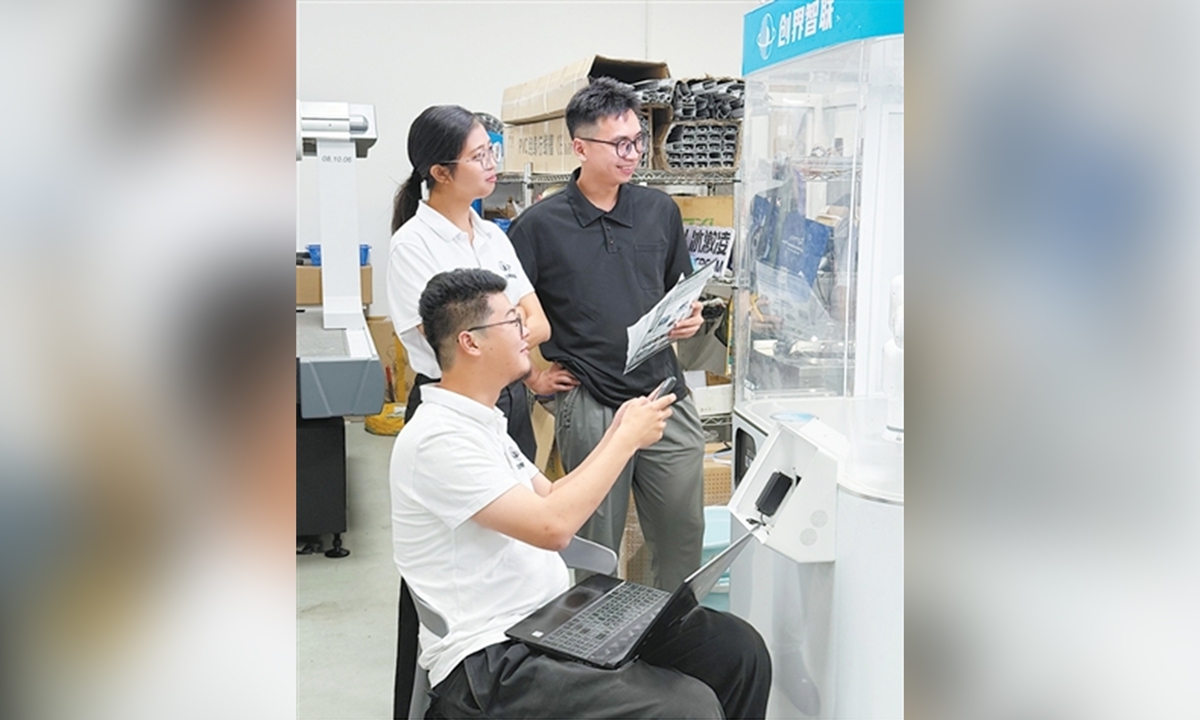
Lun Wenjing (middle) and her colleagues test an ice cream robot. Photo: Lin Junrun
"Hi! Fancy a freshly made ice cream?" At Longtan Park in Longgang District, Shenzhen, South China's Guangdong Province, a virtual cartoon "store manager" on the screen of an ice cream robot warmly greets visitors.
After visitors scan a QR code, select a flavor and complete payment, a compact white robotic arm springs into action, placing a cup beneath the dispenser. As the cup rotates gently, the ice cream is layered into a torch-like swirl. In under 30 seconds, an ice cream is made and sent to the serving area.
This ice cream robot, equipped with artificial intelligence (AI) interactive technology, is the latest achievement of Lun Wenjing, a post-2000s girl from Hong Kong, who started her business in Shenzhen. The machines have already been deployed across Shenzhen's Guangming, Longgang, Longhua and Futian districts. From conceiving the idea of starting a business in 2022 to developing products such as unmanned coffee kiosks and ice cream robots, she has dared to think, try, and strive. On the fertile ground of innovation that is Shenzhen, she has deeply cultivated intelligent unmanned retail machinery and pursued her entrepreneurial dreams.
Identify demand
In Guangming District, Shenzhen, the production workshop of Shenzhen Chuangjie Zhilian Technology Co, founded by Lun, is bustling with activity.
"Ice cream robots and unmanned coffee kiosks operate on essentially the same logic and principle. They rely on a complete algorithm to precisely schedule hundreds of parts. We have applied for more than 20 invention patents," said Lun, born in 2001, speaking eloquently about her products.
Why choose to start a business in Shenzhen? In the summer of 2020, Lun became a student in the Department of Economics at Shenzhen University. Shenzhen University has a strong entrepreneurial atmosphere, and besides her studies, she thought most about finding entrepreneurial opportunities. During her freshman year, she participated in the school's entrepreneurship competition, gaining experience and broadening her horizons through repeated competitions.
In 2022, while still a sophomore, Lun had an idea over a cup of coffee: Guangdong's robotics industry was booming, and robotic arms were already widely used in smart manufacturing. Could these "tireless" robotic arms be brought into the beverage sector? The idea of building an unmanned coffee kiosk took root from that moment.
But was the idea commercially viable? Lun was not sure. After giving it careful thought, she decided to work part-time at a tea shop first to better understand the market. "I can't just make assumptions or act on impulse; I have to accurately identify the demand," she said.
Every weekend, Lun worked part-time at a popular tea shop in downtown Shenzhen. She took orders, prepared drinks and delivered them to customers, gradually becoming familiar with every step of the beverage-making process.
Lun then reached out, one by one, to the people she had met at entrepreneurship competitions. Armed with strong determination and a clear plan, she quickly brought together a like-minded team with complementary strengths in computer science, power machinery, journalism and communication, with each member assuming a clearly defined role.
Support also came from her university. In 2022, Lun's unmanned coffee kiosk project stood out from more than 70 entries in a call for startup incubation at Shenzhen University's entrepreneurship park. The team was given free workspace, utilities and WiFi, helping cut operating costs significantly.
At the outset, Lun and several of her partners pooled 1 million yuan ($145,700) of their own money, but it was far from enough. Just as she was worrying about funding, a new partner came on board - Pei Yicheng, a computer science graduate of Shenzhen University, who had likewise taken part in the university's entrepreneurship competitions.
Also born in the 2000s, he was very optimistic about Lun's project and understood cutting-edge AI technology, so he joined with funds and took the lead in technology research and development.
Policy support
Technical challenges are fraught with difficulties. Even after resolving the funding issue, Lun still faces research and development challenges.
The team had to develop its own algorithms while carefully selecting every component. Whenever they had spare time, they were also out searching for suppliers. Thanks to the Greater Bay Area's comprehensive industrial ecosystem, virtually everything they needed was readily available, easing much of the burden on the team.
"It takes little more than an hour to travel from Shenzhen to factories in Dongguan, Huizhou and other nearby cities in Guangdong. This has greatly reduced both coordination time and transport costs. Suppliers also respond very quickly. On one occasion, we raised our requirements in the morning and received samples the very next day," Lun said.
In May 2023, the team assembled a prototype of the unmanned coffee kiosk in the lab. After repeated testing and fine-tuning, they were able to realize the core concept of intelligent coffee-making.
To turn the prototype into a commercial product, Lun began planning to establish a company in the second half of 2023. While searching for a location, she consulted widely and carried out multiple site visits before identifying Shenzhen's Guangming District as a promising base.
"Guangming District offers strong support for startups," Lun said, noting that the district's Science and Technology Innovation Service Center has set up a Shenzhen-Hong Kong-Macao youth innovation and entrepreneurship base and introduced professional incubators. Startups that move in can receive professional guidance, enjoy three years of rent-free office space and obtain start-up funding.
In September that year, Lun rented a 200-square-meter office free of charge at the entrepreneurship base and officially registered the company.
By establishing a presence in Guangming District, the team also gained access to numerous resources. In November of that year, with the assistance of the Guangming District Science and Technology Innovation Bureau and the Commerce Bureau, the company obtained a free exhibition at the China Hi-Tech Fair, where the company's 1.0 version of the unmanned coffee kiosk prototype was successfully unveiled.
"With its complete industrial chain, supportive policies and strong backing for startups, the Greater Bay Area is especially friendly to first-time entrepreneurs," Lun said.
In July 2025, the team launched the 5.0 version of its unmanned coffee kiosk and moved into mass production. The new model can prepare three drinks simultaneously in fully automated fashion, with each drink taking about 70 seconds. It also features new AI-powered interactive functions, including a virtual store manager carefully designed by the team to converse with customers.
Growing business
In July 2025, shortly after the 5.0 version of the unmanned coffee kiosk was launched, a company in Huizhou approached Lun's team and placed an order for 25 units at once, planning to install them in pedestrian streets and other cultural and tourism venues. The 6-million-yuan deal was the largest order the company had received since its establishment, providing a much-needed cash injection just as funds were running low.
But the order also brought new challenges. "Previously, our products had all been used indoors. Suddenly, they were being moved outdoors, with no shelter from the elements, exposed to wind, sun and rain, and expected to withstand typhoons and extreme heat. Could the product really stand up to that kind of test?" Lun recalled.
They had to tackle the challenges head on. Lun and Pei took the product to the site and tackled problems as they arose. When rainwater seeped in during typhoons, they thickened the machine's waterproof coating. When ground temperatures climbed above 60 C in extreme heat and the screen repeatedly malfunctioned, they immediately contacted the supplier and replaced it that same day with a heat-resistant screen.
It was also at this point that Lun realized where the real bottleneck lay: If the products were to be rolled out on a large scale in the future, on-site operations and maintenance would be critical, and the team lacked talent in that area.
Born in 1997, Hong Zhaolong is also an alumnus of Shenzhen University and had previously started a business in the convenience store sector. His arrival helped fill the company's gap in market operations.
"Coffee kiosks need to be cleaned every day and restocked daily, so on-site operations and maintenance must be standardized," Hong said. After joining the company, he worked with the team to map out seven major categories and 163 specific operations and maintenance tasks, giving the work a unified template and raising standards to a new level.
Not long afterward, a company from Northeast China's Jilin Province approached Lun, hoping it could adapt the unmanned coffee kiosk model to develop customized machines for herbal wellness drinks and ice cream.
Off-the-shelf components could not meet the demands of customization, making tailor-made parts essential. To solve the problem, Lun reached out to multiple suppliers. In the end, a supplier in Guangming District was persuaded to join the effort and began producing bespoke components specifically for the ice cream robot. At the same time, Pei led the technical team in developing proprietary technologies, including a dedicated Internet of Things development system.
Soon, four customized ice cream robots were developed and put into operation in Changchun, Jilin. Today, the robots can be found in 10 parks across Shenzhen, each featuring its own distinctive exterior design and virtual character.
"The entrepreneurial journey has come with its share of ups and downs, but our team has only grown stronger along the way. Clients and suppliers have become partners, and our products are reaching ever farther afield, it feels remarkable," Lun said with emotion. "This fertile ground has given ideas the space to grow. Going forward, we will continue to build our future in Shenzhen."
This was compiled from an article originally published on the 13th page of the People's Daily on April 21, 2026.