


Chinese firms bet on embodied AI boom in 2027
China is stepping up support for embodied AI, as policymakers and industry leaders eye 2026 as a breakthrough year for commercial deployment. The country's 2026 Government Work Report calls for expanding the "AI+" initiative, accelerating the adoption of next-generation intelligent terminals and agents, and promoting large-scale commercial use of AI in key sectors.
Industry experts say that policy backing is now converging, with rapid advances in large-model technology, robotics hardware and real-world applications.
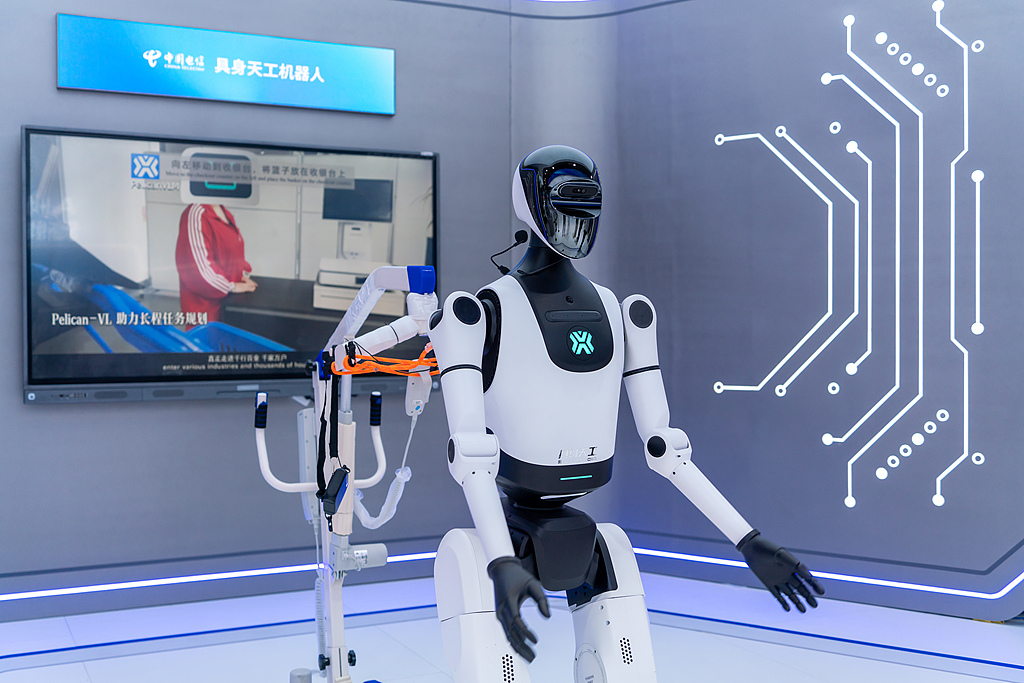
Chinese robotics firm AGIBOT is betting big on embodied AI moving from concept to commercial reality. /VCG
AI economy
At its 2026 partner conference, Chinese robotics firm AGIBOT put its faith in embodied AI moving from concept to commercial reality, as the company maps out an aggressive growth plan tied to the next phase of humanoid robot deployment. The tech company said it generated 1.05 billion yuan ($154 million) in revenue in 2025 and is aiming to lift that figure to more than 10 billion yuan ($1.47 billion) by 2027.
Company founder Deng Taihua said the result makes AGIBOT one of the fastest robot and AI companies in China to cross the one-billion-yuan revenue mark.
AGIBOT executives argue that the inflection point for embodied intelligence is not being driven by a single breakthrough, but by the convergence of three forces: the stronger reasoning and understanding capabilities of large AI models, more reliable robotic hardware, and the emergence of real-world deployment data that can continuously improve performance. The company said this alignment is helping shift the sector from showcasing technical capability to delivering measurable productivity in factories, commercial spaces and service environments.
Peng Zhihui, AGIBOT's co-founder, president and CTO, framed the opportunity in terms of the AI economy. He said tokens have become the "base currency" of the AI era, with digital AI systems consuming tokens to generate text and video, while robots in the physical world constantly consume tokens through perception, reasoning, decision-making and control. In his view, embodied agents could become some of the largest token consumers in the future, making robots not just physical executors, but a core gateway connecting large models with the real world.
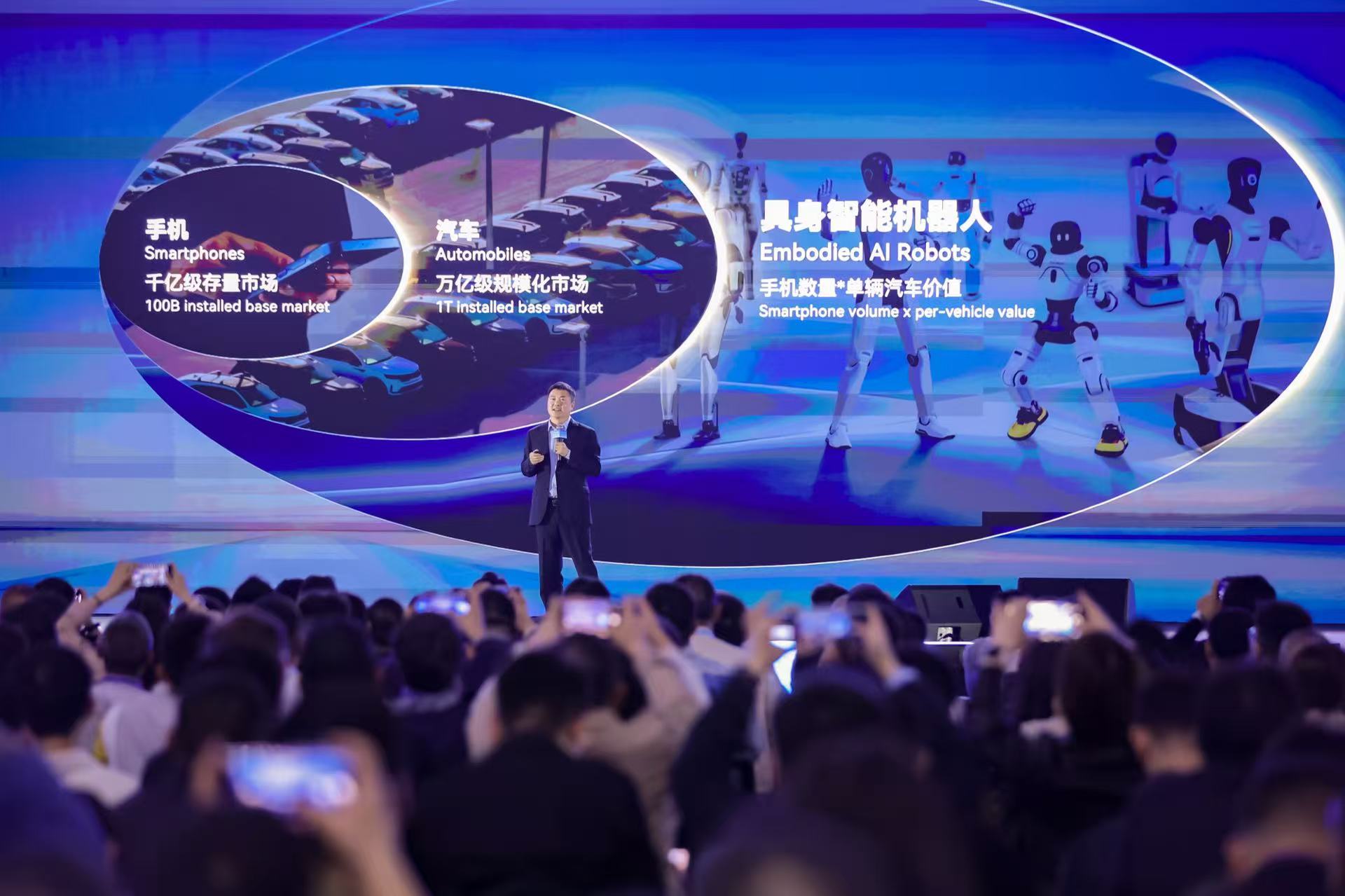
AGIBOT announced its new generation of embodied AI products and foundation models at its 2026 Partner Conference, April 17, 2026. /CGTN
Humanoid robotics sector
The broader humanoid robotics sector in China is heating up, with companies increasingly pursuing large-scale deployment and clearer revenue models as commercialization accelerates in 2026.
Violet Chung, senior partner at McKinsey & Company, said China accounts for roughly 90 percent of global robotics exports and a dominant share of unit sales. "At the same time, the ecosystem is much broader: There are over 100 robotics-related enterprises in China, compared to around 50 in North America. But the real differentiator is cost—it reflects something deeper: a highly integrated supply chain, mature manufacturing clusters, and the ability to scale quickly."
She added that when it comes to robotics, people are not just seeing volume leadership, but a structural advantage, where scale, ecosystem depth and cost efficiency all reinforce each other.
AGIBOT's message is clear: In the next stage of embodied AI, the winners may not be those with the flashiest demo, but those that can close the loop between intelligence, hardware and real-world data, and turn that loop into repeatable delivery at scale.
Xu Ningyi, founder and CEO of Huixi Intelligence, said 2026 will be a critical year to "validate whether embodied intelligence can close the loop commercially." He said the company plans to support that push by providing high-performance computing infrastructure and working closely with full-machine manufacturers and supply-chain partners. In his view, powerful AI chips will be central to enabling robots to sense, process and act more effectively in the physical world.
A hot market
Meanwhile, fresh capital is pouring into China's embodied-AI sector. According to incomplete statistics from IT Juzi and CENTI, the industry logged more than 50 disclosed funding rounds in the first quarter of 2026, with over 30 companies receiving investment and total disclosed financing reaching about 20 billion yuan, or roughly $2.9 billion.
That represents nearly 60 percent growth from a year earlier and a new record. Investors are no longer betting only on full humanoid-robot makers. Funds are also moving into critical component suppliers, including firms focused on robotic hands, tactile perception and joint modules.