


China's economy got off to a solid start in the first quarter of the year, with GDP expanding 5.0 percent year on year. Across the board, key indicators showed encouraging performance. Four keywords shed light on the quality and underlying strength of the country's Q1 economic performance.
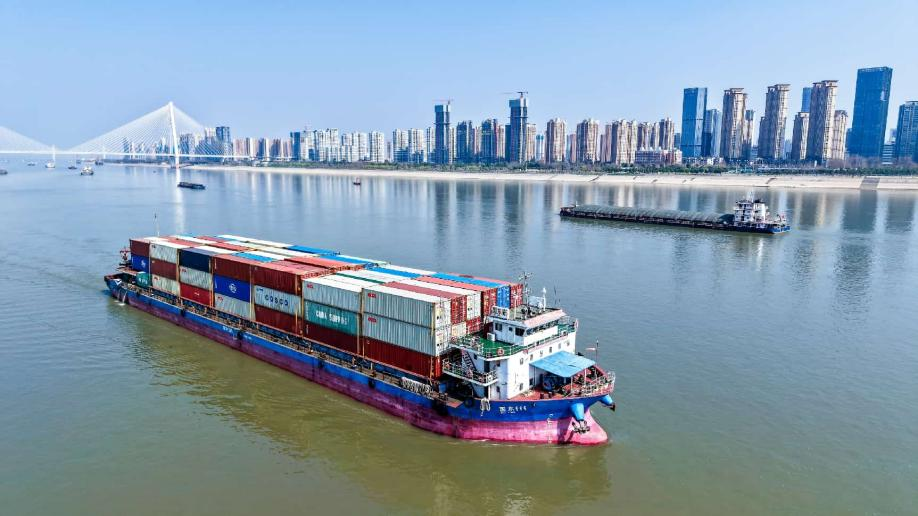
Cargo vessels sail on Yangtze River in Wuhan, capital of Central China's Hubei Province. (Photo: Wang Jiang)
Steady improvement
Preliminary data show that China's GDP reached nearly 33.42 trillion yuan ($4.9 trillion) in the first quarter, growing 5.0 percent year on year in real terms, up 0.5 percentage points from Q4 2025.
Breaking down the data, agricultural production remained stable while industry and services both posted steady growth. The value added of the primary industry reached 1.19 trillion yuan, up 3.8 percent. The secondary industry grew 4.9 percent to 11.61 trillion yuan. The tertiary industry rose 5.2 percent to 20.61 trillion yuan.
Price levels remained generally stable, with core CPI, which excludes food and energy prices, up 1.2 percent year on year. Investment also rebounded. Fixed asset investment excluding rural households reached 10.27 trillion yuan, up 1.7 percent and returning to positive growth.
Consumption showed steady improvement as retail sales of consumer goods rose 2.4 percent year on year to nearly 12.77 trillion yuan, accelerating by 0.7 percentage points from the previous quarter. Employment remained stable, with the surveyed urban unemployment rate averaging 5.3 percent, unchanged from a year earlier.
"Overall, major macroeconomic indicators picked up in the first quarter, new growth drivers expanded rapidly, and the economy achieved a good start," said Mao Shengyong, deputy head of the National Bureau of Statistics.
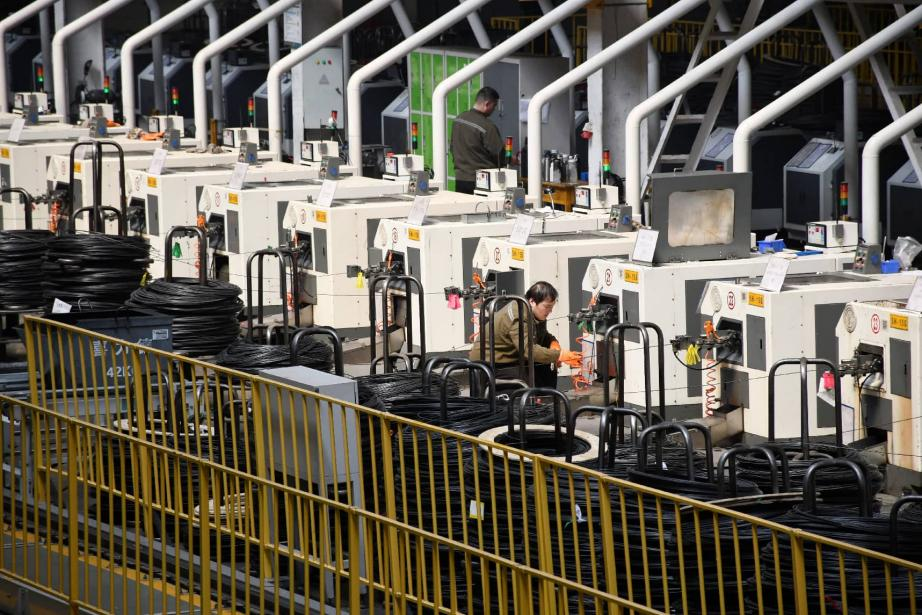
Workers fulfill overseas orders at a smart workshop in a hardware manufacturing factory in Handan, North China's Hebei Province. (Photo: Hu Gaolei)
Strong resilience
Against a high comparison base from last year's first quarter and a more complex and challenging global outlook, China's economy delivered a robust opening performance, demonstrating its resilience.
Take foreign trade as an example. In the first quarter, China's total imports and exports of goods reached nearly 11.84 trillion yuan, up 15 percent year on year, the fastest quarterly growth in the past five years. Mao noted that the strong competitiveness of Chinese enterprises, the high cost effectiveness of their products and supportive policy measures have helped offset external uncertainties and expand new space for trade.
Energy security also reflects this resilience. "Amid rising global energy prices driven by geopolitical tensions, China has maintained a stable and orderly energy supply, with timely price adjustments ensuring sufficient energy for both households and businesses," Mao said.
This stability stems from years of forward looking efforts to develop new energy industries and build a diversified energy supply system, significantly enhancing the economy's autonomy and stability, he added.
Supported by China's vast domestic market, complete industrial system and strong supporting capabilities, industrial and supply chains have remained secure and stable, effectively cushioning external shocks. This demonstrates the strong resilience and risk resistance of Chinese industry and provides solid support for overall economic stability.
Innovation-driven high-quality development
In the first quarter, China's new quality productive forces continued to grow steadily, characterized by high end, intelligent, green and upgraded development.
High-end manufacturing and modern services expanded rapidly. The value added of high tech manufacturing enterprises above designated size rose 12.5 percent year on year, raising its share in total output of industrial enterprises above designated size to 16.9 percent and contributing 2 percentage points to overall growth.
Intelligent development gained further momentum. Output in sectors directly related to AI, including electronic materials and integrated circuits, grew by 32.5 percent and 49.4 percent respectively, highlighting AI's growing role as a driver of economic activity.
Green transformation is also creating new growth engines. In the first quarter, production of lithium ion batteries and wind turbines rose by 40.8 percent and 30.1 percent respectively. Exports of the "new trio" of electric vehicles, lithium batteries and solar products continued to grow rapidly, with electric vehicle exports surging 77.5 percent and contributing to the global transition toward green and low carbon development.
Meanwhile, traditional industries are being revitalized through steady upgrading, with faster progress in equipment renewal and technological transformation.

People browse smart phones at a shopping mall in Leshan, Southwest China's Sichuan Province. (Photo: Li Huashi)
Outlook confidence
Looking ahead, China has strong reasons to remain confident about its economic prospects.
"We have strong institutional strengths as well as accumulated advantages in industry, market size and talent. We are fully capable of maintaining stable economic performance and achieving high quality development throughout the year," Mao said.
With Q1 GDP growth of 5.0 percent, China continues to rank among the fastest growing major economies globally. Growth is increasingly driven by innovation, the development of new quality productive forces and the rapid expansion of new growth drivers.
At the same time, improving demand is creating favorable conditions. Domestic demand contributed 84.7 percent to economic growth in the first quarter, up nearly 30 percentage points year on year. Imports of consumer goods rose 5.4 percent, indicating a gradual recovery in domestic demand, particularly the continued release of potential in service consumption.
"Despite a complex external environment, we have the strength and resolve to meet any risks and challenges," Mao said. "That assurance is built on our past achievements and we remain confident about the future."