


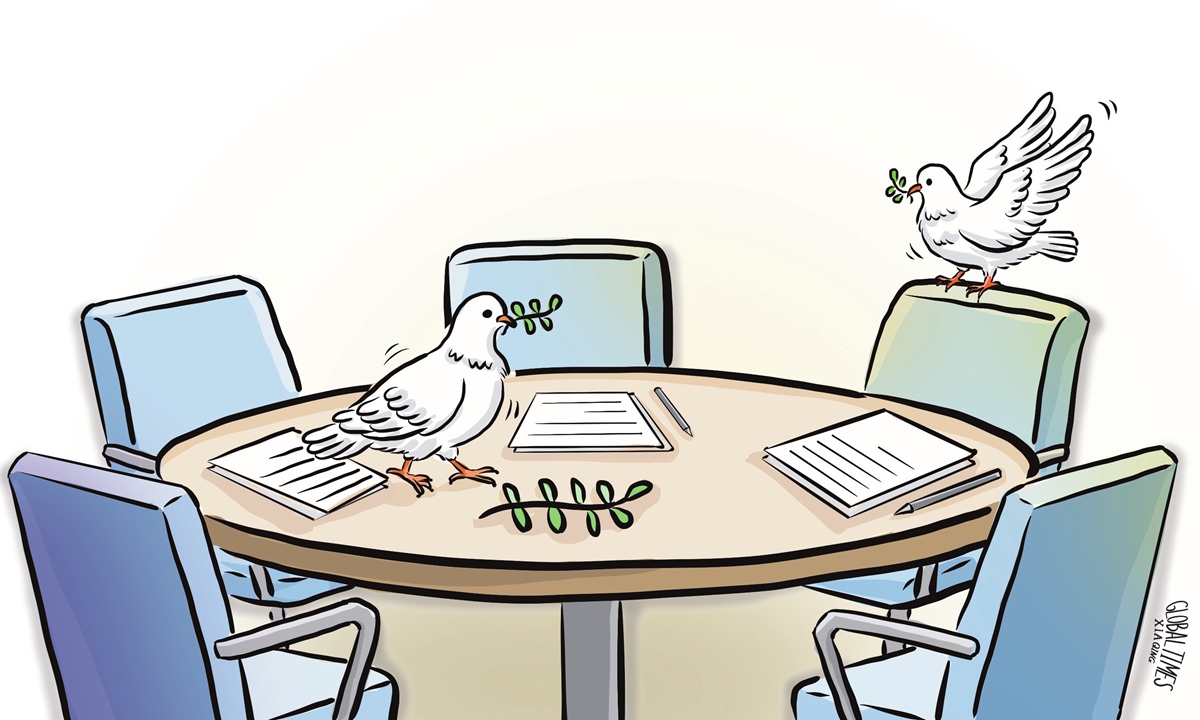
Illustration: Xia Qing/GT
Wang Yi, member of the Political Bureau of the Communist Party of China Central Committee and minister of foreign affairs, will visit Cambodia, Thailand and Myanmar upon invitation from Wednesday to Sunday. It has been four months since the cease-fire consensus between Cambodia and Thailand after their border dispute on December 27, 2025. On December 28 and 29, in a meeting held by the Fuxian Lake, Yunnan Province of China, foreign ministers and senior military officers of China, Cambodia and Thailand agreed on key outcomes. On Monday, the Second China-Cambodia-Thailand Track II Dialogue, organized by China Foreign Affairs University, was held in Beijing. The dialogue brought together think tank experts and media persons from the three countries to discuss issues around the theme "Implementing the Fuxian Consensus and Fostering a Peaceful Public Opinion Environment." Global Times reporter Wang Wenwen selects the speeches and opinions by representatives of the three countries at the scene.
Kin Phea, director general of the International Relations Institute of Cambodia, Royal Academy of CambodiaThe landmark Fuxian Consensus of December 2025 successfully halted active hostilities along the Cambodia-Thailand border. That agreement provided the essential "political hardware" - the institutional and military frameworks necessary to stop the fighting.
However, we must confront a sobering reality: a cease-fire alone is structurally fragile. The 2025 conflicts taught us that a cease-fire is only as resilient as the public's belief in it. While the guns have fallen silent, an underlying atmosphere of suspicion remains among border communities, journalists and civil society.
A peace built only on paper is a peace built on sand. I propose that our strategic mission must shift from merely managing a military de-escalation to the deliberate construction of a "Peace Atmosphere" - the "societal software" of trust, shared narratives and transparent verification that makes peace irreversible.
To achieve this, we must focus on four strategic pillars.
First, the de-securitization of national narratives. We must shift official rhetoric from "territorial defense" to "regional connectivity" and "shared prosperity," leveraging our shared heritage to reframe our relationship as one of brotherhood rather than rivalry.
Second, we must institutionalize fact-checking and transparency. We cannot allow a "perception vacuum" to be filled by nationalist disinformation.
Third, we must prioritize stakeholder inclusivity. We must institutionalize local peace committees comprising village elders, religious figures and youth representatives across all border provinces. Critically, we must include women, who are the primary drivers of cross-border trade and [who] serve as essential early-warning monitors of social tension.
Finally, we must deliver economic reassurance. By developing joint special economic zones, we create a "sunk cost" for peace, making a return to conflict economically ruinous for both nations.
In this framework, China's role evolves from a neutral observer to an "atmospheric enabler." China is uniquely positioned to provide the technological tools and development funding necessary to sustain harmony, provided we respect critical red lines: No military involvement in enforcement and no displacement of bilateral ownership.
Let us commit to shifting from the hardware of guns to the software of trust. Let us ensure that peace is not merely declared in our capitals but lived in our borderlands, moving from the battlefield of 2025 to a shared future in 2030.
Chaiwat Meesantan, director of the Institute of East Asian Studies, Thammasat University, ThailandIf war has no winner, then peace cannot belong to one side alone. Peace must rest on shared responsibility. And today, one of the most important arenas where this responsibility is tested is not just along the physical border line, but in the battle over perception.
Let me be clear. I fully respect the legitimate role of the state in defending territorial sovereignty. But in the 21st century, security is no longer only territorial. It is also psychological.
I call this "perception security."
Perception security is about how societies understand a conflict, how they view the other side, and what futures they can imagine. People do not react to facts alone; they react to what they believe.
When entire communities are portrayed as enemies, peace becomes fragile. But when public narratives acknowledge our shared vulnerabilities and shared humanity, we build a strong psychological foundation for negotiation and cooperation. Perception security is a practical condition for any sustainable peace in borderlands.
This brings me back to an old tool that might sound unfashionable in an age of viral anger: dialogue.
Dialogue is often dismissed as "soft" or "politically risky." Yet, evidence shows it is the most practical tool we have. Dialogue restores cross-border trade, rebuilds local trust and prevents small incidents from spiraling into major crises.
For border communities, the reopening of checkpoints and the return of cross-border mobility are not just symbolic gestures. They are the concrete, everyday meaning of peace. A return to normalcy is an economic and social necessity.
War has no winner. Peace, however, can have many co-authors if we are prepared to accept our shared responsibility.
"Shared responsibility" is a term often mentioned by China. In recent years, China has positioned itself as a pragmatic mediator in regional conflicts, including tensions involving the Middle East. Rather than taking a clearly ideological stance, Beijing tends to emphasize stability, dialogue and economic cooperation, which aligns with its broader interest in protecting trade routes and investments.
China's approach is often described as "balanced diplomacy." It maintains relations with multiple sides and prefers quiet, behind-the-scenes engagement rather than high-profile intervention. While its influence is still evolving, its role reflects a wider shift toward a more multipolar diplomatic landscape where mediation is no longer dominated by Western powers alone.
Gu Jiayun, director of the Center for Cambodia Studies at Beijing Foreign Studies UniversityJudging from the talks during this dialogue, I feel that both Cambodia and Thailand have a strong willingness to mend ties, especially at the Track II level.
Border communities show a clear desire to resume people-to-people and economic exchanges. After the Fuxian meeting and two rounds of Track II trilateral dialogues, there are more common grounds than differences. The two countries share a clear commitment to peace. The next step is to encourage both governments to gradually break the ice, clear up misunderstandings and rebuild cross-border economic ties. This will take time, but the outlook is optimistic.
China has been actively involved in mediation from the very beginning, using diverse approaches including shuttle diplomacy, often quietly but effectively. At this meeting, scholars from both Cambodia and Thailand expressed strong expectations for China to play a greater role.
Both Cambodia and Thailand are China's close neighbors and long‑term friends. China and Cambodia are building an all-weather China-Cambodia community with a shared future in the new era, while China and Thailand are "as close as one family." Among scholars, the public, and even officials, many believe that China naturally should help more in resolving Cambodia-Thailand tensions.
China's major global initiatives - on development, security and governance - have had significant influence in Cambodia and Thailand. Scholars from both countries cited these initiatives as guiding principles for resolving their differences. These global initiatives are no longer just words; they have taken root in the hearts of people and officials in neighboring countries, reflecting a shared aspiration for peace and development.
Amid growing global uncertainty, insecurity and instability, China is expected to serve as an anchor of stability and to continue contributing not only in economic terms but also in other fields. This is the common expectation of not only neighboring countries but also others farther away.