


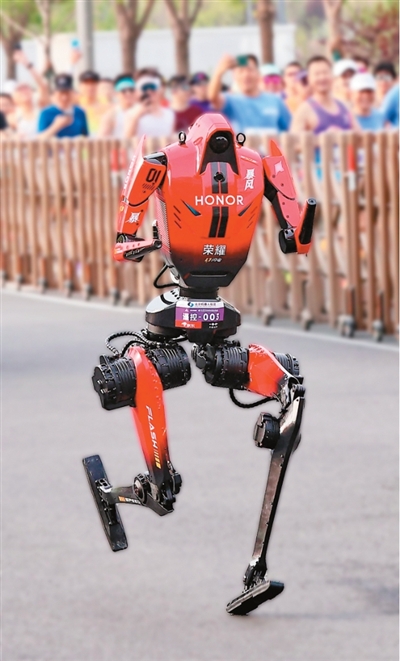
Humanoid robot "Flash" runs during the Beijing E-Town half-marathon and humanoid robots half-marathon in the Beijing Economic-Technological Development Area in southeast Beijing, China, April 19, 2026. (Photo: Cao Jianxiong)
Chinese-made humanoid robots are rapidly expanding their presence overseas, becoming a new symbol of China's technological prowess.
At the beginning of this year, AgiBot, a leading Chinese robotics firm, opened its first overseas experience center in Malaysia, offering a glimpse into how robots can be integrated into future homes, commercial environments, and health care settings.
In Poland, a newly viral sensation known as "Edward Warchocki" is in fact a humanoid robot imported from China. After being locally adapted by Poland's Mera Systemy, which provides and integrates intelligent solutions, the robot became fluent in Polish.
It has since appeared on TV, been invited into the Polish Parliament, chatted with pedestrians on the street, and even launched its own social media account. Videos featuring "Edward Warchocki" have amassed more than 500 million views across Poland.
According to market research firm Counterpoint, China accounted for over 80 percent of the world's installed humanoid robots in 2025. Data from China's Ministry of Industry and Information Technology show that the country had more than 140 companies producing complete humanoid robots in 2025, releasing over 330 models.
China has full-spectrum capabilities—from core components to final assembly. That's one of its most important competitive strengths, said Serm Teck Choon, former chairperson of the Malaysian Digital Association.
Angel Low, general manager of Advanced Semiconductor Academy of Malaysia (ASEM), believes that innovation in development pathways and operational models has been a key driver behind China's rapid advances in humanoid robotics.
She noted that China has developed a tightly integrated industrial ecosystem that has dramatically shortened the journey from R&D and prototyping to mass production. At the same time, a vibrant open-source software community has lowered barriers to entry, drawn in global contributors, and sped up the pace of innovation. Together with a strong talent pipeline and robust manufacturing capabilities, these factors combine to form a multifaceted competitive edge.
"China's capabilities in robotics are formidable," said Jensen Huang, CEO of Nvidia, pointing to the country's world-class strengths in foundational technologies such as microelectronics and electric motors.
Industry observers see two main directions for the next phase of humanoid robot development: entering factories to handle a broader range of industrial tasks, and moving into homes to support daily living and rehabilitation.
Takayuki Ito, president of the International Federation of Robotics, said China's robotics industry is steadily broadening its application scenarios while advancing its technological capabilities. This, he noted, is not only reshaping China's manufacturing landscape but also injecting fresh momentum into the global robotics industry.