


Friday marks China's 11th Space Day, a celebration of the country's growing achievements in space exploration.
Reaching for the moon
China released its long-term plan for a manned lunar landing in 2023.
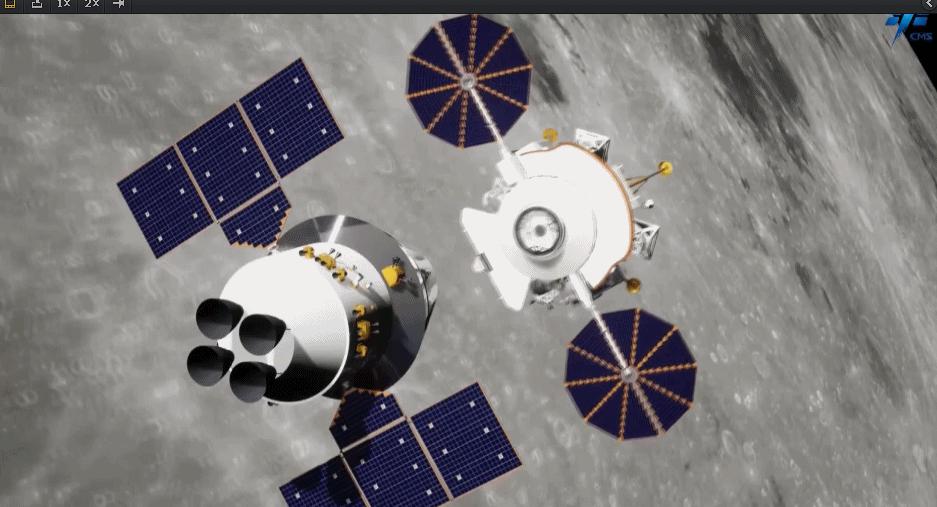
An animation shows China's lunar lander "Lanyue" (R) separating from China's new crew spaceship "Mengzhou" and landing on the moon. (Photos: China Manned Space Agency)
China's manned lunar landing consists of three steps. First, two Long March-10 carrier rockets will send the lunar lander, "Lanyue" (embracing the moon), and the crewed spacecraft, "Mengzhou" (dream vessel), into lunar orbit for an in-orbit rendezvous and docking, allowing the astronauts to transfer to the lunar lander. Next, the lander will descend and land on the predetermined area of the lunar surface, where astronauts will conduct scientific exploration and collect samples. After completing the scheduled tasks, they will take the lander and ascend into orbit around the moon; the lander will then rendezvous and dock with the spacecraft, which will return both the crew and lunar samples to Earth.
Major breakthroughs have been achieved in the development of related key facilities in recent years, driving China closer to its goal of landing astronauts on the moon by 2030.

China conducts a low-altitude demonstration and validation flight test of the Long March-10 launch vehicle system at the Wenchang Space Launch Site in south China's Hainan Province, February 11, 2026.
In February, a low-altitude demonstration of the Long March-10 rocket and a high-speed abort test of the Mengzhou crewed spacecraft under maximum aerodynamic pressure were complete successfully at the Wenchang Space Launch Site in south China's Hainan Province.
The missions introduced several firsts and highlights, including a new rocket model, a new crewed spacecraft, a newly built launch pad and new at-sea recovery missions for both the rocket and the spacecraft.
These tests verified the rocket's ascent and recovery performance, as well as the spacecraft's maximum dynamic pressure abort and recovery functions. It also validated interface compatibility across multiple engineering systems, providing valuable flight data and engineering experience for the crewed lunar exploration missions.
Earlier milestones included tethered ignition tests for the Long March-10 rocket, a zero-altitude abort flight test for Mengzhou and integrated landing and takeoff verification for Lanyue.
Meanwhile, China's lunar remote sensing satellite project has completed its approval and competitive selection processes, and the development and construction of ground systems, including the launch site, the measurement and control communication system, and the landing site, are progressing in an orderly manner.
Next, China will tackle a series of highly challenging tasks, such as precise lunar landing and takeoff, extreme heat protection during reentry, efficient life support in deep space and remote autonomous rendezvous and docking.
Chang'e-7 and Chang'e-8
Supporting the manned mission are uncrewed exploratory programs. Currently, the Chang'e-7 spacecraft is undergoing final preparations at Wenchang ahead of its planned launch in the second half of 2026. It will survey the lunar south pole, gathering essential data on terrain, resources and environmental conditions to inform future crewed mission.
Around 2028 or 2029, China plans to launch the Chang'e-8 mission, which will cooperate with the Chang'e-7 to establish a basic type of the International Lunar Research Station (ILRS) at the moon's south pole and conduct experiments on the exploration and utilization of lunar resources.
ILRS

An animation shows a basic model for a lunar research station built by China.
The ILRS is a comprehensive scientific experiment facility program initiated by China and jointly developed by multiple countries and organizations. Deployed on the lunar surface and in lunar orbit, it follows principles of peaceful use, equality and mutual benefit, and common development.
According to the plan, the station is designed for long-term autonomous operation with short-term manned participation. It will be expandable and maintainable, with capabilities for Earth-moon transportation, energy supply, central control, communication and navigation, lunar surface scientific exploration and ground support.
It will support multidisciplinary and multi-objective, integrated scientific activities, including scientific exploration, resource development and utilization and cutting-edge technology verification.
China plans to implement the ILRS in two phases: the first phase will complete a basic version of the station by 2035, and the second phase will focus on upgrading this foundation into an expanded version by around 2045.
To date, a total of 17 countries and international organizations, and more than 50 international research institutions, have joined the ILRS project.