


Pakistani delegates laud Wuhan's bridging role in China-Pakistan cooperation
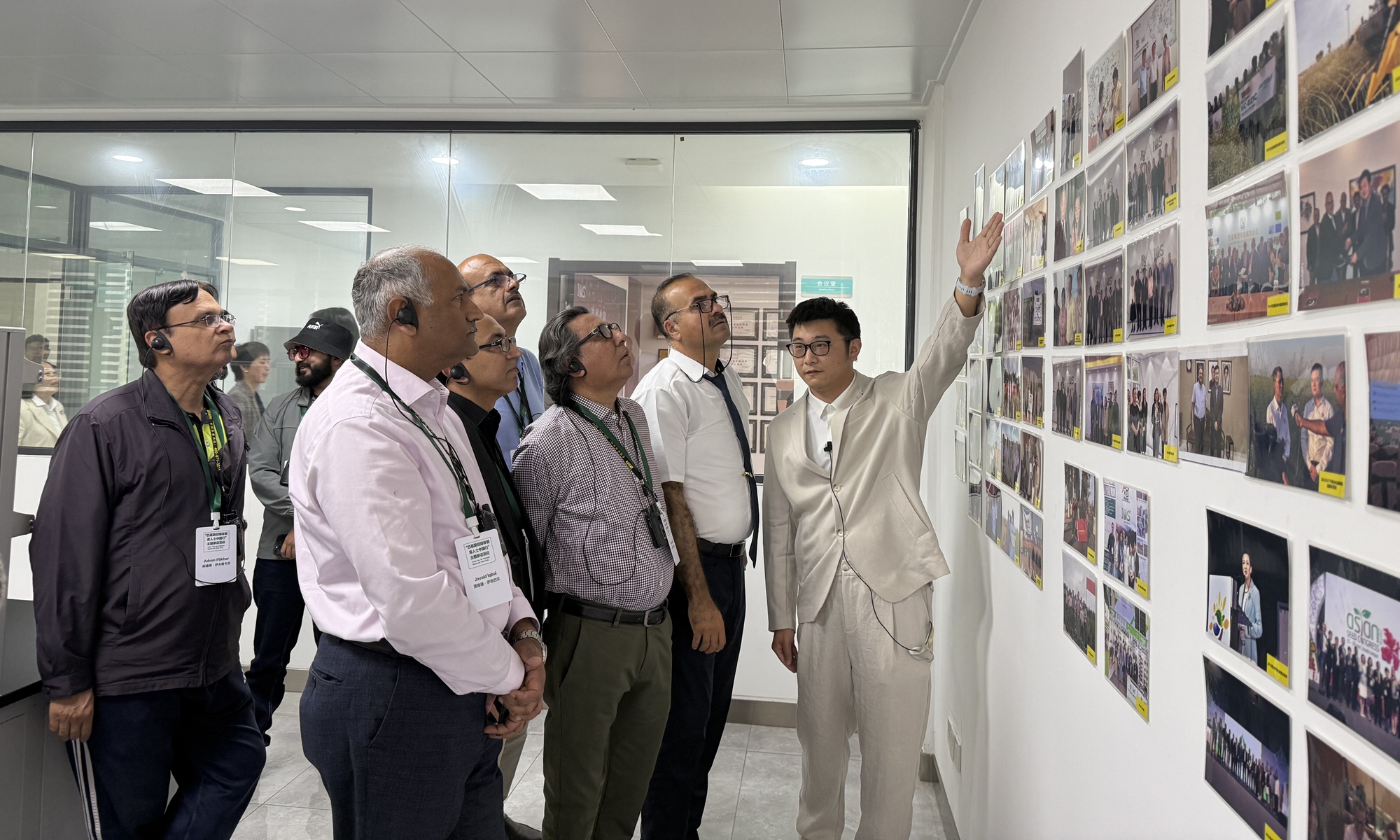
A delegation of Pakistani media representatives and think tank scholars visits Wuhan Qingfa Hesheng Agricultural Development Co., Ltd in Wuhan, central China's Hubei Province, on April 24, 2026. (Photo: Ma Ruiqian)
A delegation of Pakistani media representatives and think tank scholars visited Wuhan, central China's Hubei Province on Friday, witnessing the implementation of the China-Pakistan All-Weather Strategic Cooperative Partnership through concrete projects, from cross-border trade exchanges to modern agricultural cooperation.
At Yangluo Port, towering bridge cranes rose and fell in orderly fashion under remote operation, steadily stacking containers into place. Freight vehicles moved constantly back and forth, while ships streamed across the river in an endless flow, creating a bustling scene. As an important intersection of the Yangtze River Economic Belt and the Belt and Road Initiative, Yangluo Port has become a convenient and efficient gateway for global goods entering the central China market.
Within the Wuhan Financial Holding Central China Trade Service Zone at Yangluo Port, the Belt and Road National Pavilion left a deep impression on the delegation. As an innovative platform integrated into national strategy and showcasing Wuhan's achievements in the opening-up, it highlighted the city's growing international connectivity.
Walking among the pavilions of dozens of countries, members of the Pakistani delegation quickly found the familiar national flag. Pakistani journalist Rashida Shoukat leaned close to the national flag for a photo. She said seeing the Pakistan Pavilion and products from her homeland in China "was a joy to see," and she hoped that more Pakistani goods would enter the Chinese market in the future.
At that moment, in the Pakistan Pavilion and many other exhibition halls, livestream hosts enthusiastically introduced specialty products from around the world, while large screens displayed real-time figures such as online viewers and transaction volumes. Products, including gemstones from Pakistan, are being sold across China through e-commerce channels.
Javaid Iqbal, President of the National Institute of Maritime Affairs of Pakistan, told the Global Times that China represents an important opportunity for development.
"This is a center of innovation, a center of industry, and a major trade hub connecting the world. I believe this is also a very good opportunity for Pakistan to fully make use of such capacity," Iqbal said. He added that e-commerce has profoundly changed the way companies sell and promote products, making business exchanges more convenient and efficient.
"As a Pakistani, I feel very excited and proud to see a Pakistan Pavilion here, to see products from my country displayed here, and to be able to represent my nation," Zeeshan Khan, reporter for Dunya News in Pakistan, said. "The various supportive measures provided by the Chinese government will help further advance bilateral economic and trade cooperation and create more employment opportunities," Khan told the Global Times.
Through the window of the Belt and Road National Pavilion, one can see the increasingly close economic and trade ties between Hubei Province and Belt and Road partner countries, and feel how BRI cooperation is being transformed from a grand vision into tangible results.
If Yangluo Port connects the world through waterways and railways, then the next stop, Hi-Tech Bio-Agricultural Park in Wuhan's core area, links the world through high-quality agricultural products. Before entering the office building of Wuhan Qingfa Hesheng Agricultural Development Co., Ltd, few members of the delegation knew that within this ordinary-looking building were stories of China-Pakistan friendship and cooperation.
From introducing hybrid rice and canola into Pakistan and establishing R&D farms for local variety breeding and technology transfer, to running training programs for Pakistani agricultural professionals, and receiving a letter of appreciation from the Pakistani side after post-disaster reconstruction assistance in Balochistan Province — China-Pakistan agricultural cooperation is steadily advancing in a "small yet impactful" way.
Photographs showing smiling Pakistani faces and sets of practical data vividly demonstrate the real changes that Chinese seeds have brought to Pakistan's agricultural development.
The "China-Pakistan cooperation project for the promotion and industrialization of hybrid double-low canola" is a flagship agricultural cooperation project under the China-Pakistan Economic Corridor. It has improved taste while increasing yield and oil content, helping reduce edible oil imports, said the company's manager.
In hybrid rice, Chinese varieties and technologies represented by Qingfa Hesheng have helped Pakistan rise steadily from the world's seventh-largest rice exporter to fourth place, making "Chinese rice seeds" an important pillar for boosting grain output in the country, according to the company.
"In the past, many Pakistani farmers used local traditional techniques, and yields were nowhere near what they are today. As far as I know, their incomes have increased significantly through cooperation with China. In the future, if they continue to use such scientific and smart technology, they will certainly gain even greater economic benefits," Adnan Iftikhar, editor of the sub news media house in Pakistan, told the Global Times.
"China is helping the world grow and make progress together. When I see these seeds, I realize they are not just crop seeds - they are seeds of hope and love that China is sowing in our land. I am confident that both China and Pakistan will reap better food and sweeter fruit from these seeds," Noor Ullah, senior manager of Jang Media Group, told the Global Times.
From Wuhan in Hubei Province to the farmlands of Pakistan, Chinese agricultural enterprises are using technology as a bridge and industry as a bond, transforming China's agricultural resources and development experience into strong momentum for the agricultural modernization of Belt and Road partner countries.