


Chinese naval hospital ship Silk Road Ark wraps up first, longest overseas mission
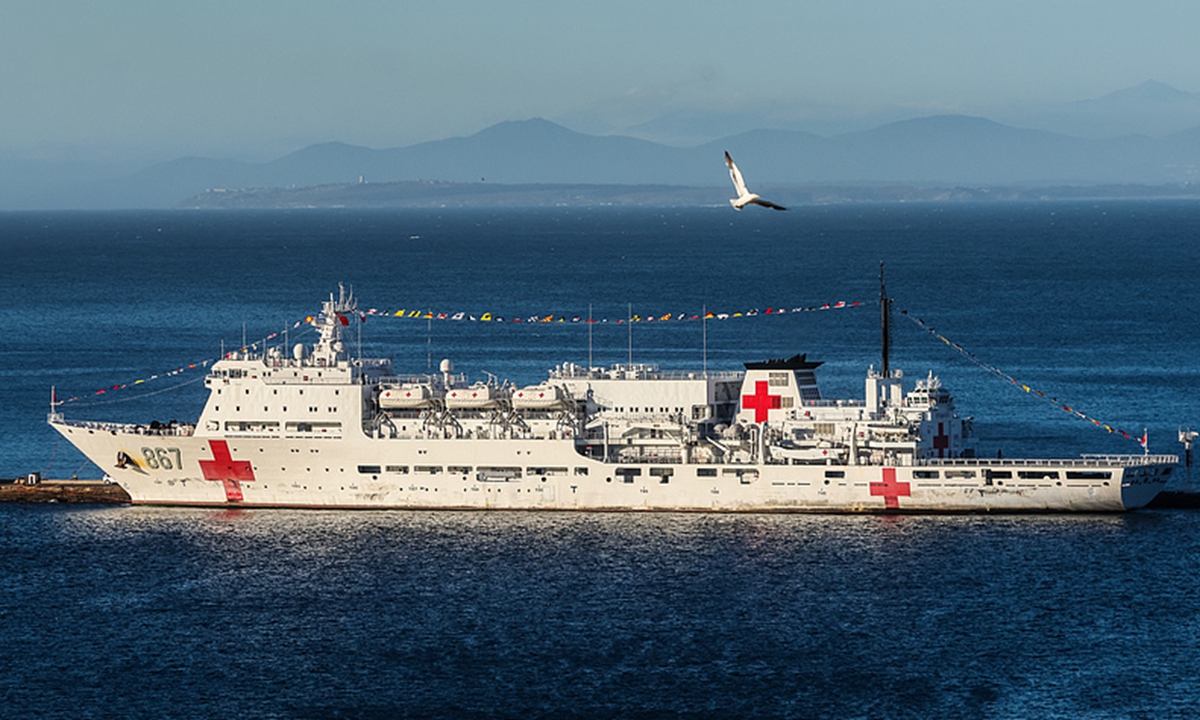
Chinese People's Liberation Army (PLA) Navy's hospital ship Silk Road Ark (Photo: VCG)
The Chinese People's Liberation Army (PLA) Navy's hospital ship Silk Road Ark returned to a military port in Sanya, South China's Hainan Province on Sunday after completing Harmony Mission-2025, its first mission outside China and the longest of its kind, Xinhua News Agency reported. A Chinese military expert highlighted the vessel's advanced technology and comprehensive medical capabilities as a purpose-built platform, adding that the mission showed China's sense of responsibility as a major country, with the PLA Navy's growing strength benefiting the international community through overseas medical services.
Lasting 234 days and covering about 36,000 nautical miles, the mission was the eleventh Harmony Mission since 2010. It was also the longest one in the series and marked first time the Silk Road Ark had sailed beyond China's borders since entering service, Xinhua reported.
According to the report, the vessel departed Quanzhou in East China's Fujian Province on September 5, 2025, visiting Nauru, Fiji, Tonga, Jamaica, Barbados and Papua New Guinea to provide medical services, and visiting Brazil and Chile for medical exchanges. The ship also made technical port calls in countries including Nicaragua and Uruguay.
During the mission, the medical team offered free treatment to local residents, overseas Chinese communities and Chinese personnel stationed abroad, handling 26,324 outpatient visits, performing 2,724 surgeries and medical procedures, conducting 17,273 diagnostic examinations, and treating 136 inpatients, said Xinhua.
Beyond humanitarian assistance, the crew also carried out exchanges with host countries, including official visits, medical seminars, cultural and sports activities, and joint drills. A total of nine medical exchange events, eight deck receptions and 17 sports and cultural activities were held, while maritime joint exercises were conducted with the navies of Fiji, Tonga and Brazil, Xinhua said.
While some countries around the world also operate hospital ships. Many are converted from transport vessels. In contrast, the Silk Road Ark is a purpose-built hospital ship designed specifically for medical rescue missions, Zhang Junshe, a Chinese military affairs expert, told the Global Times on Sunday.
As China's second domestically built 10,000-ton class ocean going hospital ship, the Silk Road Ark is equipped with 14 clinical departments, seven auxiliary diagnostic departments and eight modern operating rooms, capable of performing more than 60 types of surgeries, Xinhua reported.
The ship also carries a shipborne medical rescue helicopter, allowing for rapid forward emergency response in humanitarian relief or island rescue missions. Carrying medical personnel and supplies, the helicopter can reach disaster-stricken zones, islands or vessels at sea to deliver urgent medical care, Zhang added.
China commissioned its first purpose-built ocean-going hospital ship, the Peace Ark, at the end of 2008. With the commissioning of the Auspicious Ark in May 2025, the Chinese Navy now operates three 10,000-ton hospital ships, with deployments across the Eastern, Southern, and Northern theater commands, according to Xinhua's previous reports.
All three ships are purpose-built platforms featuring advanced technologies and comprehensive medical capabilities, with capabilities comparable to those of a Grade 3A (the highest grade in China) hospital, Zhang said.
Regarding the role and significance of hospital ships, Zhang said that during peacetime, they provide robust medical support to fleet formations and island-based troops, serving as a strong backbone for the navy's maritime defense.
The Harmony Mission-2025 demonstrated China's sense of responsibility as a major country. Through continued overseas missions and the provision of medical services for foreign populations, the PLA Navy's international partnerships continue to expand. This also shows that the growing strength of China's military benefits the international community by providing more public goods, Zhang added.