


China speeds up development of integrated 'space-ground network': MIIT
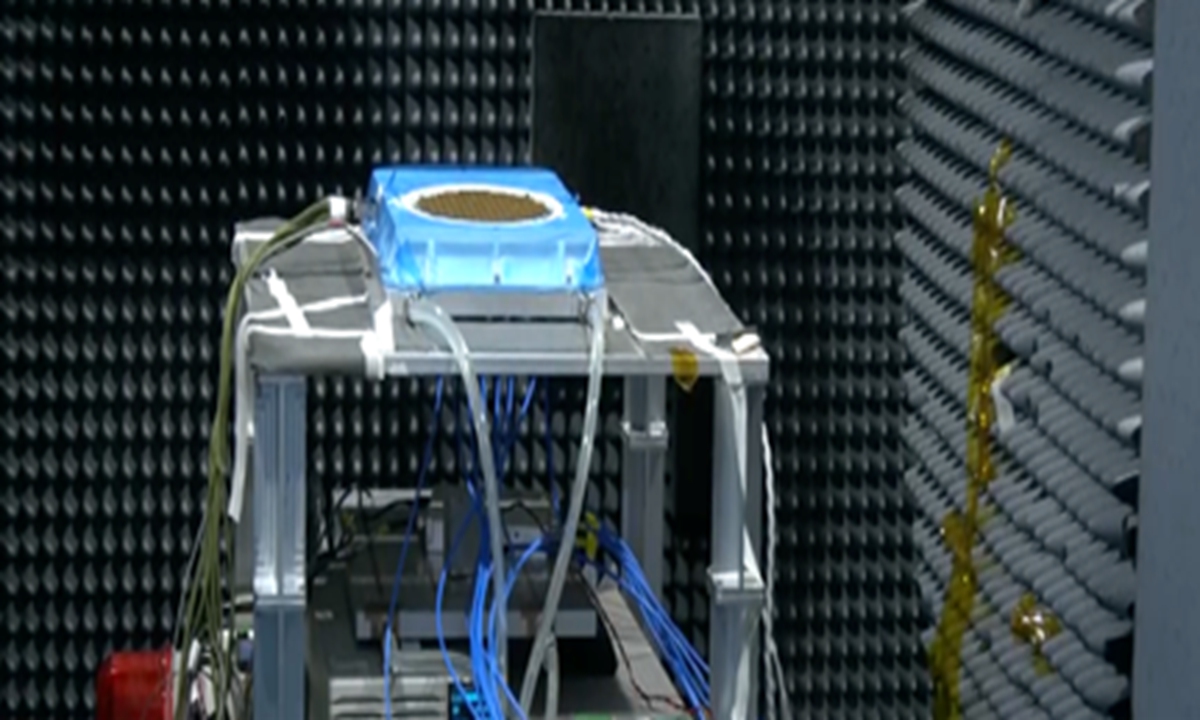
The phased array antenna is one of the core payloads that determines whether a satellite can simultaneously serve a large number of ground users. (Photo: CCTV News)
In recent years, China has been accelerating the deployment of satellite internet. By launching tens of thousands of communication satellites into low Earth orbit, the country aims to build a global high-speed broadband network, which can be widely used in diverse scenarios such as broadband access in remote areas, maritime and aviation communications, emergency disaster response, and the Internet of Things, according to a post published by the official account of China's Ministry of Industry and Information Technology (MIIT) on Sunday.
The post, citing a report from China Central Television (CCTV), said that in a bid to accelerate the development of an integrated "space-ground network," several key satellite communication technologies have secured engineering breakthroughs.
For instance, when a user opens a TV streaming app on a phone accessed to the internet via satellite, high-definition video plays smoothly. This is made possible by a trial constellation of eight satellites, where connectivity is only available during a brief window of a few minutes as each satellite passes overhead.
What China is building, however, is a massive satellite internet constellation composed of more than 10,000 satellites, capable of providing continuous and stable network coverage, the report said.
Accelerating the development of an integrated "space-ground network" is not only necessary for future-oriented technological upgrades, but also a key component of information infrastructure in the 6G era, industry experts said.
"It will significantly enhance emergency response capabilities in the face of natural disasters and unexpected incidents, while also better empowering the low-altitude economy in the digital era. It is foreseeable that many new applications - beyond what we can currently imagine - will emerge," Ma Jihua, a veteran tech industry analyst, told the Global Times on Sunday.
At the same time, speeding up this development is essential for securing scarce strategic space resources and ensuring a strong voice in the field of space-based communications, Ma said.
For internet communication satellites to work, a first challenge is to connect ground users to the satellites. In the production workshop of a satellite company, a satellite-borne microwave antenna about to be delivered is undergoing tests for coverage and signal strength, according to the CCTV report.
A golden panel - the phased array antenna is one of the core payloads that determines whether a satellite can simultaneously serve a large number of ground users, the report said.
Low Earth orbit satellites move at high speed relative to the ground, reaching up to 7.8 kilometers per second. The beam switching of phased array antennas can be completed at the millisecond level, enabling extremely rapid transitions, Sun Yaohua, an associate professor at the School of Information and Communication Engineering of Beijing University of Posts and Telecommunications, was quoted as saying in the report.
In the future, a single low Earth orbit satellite may be equipped with at least three to four phased array antennas, Sun said.
Once the signal is transmitted to the satellite, a next challenge is to make tens of thousands of satellites interconnect with one another in orbit. This is achieved by using laser beams thinner than a human hair.
In April this year, China achieved its first multimodal relay transmission combining "inter-satellite laser links and satellite-ground microwave links." In this process, data is transmitted from the ground, relayed between satellites via laser links, and then sent back to the ground, forming a closed-loop communication system, according to the report.
For instance, the China Mobile Research Institute has been actively advancing research and development of satellite-ground integration technologies by proposing a space-based optical transport network system and innovatively established an integrated networking architecture combining "inter-satellite, satellite-ground, and ground-based" segments, an industry information website cww.net.cn reported on April 9.
So far, human communication systems have mainly covered the Earth's surface, and even then, largely concentrated on land-based regions. Remote deserts, vast oceans, and low-altitude airspace below 1,000 meters have not been fully covered by communication networks, which has significantly limited the utilization of these areas, Xiang Ligang, director-general of the Zhongguancun Modern Information Consumer Application Industry Technology Alliance , told the Global Times on Sunday.
Extending communication capabilities to these domains is therefore a key direction for future development. The integration of space, air, and ground networks in the 6G era is seen as an important trend, and it is expected that even more advanced generations such as 7G and 8G will further enhance and refine this "space-air-ground integrated" system, Xiang said.
Phased array antennas and inter-satellite laser communication systems are already being deployed in batches. However, the final segment of the end-to-end signal chain is still under development and upgrading - namely, the transmission link between satellites and ground gateway stations, according to the CCTV report.
If satellite-to-ground links are implemented using laser communication, they will function like an "information highway," Liu Chao, a research fellow from the Institute of Optics and Electronics of Chinese Academy of Sciences, was quoted as saying in the report.
It could be put into practical use within three to five years, as key engineering breakthroughs have already been achieved and the critical technologies have all been validated, Liu said.