


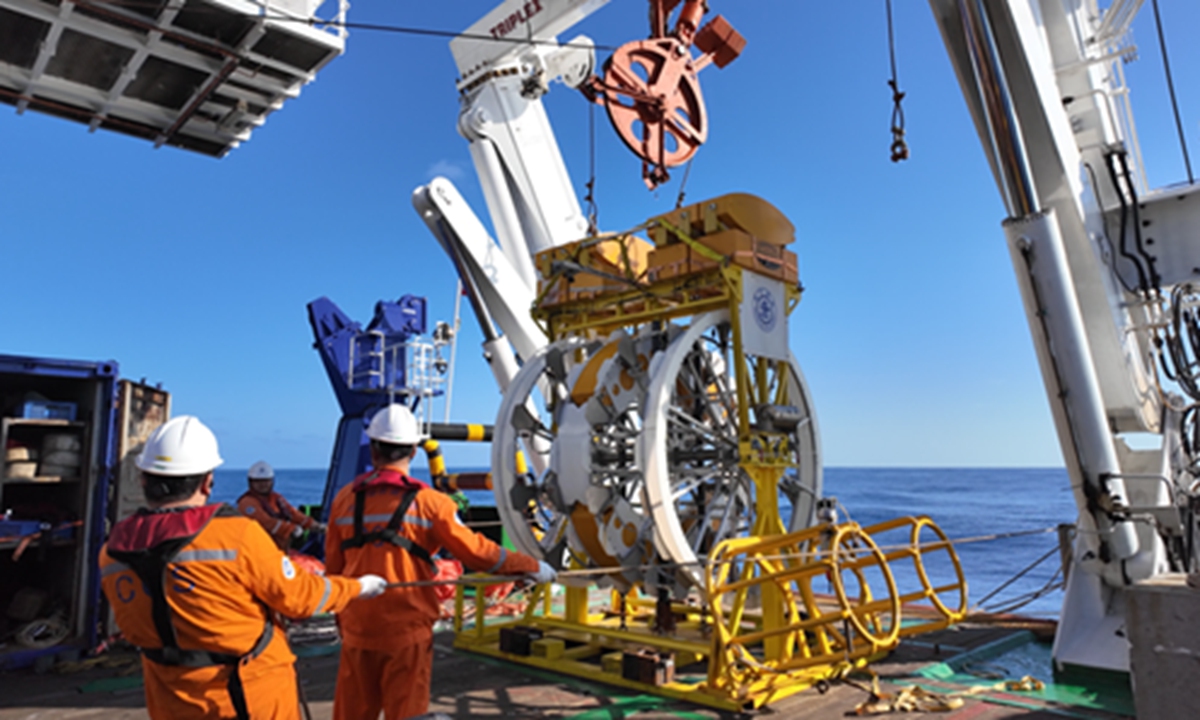
The subsea precision instrument deployer, equipped with an elastic releasing system, is prepared for deployment on the ship's aft deck. (Photo: Screenshot from website)
Chinese scientists have recently completed the sea testing for the precision instruments and engineering equipment of the Tropical Deep-sea Neutrino Telescope (TRIDENT), a powerful underwater telescope built at a depth of 3,500 meters underwater, Shanghai Jiao Tong University (SJTU) announced on Sunday.
The TRIDENT project, also named Hailing (ocean bell) project in Chinese, is a deep-sea neutrino detection initiative aimed at building a world-leading large-scale neutrino telescope in the South China Sea. By capturing high-energy neutrino signals, it seeks to explore cutting-edge scientific questions such as the origin of cosmic rays and extreme astrophysical phenomena, while promoting interdisciplinary research across areas including particle physics, astronomy, and ocean engineering, according to a statement released by SJTU.
Phase I of the project will deploy 10 neutrino detection strings, each about 700 meters tall, at a depth of 3,500 meters to form a compact array. The sea testing focused on key technological breakthroughs for Phase I construction of the project, including the subsea precision instrument deployer with elastic releasing (SPIDER) system, underwater acoustic positioning, and deep-sea wet-mate connectors, according to SJTU.
In this sea trial, the SPIDER system completed a seabed landing test at 3,500 meters and a coordinated movement test with a dynamically positioned vessel, verifying impact resistance and deep-sea precision positioning capability.
Despite the fact that neutrinos rarely interact with matter and can escape from dense celestial environments, which are hard to detect, as reported by Xinhua News Agency, Xu Donglian, the telescope's chief scientist from the Tsung-Dao Lee Institute under SJTU, said that TRIDENT innovatively observes the cosmos by "looking down" instead of "looking up" at the sky, utilizing the Earth as a shield when capturing high-energy neutrinos penetrating from the other side of the globe and achieves detections without a dead angle through Earth rotation.
The prototype model of TRIDENT's hybrid Digital Optical Module design, the telescope's core unit, captured subtle neutrino signals and achieved single-photon-level precision in extremely weak conditions during the sea trial.
Meanwhile, the project team underwent multiple 3,500-meter underwater mating tests on five domestic systems of the deep-sea wet-mate connector, a key device linking subsurface buoys with seabed junction boxes in Phase I of the project.
During this voyage, the scientists also successfully recovered the neutrino environmental mooring and neutrino mooring deployed in April 2025. These moorings provide full-cycle meteorological, oceanographic and hydrological environmental parameters along with equipment operation records. Most sensors functioned well with minimal biofouling, providing long-term continuous data to support deep-sea neutrino observatory site selection.
In addition, in-situ sampling and large-volume filtration experiments carried out by the scientists have provided biodiversity data in the abyssal plain and key references for deep-sea neutrino signal analyses.
Global Times