


Daydream believers lift 'lunch-break economy'
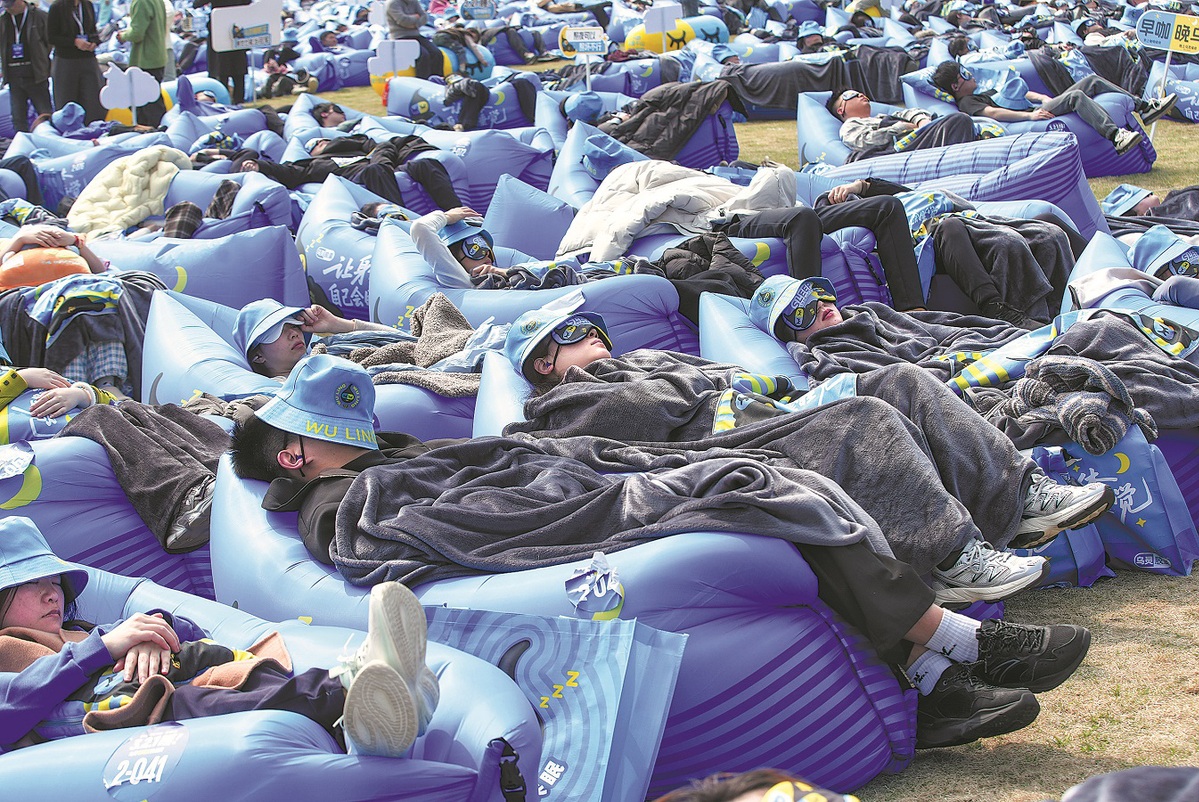
Contestants rest on a lawn in Huzhou, Zhejiang province, on March 21. The sleep competition invited 1,000 participants to set aside their phones and focus on healthy sleep by wearing masks and earplugs, aiming to raise awareness of sleep health. WANG SHUCHENG/FOR CHINA DAILY
At 12:00 pm on a Wednesday, Lin Yihan, a 43-year-old legal counsel at a firm in Dalian, Liaoning province, is lying fully reclined in a massage shop a 10-minute walk from her office.
Soft ambient music plays. An eye mask covers her face. She has paid 100 yuan ($14.7) to escape the open-plan office and be somewhere that is not her home or workplace for the next 60 minutes.
"Usually, my day is occupied by heavy work and taking care of my family," said Lin, who goes to the shop twice a week.
"It's the only time when no one is asking me for anything. No emails, no WeChat messages, no urgent requests. Just 60 minutes of being taken care of."
Lin is not alone. More urban professionals are actively spending on the midday hour. For the stressed out, it has become one of the few stretches of the day they can truly control. And they are willing to pay for that control.
From power naps and express facials to sweat-drenched high-intensity interval training (HIIT) workouts and even 30-minute group meditations, the traditional lunch break is being repackaged as a discrete, consumable, and increasingly necessary pocket of self-care.
"In the past, during my lunch break, I would have meals and take walks with my colleagues. But now, I prefer to have a simple meal and then spend money to have a good sleep," said Lin.
Booming market
While the total value of the "lunch-break economy" has yet to be established, Lin's spending provides a good snapshot.
Over 19,000 orders from the same shop similar to Lin's 60-minute full-body relaxation massage were sold on Meituan alone in the past year. A total of 45,000 orders were sold for 19 other service products, with the prices ranging from 100 to 250 yuan.
Even though the lunchtime orders account for less than one-quarter of the total, the quantity is quite substantial.
On JD.com, products such as the napping pillows for desks, camp beds in offices, and sleeping chairs for primary and secondary schools have all achieved sales exceeding 1 million units.
More service providers are changing their offerings to cater to the tight 60-minute window.
In Shanghai's Jing'an Temple business area, head spas have become so popular that customers must book by 10 am for a lunchtime slot. The most sought-after establishments require reservations be made a full day ahead.
"It's crazy," a regular customer told local media. "I walked in at lunchtime wanting a quick head wash to relax, and they told me there were no slots left."
Unlike well-tracked sectors such as e-commerce or ride-hailing, the lunch-break economy is a fragmented phenomenon spanning wellness, beauty, fitness, hospitality, restaurants, and even furniture retail.
At a 24-hour fitness club in downtown Dalian, which boasts over 400 members who pay about 4,000 yuan per year in membership fees, nearly one-fifth of them show up at the gym during their lunch break.
"Many white-collar workers who work nearby have signed up for our yoga class during the busiest time at noon," said a gym manager surnamed Zhang.
A regular attendee surnamed Luo said his typical lunch break includes a 15-minute bento box at his desk and a 45-minute HIIT session at the gym.
"I used to drink two espressos to get through the afternoon," he said,"now I just move my body for 45 minutes. It's more effective than any amount of caffeine."
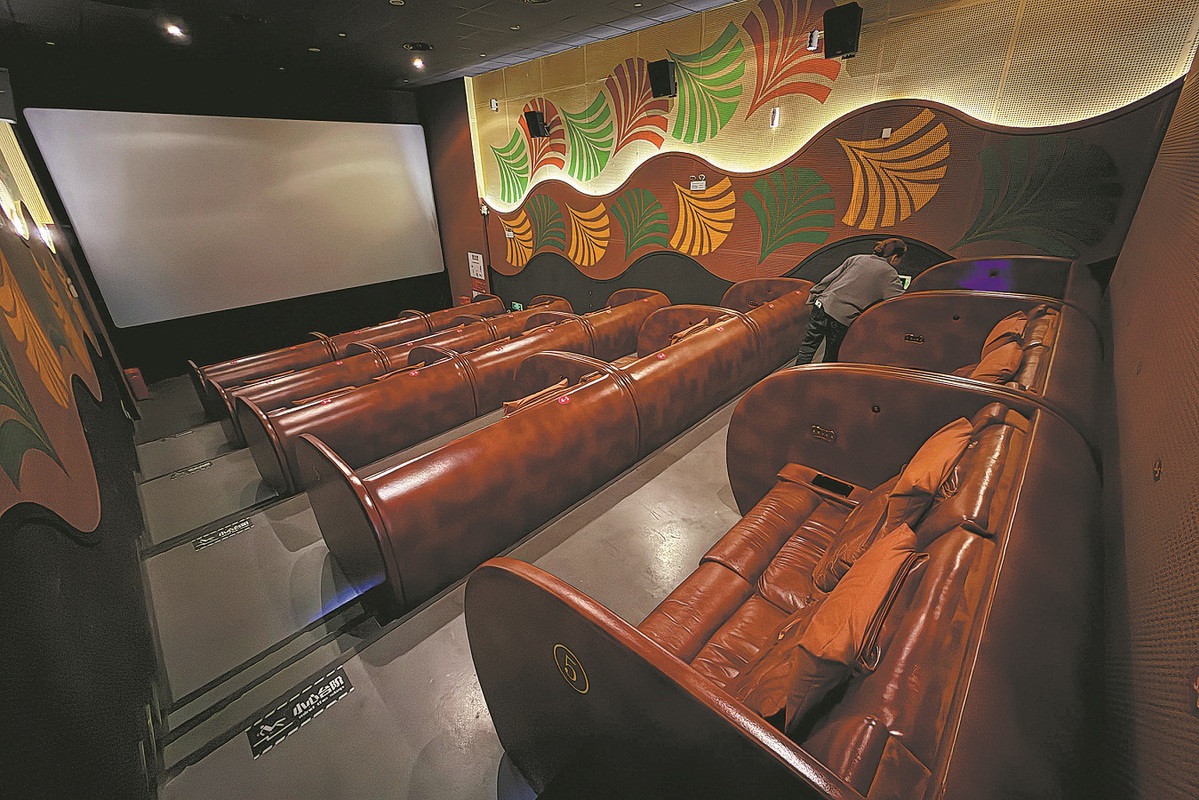
Napping service during lunch time has been provided at Lumiere cinema in Xi'an, Shaanxi province, since May 2025. [Photo provided to China Daily]
Easing pressure
In a high-end office building in Dalian's Donggang Business District, mild hyperbaric oxygen chamber treatment is helping workers relax and recover during their lunch breaks.
Mild hyperbaric oxygen therapy uses low pressure to enhance oxygen delivery throughout the body to relieve stress, improve illnesses and speed recovery.
Offered as promotions for first-time online buyers, the 60-minute treatment costs 250 yuan for a single-person chamber and 360 yuan for a double-person chamber.
"You can't expect a noticeable improvement from just one session. Unless you've been pulling all-nighters and your back feels like it's carrying a mountain — then after one session you'll feel instantly lighter. Or if you've had too much to drink and your head is foggy, it will sober you up immediately," said a staff member surnamed Song.
She said many people who try the treatment become long-term members, adding the chambers are often fully booked.
Some frequently bring friends along, treating it as a new form of socializing. Others, too busy to step away from work, bring their laptops inside the chamber and continue working. But the majority, she said, simply come for a good, deep sleep.
In Xi'an, Shaanxi province, a Lumiere cinema launched a "Lie-flat plan" in May 2025, opening two of its auditoriums for midday napping during the weekday 12:00 pm to 2:30 pm window. The service costs just 29.9 yuan per month for a single person or 49.9 yuan for two — roughly the price of a single movie ticket.
The cinema provides pillows and blankets, sets the lighting to a dim, sleep-friendly level, and maintains a constant, comfortable temperature. Within months, all 76 available seats were sold out, with renewal rates so strong that management decided to continue the service even during peak movie screening seasons.
"In the office, even if I can lie down, my brain is still thinking about work," one customer who has renewed his monthly pass twice told media.
"Walking into the cinema, my mind automatically switches from 'work mode' to 'rest mode'. That psychological shift is worth more than any mattress."
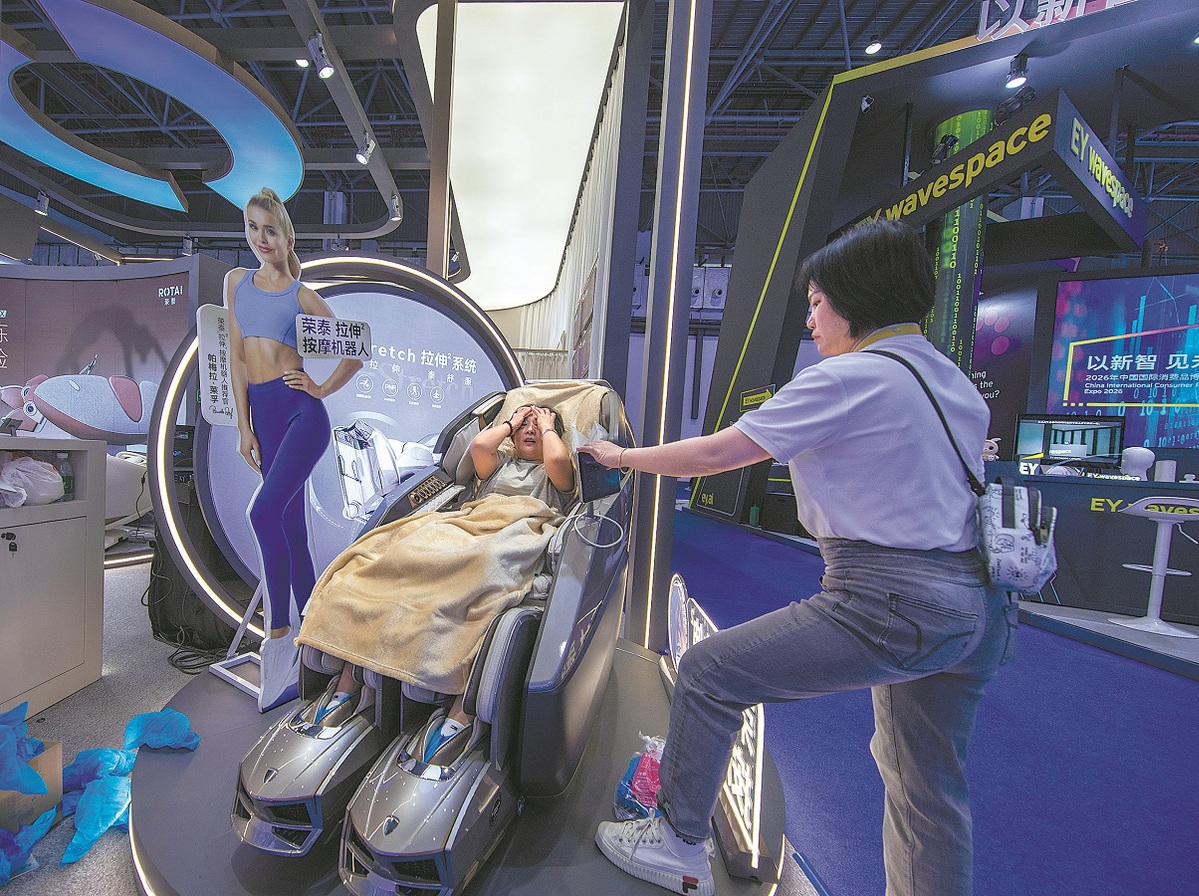
A visitor tries a smart stretching and massage machine designed for short breaks and relaxation at the China International Consumer Products Expo in Haikou, Hainan province, on April 17. LIU GUOXING/FOR CHINA DAILY
Sleep therapy
In Shenzhen, Guangdong province, sleep therapy centers have become increasingly popular among working professionals, as more people are willing to pay for sleep services.
According to the 2025 China sleep health research white paper released by the China Sleep Research Society, more than 300 million people in China suffer from sleep disorders, with about 150 million of them requiring active intervention.
"I've been under too much pressure lately and can't sleep well. When you enter this environment and let your mindset settle down, you stop thinking about other things, and you just drift into sleep," a consumer surnamed Tian told local media.
"Between money and health, I think health is more important. You can always earn money, but if you lose your health, there's no way to earn it back."
The head of the sleep therapy center said foot traffic has been rising steadily over the past two years, with revenue growing by about 20 percent last year.
In addition to individual consumers, a number of enterprise trade unions have proactively reached out to book customized on-site sleep services for their employees, in an effort to alleviate chronic sleep deprivation in the workplace, she said.
The 2026 white paper released on March 21 shows that although sleep problems still affect nearly half of all adults, a positive shift is underway: a growing number of people are moving from passively enduring poor sleep to actively managing their sleep health.
Gao Wen, an associate professor of psychology at Liaoning Normal University in Dalian, said the lunch-break economy has a very clear geographical adaptability, tending to concentrate in business districts and industrial parks in first-tier and new first-tier cities.
"Consumers are mostly white-collar workers who have long commutes, high work intensity, and relatively high disposable income. They are quite willing to pay for their personal physical and mental health, as well as for improved work efficiency," she said.
In addition, she noted, some people accumulate negative emotions at work and need appropriate regulation to restore emotional stability and enhance their reclaiming control of their life.
Gao lives near the Dalian Software Park, where most commercial facilities cater to white-collar workers and university students in the area. Restaurants, gyms, beauty salons, barbershops, bathhouses, and massage shops are all readily available.
She has noticed that during the lunch break, some merchants set up stalls in the park selling fruit, pastries, fresh flowers, jewelry, and other items — and they are very popular.
"Whether university students or young people just entering the workforce, they are more willing to pay for emotional value and for things that enhance their sense of well-being," she said.
Issues to chew over
Five years ago, if a businessman said they were targeting the lunch break, people might have assumed they meant fast-food delivery. Now they mean massage chairs, meditation pods, and 45-minute HIIT classes. The lunch hour has become personal prime time.
But beneath the surface of consumer choice and market innovation lie deeper structural questions about equity, safety, employer responsibility and other issues.
For blue-collar workers — such as factory employees, logistics drivers, retail staff, and restaurant servers — the lunch break is often shorter, less protected, and frequently unpaid.
Many do not have the option to leave their workplace during the midday window. Even if they do, spending 50 yuan on a nap pod or 100 yuan on a massage would represent a significant portion of a day's wages.
"It is kind of a luxury good, accessible only to those who can afford to treat rest as a consumable," said Gao.
More concerning than the business model are the regulatory gaps. Who is liable if a customer falls ill or is injured inside a pod? What standards govern the hygiene of shared bedding? These questions have not been answered.
Moreover, corporate attitudes toward the midday hour remain deeply ambivalent.
On one end of the spectrum are companies that actively support employees' lunch-break activities. Some tech firms have installed nap rooms, subsidized gym memberships, and even offered on-site massage services.
"Once I went to apply for a job at a company in Shenzhen. It was 1:30 pm and the place was pitch-dark with no one around. I thought maybe the company had gone bankrupt. But later I learned that there is a midday-break culture in Shenzhen!" said one netizen.
On the other end are companies that view any departure from the desk during lunchtime as a dereliction of duty. In some workplaces, employees who leave the office for more than 45 minutes face questions from supervisors.
"I hope that everyone can enjoy their lunch break. One hour isn't enough to reach a distant place, but it's enough to let your soul escape from the routine," said another netizen.