


Visitors to Shenzhen's Longtan Park can now get freshly made ice cream from an AI-powered kiosk in under 30 seconds.
A digital "store manager" greets passersby on screen while a robotic arm prepares orders after customers scan, select flavors and pay.
This innovation comes from Hong Kong Gen Z entrepreneur Lun Wenjing, whose Shenzhen-based startup has deployed these robots across the city since 2022. Her company has also developed unmanned coffee kiosks, leveraging Shenzhen's robust innovation ecosystem.
"The core technology behind both our ice cream and coffee systems relies on sophisticated algorithms that coordinate hundreds of components,” said Lun, who was born in 2001. "We've secured more than 20 invention patents."
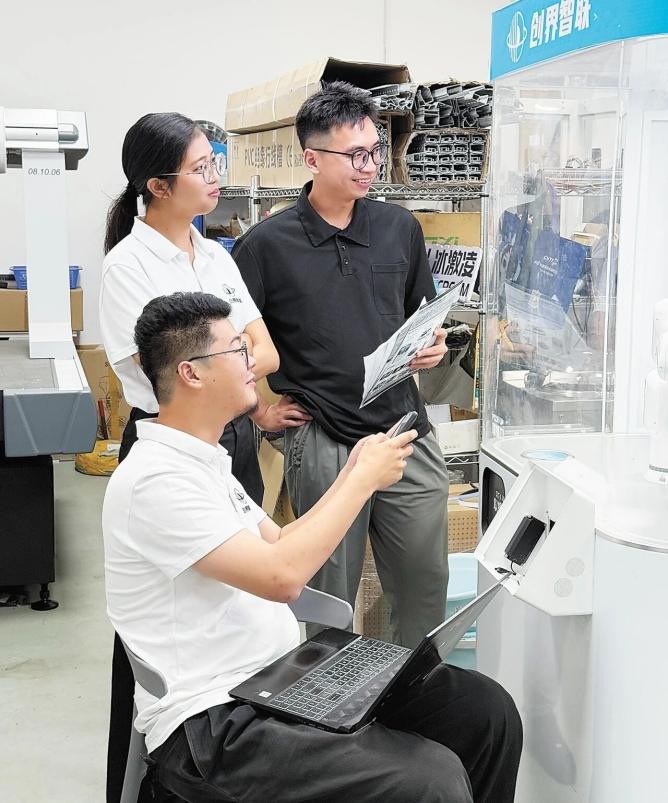
Lun Wenjing (left) and her colleagues fine-tune a robotic ice cream kiosk. (Photo: Lin Junrun/People's Daily)
Lun's entrepreneurial journey began at Shenzhen University, where she studied economics in a vibrant startup environment. In 2022, after observing Guangdong's thriving robotics sector, she envisioned applying robotic arms to beverage services. To test her idea, she trained at a bubble tea shop in Shenzhen, where she learned the operational workflow.
She soon assembled a cross-disciplinary team, including Pei Yicheng, a computer science graduate who led technical development. Their main challenge was translating human actions into precise machine instructions. "Our team worked day and night coding coffee brewing times, milk tea mixing cycles and ingredient measurements," Pei recalled.
The Greater Bay Area's manufacturing ecosystem proved crucial. "Factories in Shenzhen, Dongguan, and Huizhou are all within an hour's reach," Lun said. "Suppliers can deliver prototypes within 24 hours."
After developing a functional coffee kiosk prototype by May 2023, Lun established her company in Shenzhen's Guangming district later that year. The district's startup incubator provided three years of rent-free office space, expert guidance, and seed funding.
"The Greater Bay Area's industrial base and supportive policies create an ideal launchpad for new entrepreneurs," Lun said.
By July 2025, her team had achieved mass production of its fifth-generation coffee kiosk, capable of preparing three beverages simultaneously in 70 seconds. An order for 25 units from Huizhou significantly boosted the company's cash flow.
Later, a company based in Changchun commissioned customized robots for traditional herbal drinks and ice cream. Lun's team quickly developed four specialized units, which were deployed in the city. Each machine now sells more than 100 servings daily.
The company has since expanded to 10 parks across Shenzhen. Since April 2026, its ice cream robots have generated monthly revenues exceeding 400,000 yuan (58,609 US dollars).
"Shenzhen is where ideas take root," Lun said. "We will continue building our future here."