


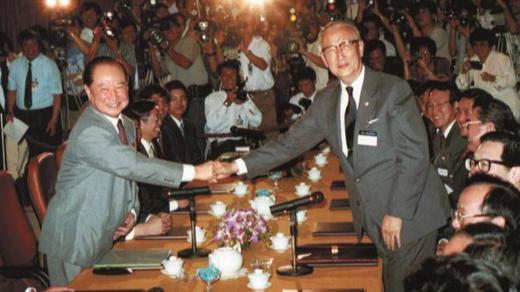
Wang Daohan, then president of the mainland-based Association for Relations Across the Taiwan Straits, and Koo Chen-fu, chairman of the Taiwan-based Straits Exchange Foundation, shook hands at Singapore's NOL Building, April 27, 1993. (Photo: Xinhua)
Thirty three years ago, at Singapore's NOL Building, Wang Daohan, then president of the mainland-based Association for Relations Across the Taiwan Straits (ARATS), and Koo Chen-fu, chairman of the Taiwan-based Straits Exchange Foundation (SEF), stood up from across the table and shook hands. More than 200 journalists witnessed the historic moment: the first formal high-level contact between the two sides of the Taiwan Strait since 1949.
Today marks the 33rd anniversary of the landmark meeting between Wang and Koo, widely known as the "Wang–Koo Talks," a pivotal moment in the history of cross-Strait relations.
The talks sets a precedent for high-level contact, dialogue and equal-footed consultation across the Taiwan Strait, highlighted the importance of the 1992 Consensus as the foundation for cross-Strait consultation, and demonstrated that the Chinese people on both sides have the ability and wisdom to properly handle their own affairs.
Wang-Koo Talks: An embodiment of the 1992 Consensus
The origins of the talks can be traced back to a series of discussions between ARATS and SEF from March to November 1992 on how to express cross-Strait relations.
On August 1, 1992, the Taiwan authorities reached a "conclusion" on the meaning of "one China" in talks between the ARATS and SEF, confirming that "both sides of the strait adhere to the one-China principle."
Later that same year, with the authorization from authorities on both sides of the strait and through repeated communication, consultation and correspondence, the two organizations reached the consensus that "both sides of the strait adhere to the one-China principle," which has become known as the 1992 Consensus.
The 1992 Consensus, though expressed orally, was backed by written records, articulating the shared commitment to the one-China principle across the strait.
Building on this consensus, from April 27 to 30, 1993, Wang and Koo held their historic meeting in Singapore. As former SEF vice chairman Chiu Chin-yi once noted, it was precisely the existence of the 1992 Consensus that made the Wang–Koo Talks possible.
Adherence to the 1992 Consensus facilitated steady progress in cross-Strait relations. From 2008 to 2016, the ARATS and the SEF signed a series of agreements, which brought real and tangible benefits to people on both sides of the strait, especially those in Taiwan.
Direct flights, postal services and trade links were gradually realized, while exchanges between political parties, as well as economic and cultural cooperation, flourished. Cross-Strait travel and people-to-people exchanges became increasingly frequent.
During the eight-year tenure of Ma Ying-jeou, cross-Strait relations saw significant advancement, with 23 agreements signed, including the Economic Cooperation Framework Agreement, further deepening ties and interaction across the Strait.
Anchor of peace and stability
However, since May 2016, the Democratic Progressive Party authorities have stubbornly adhered to a secessionist stance, refused to recognize the 1992 Consensus, undermining the political foundation for cross-Strait consultations, and obstructing cross-Strait exchanges and cooperation.
Against this backdrop, the anniversary of the Wang–Koo Talks carries renewed relevance.
Earlier this month, Cheng Li-wun, chairwoman of the Chinese Kuomintang (KMT) party, visited the Chinese mainland. During her visit, the 1992 Consensus and the one-China principle were reaffirmed by both sides. One day before her departure, the Chinese mainland unveiled a package of 10 policies and measures to promote cross-Strait exchanges and cooperation,
Experts noted that the package is a key outcome of pragmatic dialogue between the two sides under the shared political foundation of upholding the 1992 Consensus and opposing "Taiwan independence."
At a press conference on April 15, Chen Binhua, spokesperson for the State Council Taiwan Affairs Office, reiterated that the 1992 Consensus serves as a touchstone for cross-Strait dialogue.
Chen said that on the common political foundation of adhering to the 1992 Consensus and opposing "Taiwan independence," the Chinese mainland stands ready to strengthen exchanges with political parties, organizations and individuals from the Taiwan region, with the aim of enhancing mutual trust, safeguarding peace in the Taiwan Strait, and advancing the well-being of people on both sides.
He stressed that peace, development, exchange and cooperation reflect the shared aspirations of people across the Strait, and that the momentum for dialogue and exchange cannot be stopped.
More than three decades of practice has proven that the 1992 Consensus serves as an anchor of peace and stability across the Taiwan Strait. Adhering to the 1992 Consensus can bring peace to both sides of the strait and benefit Taiwan compatriots. Denying the 1992 Consensus and departing from the one-China principle will only lead to tensions and instability in cross-Strait relations and harm the interests of compatriots in Taiwan.