


BEIJING, April 28 (Xinhua) -- Chinese research institutions have recently completed a demonstration of space metal 3D printing technology in orbit, with potential applications in space manufacturing and maintenance.
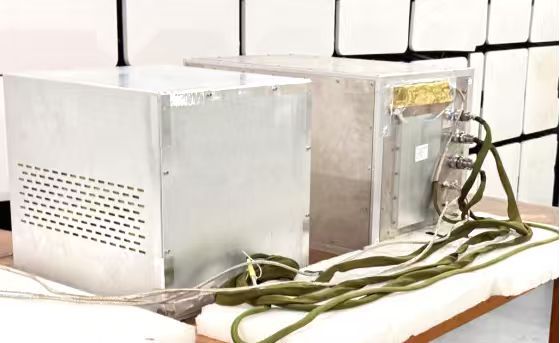
Photo: CAS
The Institute of Mechanics under the Chinese Academy of Sciences (CAS), in collaboration with the Innovation Academy for Microsatellites of CAS, successfully carried out the demonstration in the previously launched Qingzhou Cargo Spacecraft Test Vehicle, Science and Technology Daily reported on Monday.
Space metal 3D printing technology faces many challenges. It has to address special physical mechanisms such as metal droplet transfer, liquid bridge stability, and melt pool evolution under microgravity conditions, and also needs to resolve a series of engineering challenges, including payload lightweighting, launch vibrations, energy interface adaptation, telemetry and remote control, autonomous operation, and in-orbit safety.
During the demonstration, the 3D printing device aboard the Qingzhou spacecraft autonomously initiated operation according to ground commands. Using a laser wire-feed process, it completed metal melt deposition in a stable and smooth manner, successfully verifying the reliability of multiple remote-controlled start-stop cycles.
The demonstration also tested core capabilities, including payload compatibility with the spacecraft platform, full-process automated execution, data and image transmission, and metal melt deposition processes in the space environment.
The technology is expected to help transform the traditional space mission model of "bring what you need" into "make what you need." In the future, it can be used in scenarios such as in-orbit manufacturing and maintenance, spare part production for space facilities, structural component repair, and autonomous support for deep-space missions.