


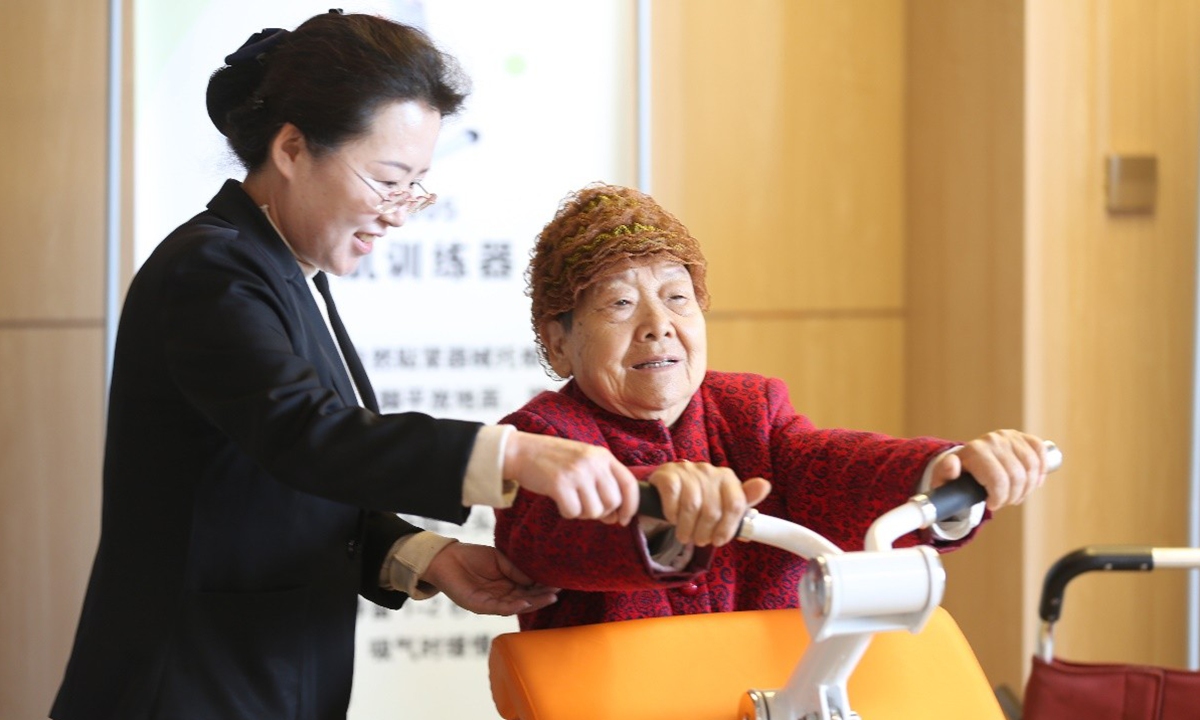
A staff member assists an elderly person with exercise at a fitness center in Rizhao, East China's Shandong Province. (Photo: VCG)
China's Ministry of Civil Affairs, together with 10 other government departments, has jointly issued a policy document to promote the development of mutual-aid eldercare services, aiming to encourage neighbors or residents within villages and communities to better support older people through voluntary and non-profit services, according to an official statement released on the ministry's WeChat account on Wednesday.
The guidelines set clear targets for expanding such services. By 2030, at least 70 percent of urban and rural communities are expected to be equipped with eldercare facilities featuring mutual-aid functions, while regular visits and care services for elderly people in particular difficulties will be fully established at the township and subdistrict levels. By 2035, the system is expected to become more organized and better supported, with improved services including daily care, social participation, and emotional support.
China has entered a moderately aging society. According to China's National Bureau of Statistics, by the end of 2025, the population aged 60 and above had reached 320 million, accounting for 23 percent of the total population. This number is expected to exceed 400 million by around 2035, the Xinhua News Agency reported on April 2.
The guidelines clearly set out who will provide the mutual-aid eldercare services, what will be delivered, where they will take place, and how support will be ensured, offering a practical roadmap for implementation. They also outline concrete measures to improve service models and strengthen support systems, Zhang Jun, a senior official from the Ministry of Civil Affairs, said at a regular press conference on Wednesday, according to media reports.
The guidelines call for developing community-supported, home-based mutual-aid services supported by grassroots networks, including community workers and volunteers. These teams will help identify needs and provide basic services such as meal support, cleaning, mobility assistance, and emergency assistance, ensuring that elderly people in need receive timely support in daily life and emergencies.
The guidelines also encourage flexible models tailored to local conditions, particularly in rural areas, such as neighbor-to-neighbor support and shared living arrangements.
To support the development of mutual-aid services, the guidelines call for better use of community facilities and public resources, and encourage participation from eldercare institutions to provide professional support. They stress improving resource coordination and leveraging digital technologies to enhance service efficiency and elevate the level of informationization and intelligence in services.
In a community in Tangshan, North China's Hebei Province, a volunteer from a "senior-helping-seniors" team regularly visits an elderly neighbor to assist with daily tasks such as shopping, cooking and companionship. The initiative, launched by a group of retired residents in the early 1990s, has since grown into a long-running mutual-aid network, with seniors supporting each other through both practical assistance and emotional care. Over the past 35 years, this spirit of mutual-aid eldercare has quietly taken root and spread, with acts of kindness passed from one generation to the next, China National Radio (CNR) reported on Wednesday.
As China's elderly population continues to expand, the guidelines highlight a shift toward more community-driven care solutions. By promoting mutual aid, authorities aim to better mobilize local support and complement existing care systems, offering a more flexible way to meet the needs of older people.