


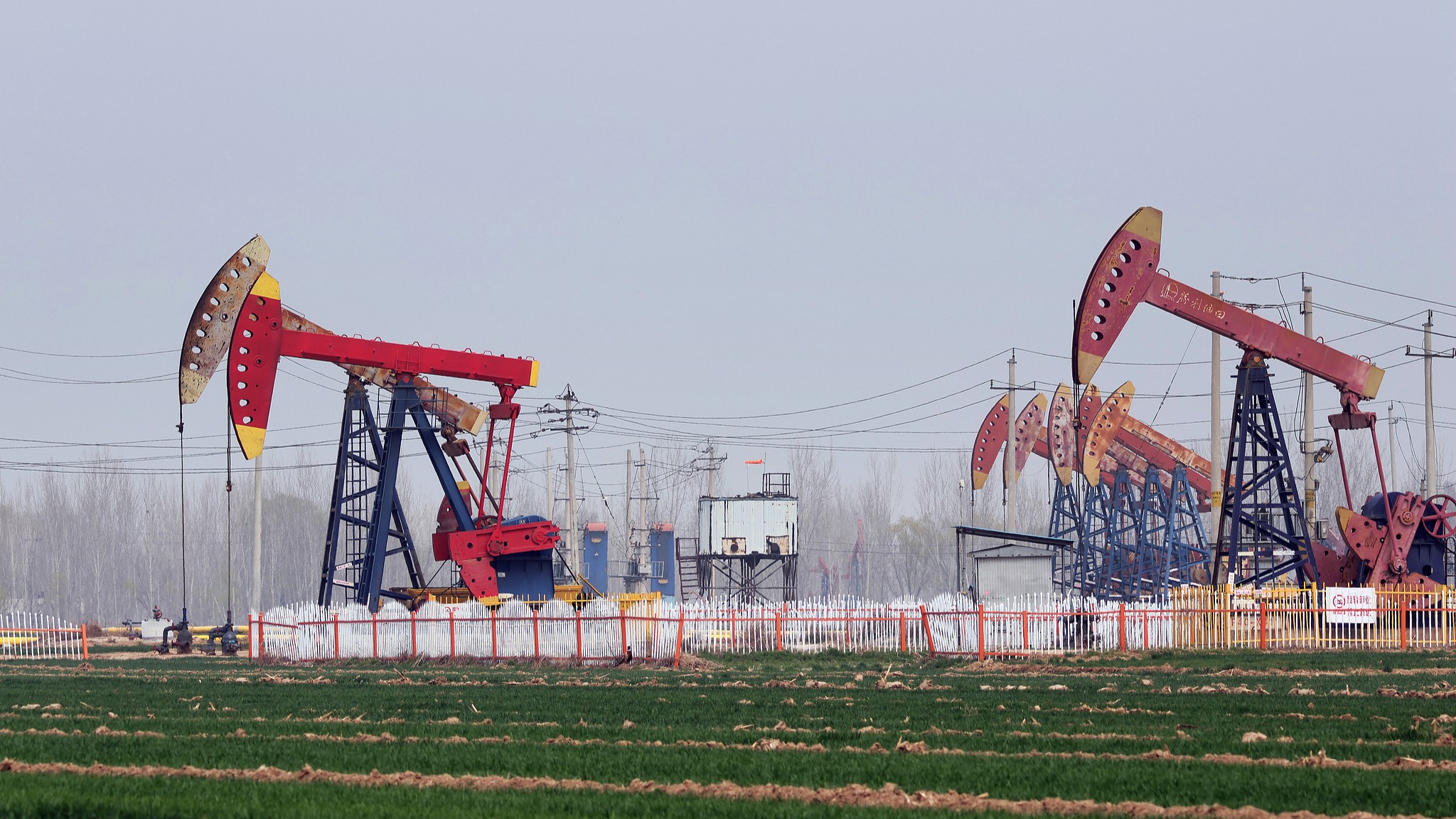
Pumping units are in operation at an oilfield near Dezhou City, east China's Shandong Province, March 23, 2026. (Photo: VCG)
China has significantly strengthened its energy and resource security over the past five years, with a state-led exploration push discovering 13 new oil fields each holding over 100 million tonnes of reserves. The findings were released during a Ministry of Natural Resources (MNR) press conference on Wednesday.
Historic oil and gas haul
The 14th Five-Year Plan period (2021-2025) saw China's oil and gas exploration hit new heights. Total investment in the sector reached nearly 450 billion yuan, said Xiong Zili, head of exploration management at MNR.
Beyond the headline-grabbing 13 hundred-million-tonne oil fields, explorers also found 26 gas fields, each with reserves exceeding 100 billion cubic meters, Xiong revealed. As a result, newly proven geological reserves of oil and hydrocarbon natural gas jumped by 51.7% and 44.2%, respectively, compared to the previous five-year period.
A critical engine for this growth was unconventional drilling. Deep coal-bed methane alone added over 1 trillion cubic meters in new proven reserves – more than the historical cumulative total for shallower deposits. Shale oil also proved its worth in 2025, contributing 38% of the year's total new oil reserves from eight fields across five major basins, according to Niu Li, deputy head of exploration management at MNR.
On the production side, China's crude oil output reached a record 216 million tonnes in 2025, while natural gas production surpassed 260 billion cubic meters.
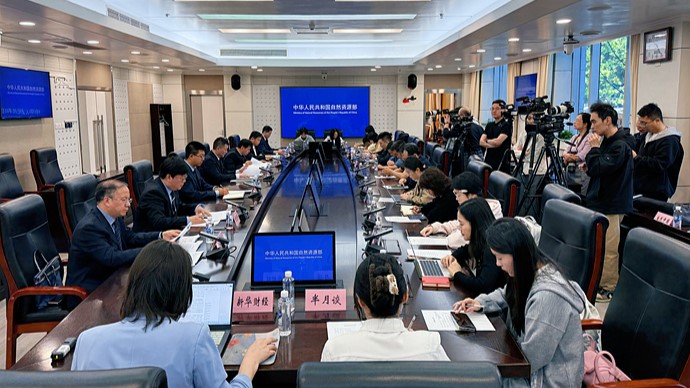
Officials from the Ministry of Natural Resources meet with journalists at a press conference, Beijing, China, April 29, 2026. (Photo: Zhao Xinhao/MNR)
Mineral abundance secured
The exploration push was not limited to energy. The campaign also targeted strategic minerals, securing China's dominant position in global supply chains.
The country now ranks first globally in reserves for 14 minerals, including but not limited to rare earths, tungsten and gallium, and holds a top four position for nine others like coal and lithium, said Xiong.
This resource base underpins its massive processing industry, which produces 99% of the world's manganese products and 94% of rare earth products.
Reform and innovation unlock potential
Xiong attributed the success to market-oriented reforms that unleashed nearly 500 billion yuan in total exploration investment, over 85% of which came from private capital.
The issuance of a record 1,868 exploration rights for strategic minerals during the period was made possible by streamlining approval processes and mandating competitive public auctions.
Technological breakthroughs also pushed the exploration frontier into ultra-deep and deep-sea territories, effectively broadening the nation's resource map for the next phase of the campaign through 2030.
Read more: World's 2nd-largest rare earth mine expands China's resource advantage