


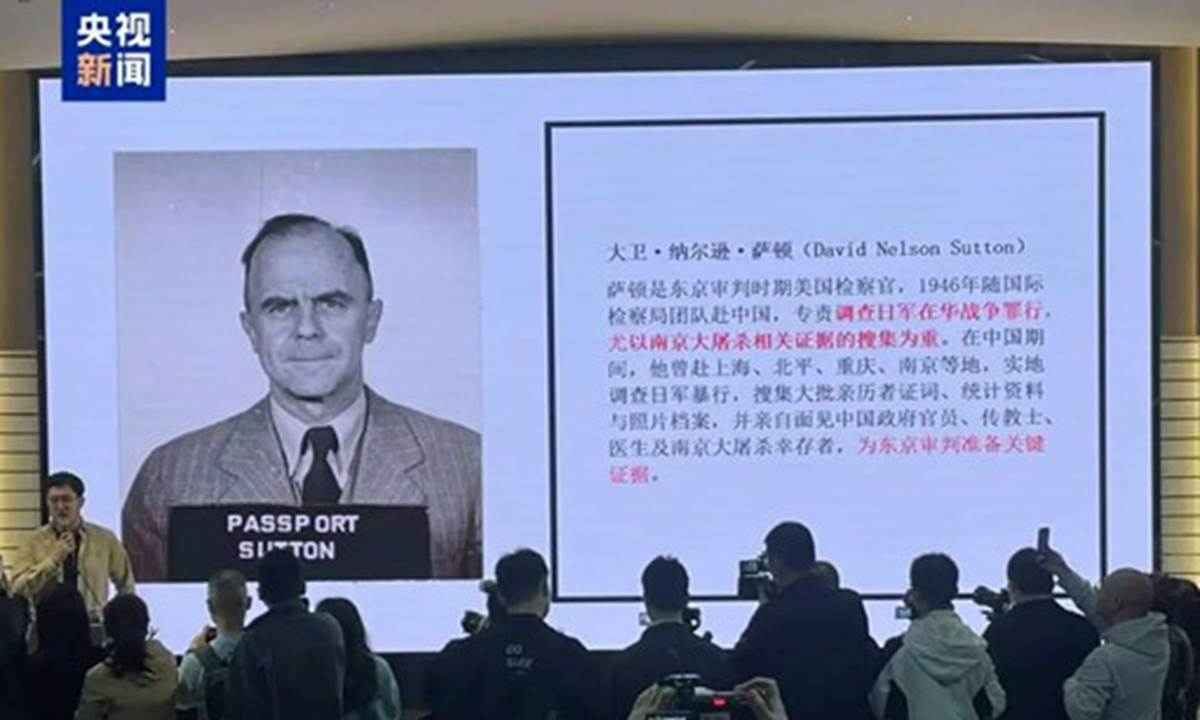
The Memorial Hall of the Victims in Nanjing Massacre by Japanese Invaders officially added 18 rare archival items related to David Nelson Sutton, a US assistant prosecutor at the International Military Tribunal for the Far East, to its collection, on April 29, 2026 in Nanjing, East China's Jiangsu Province. (Photo: CCTV News)
The Memorial Hall of the Victims in Nanjing Massacre by Japanese Invaders officially added 18 rare archival items related to David Nelson Sutton, a US assistant prosecutor at the International Military Tribunal for the Far East, to its collection on Wednesday.
The materials include six original diaries (1946-48), reports on Japanese military involvement in opium and narcotics trafficking in China, 1946 trial record copies from the International Military Tribunal for the Far East, and reports from the same year documenting crimes against humanity by Japanese forces in China, according to a statement the memorial hall shared with the Global Times.
From March to April 1946, Sutton traveled to China with the International Prosecution Section and was tasked with investigating Japanese war crimes, focusing on evidence related to the Nanjing Massacre. During his stay, he conducted fieldwork in Shanghai, Beiping, Chongqing and Nanjing, among others, gathering eyewitness testimonies, statistical data and photographs of mass burial sites, and meeting with Chinese officials, missionaries, doctors and survivors, according to the statement.
In June 1946, he returned to Nanjing to interview trial witnesses, went with them back to Tokyo, and brought archives from the US Embassy in Nanjing on Japanese atrocities, providing key evidence for the Tokyo Trials.
An 89-page report titled "Report from China on Atrocities Against Civilians, 'The Rape of Nanking,'" with a cover inscribed by Sutton, was one of his five "Reports from China." It opens with an overview of the massacre and includes 27 testimonies from Chinese witnesses detailing firsthand accounts of large-scale killings, rape and torture. The other four reports address economic aggression in China, bacteriological warfare, the opium and narcotics trade, and German-Japanese collusion in China.
Another 65-page trial record presents medical and eyewitness evidence of the Nanjing Massacre, including testimony from Dr. Robert Wilson, a surgeon at Nanjing's Gulou Hospital, who described an eight-year-old boy with a "deep, penetrating abdominal wound," civilians along the Yangtze River who were shot one by one and bayoneted to ensure none survived, and a Chinese policeman stabbed through the back, who was the sole survivor after a mass machine-gun execution.
The collection also contains a 70-page legal document detailing atrocities committed by Japanese forces across occupied areas, including murder, torture, rape, looting and wanton destruction. It explicitly identifies these acts as crimes against humanity in China, noting their prolonged duration, wide scope, and execution with the acquiescence or even direction of Japanese military and political authorities, constituting a "state-level pattern of warfare."
The legal document highlights the Nanjing Massacre as the earliest and most egregious case, incorporating detailed testimonies from Western witnesses such as International Committee for the Nanjing Safety Zone member Miner Searle Bates, committee secretary-general George Ashmore Fitch, as well as missionary and photographer John G. Magee, according to the statement.
A separate 41-page typed report written by Sutton exposes how Japanese forces and puppet regimes systematically promoted the opium and narcotics trade as a source of revenue while seeking to "weaken the health and resistance of the Chinese people," tracing the flow of drugs from production areas in Mongolia through distribution networks controlled by puppet authorities and the Japanese military into cities such as Shanghai and Nanjing, and including testimonies from Shanghai police, traffickers and massacre witness Bates.
Previously, marking the 88th anniversary of the Nanjing Massacre, a collection of artifacts and archival materials documenting atrocities committed by Japanese forces was added to the Memorial Hall of the Victims in Nanjing Massacre by Japanese Invaders. On December 5, 2025, the memorial hall held a donation ceremony at which 13 items were unveiled, including Japanese soldiers' letters, photographs taken after the occupation of Nanjing, archives of military doctors killed during the city's defense, an album from the Japanese "Hanami unit," and publications in English and French.
According to experts, these materials constitute a powerful rebuttal to Japanese right-wing forces, providing irrefutable evidence for restoring historical truth and preserving the memory of national trauma. They demonstrate a firm resolve at home and abroad to safeguard historical memory and uphold justice and conscience, the statement said.