


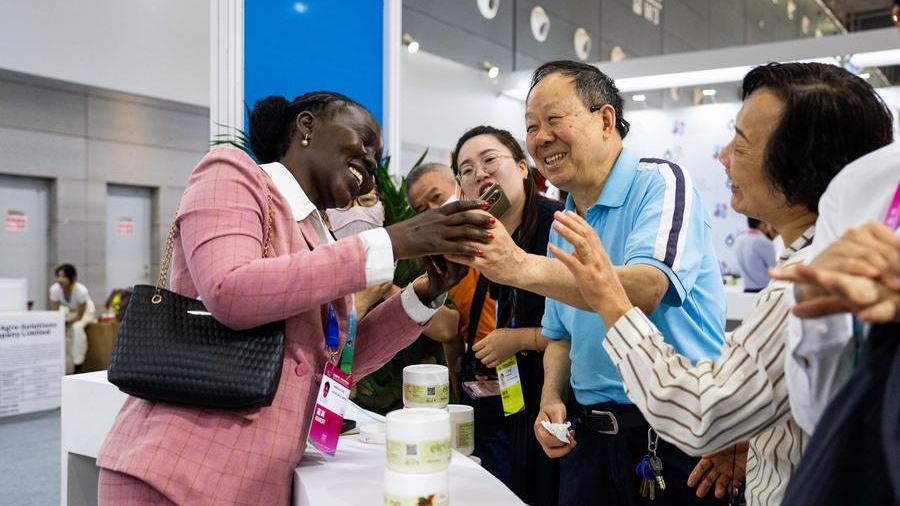
An exhibitor (L) chats with visitors during the fourth China-Africa Economic and Trade Expo at Changsha International Convention and Exhibition Center in Changsha, central China's Hunan Province, June 13, 2025. (Photo: Xinhua)
China on Friday expanded its zero-tariff treatment to cover all 53 African countries with which it has diplomatic ties, creating new opportunities for Africa to boost exports and industrialization amid the global headwinds of protectionism.
In the early hours of Friday, 24 tonnes of apples from South Africa cleared customs in south China's Shenzhen, becoming the first batch of African goods to benefit from the expanded zero-tariff policy.
China has already scrapped tariffs on 100 percent of tariff lines for 33 least developed countries (LDCs) in Africa since Dec. 1, 2024. The new zero-tariff policy will benefit the relatively better-off countries such as Kenya, Egypt and Nigeria.
Under the new arrangement, zero tariffs will apply to the 20 African non-LDCs in the form of a preferential tariff rate for two years, during which China will continue to promote the signing of the China-Africa Economic Partnership for Shared Development agreement with relevant African countries. Officials said the agreement will fix zero tariffs as a long-term institutional arrangement.
China's commerce ministry said in a statement that the zero-tariff policy will lend a competitive edge to African products such as cocoa from Cote d'Ivoire and Ghana, coffee and avocados from Kenya, and citrus fruits and wine from South Africa, which used to face tariffs ranging from 8 percent to 30 percent.
The ministry noted that zero tariffs will help encourage China and other trading partners to increase investment in Africa, bringing capital, technology, equipment and management expertise to process African specialty products locally. It will also make China-Africa trade more balanced and its growth more sustainable.
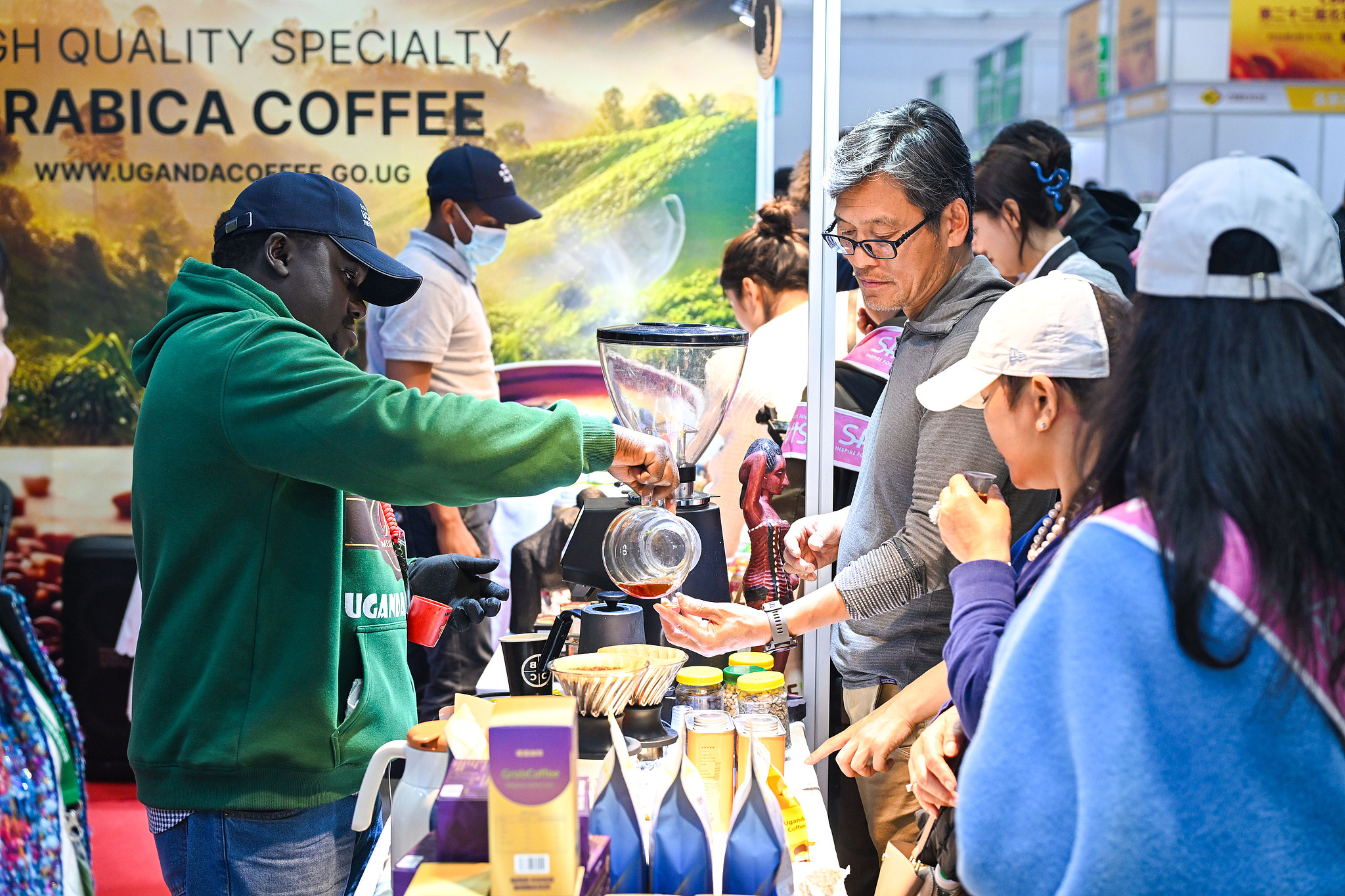
Visitors sample Ugandan coffee during the 13th Beijing International Hospitality, Catering, and Food Beverage Exhibition, in Beijing, China, April 10, 2026. (Photo: CFP)
The latest move from China has been widely praised as a significant step toward further opening up the world's second-largest economy at a time when much of the global trading system is gravitating toward protectionism and narrower market access.
The zero-tariff treatment is a "very timely" move for Africa, which bears the brunt of numerous global crises and faces isolationism and protectionism in the world, African Union Commission Chairperson Mahmoud Ali Youssouf told media last week after the inaugural meeting of the China-Africa Entrepreneurs Summit in Addis Ababa, Ethiopia.
"I would like to express, on behalf of the African Union Commission, our sincere gratitude for this very brotherly gesture that all Africans appreciate," Youssouf said.
China is Africa's largest trading partner. According to China's General Administration of Customs, China-Africa trade hit a record high of 348 billion U.S. dollars in 2025. Of this total, China's imports from Africa amounted to 123 billion dollars, an increase of 5.4 percent year on year.
Tang Xiaoyang, dean of the Department of International Relations at Tsinghua University, said China's zero-tariff initiative, unlike the preferential policies prescribed by some Western countries, does not require reciprocal openness as a prerequisite and attaches no strings to Africa's internal affairs.
"This shows China's respect for African countries and its sense of responsibility in driving common development with them," Tang said.
The professor expects the benefits of this tariff incentive to go beyond a boost in trade. More multinational companies will be tempted to set up assembly or processing bases in Africa to capitalize on the lower costs of exporting to China, thus buoying Africa's manufacturing sector, he noted.
"This zero-tariff policy aligns well with the shared development model that China and Africa have been pursuing for years through infrastructure and industrial cooperation," Tang said.
Zhao Yongsheng, a researcher from the University of International Business and Economics, said Africa's role in the global industrial chain has long been constrained as a supplier of raw materials, and its trade structure -- exporting primary products while importing manufactured goods -- has made industrialization difficult. China's zero-tariff policy, combined with investment and technology transfer, may help the continent break free from this predicament.
The latest tariff exemption also fits well into China's broad opening-up efforts. According to the outline of the 15th Five-Year Plan (2026-2030), China will actively expand opening up and foster an institutional environment that is transparent, stable and predictable. It has also pledged to improve the quality and level of trade and investment cooperation in the years through 2030.
Zhao believes that zero tariffs will facilitate the entry of African products into China, meeting Chinese consumers' surging demand for high-quality goods.
Thanks to streamlined customs procedures and other preferential policies, African products such as Ethiopian coffee beans and South African wine have gained a strong foothold in the Chinese market. Importers now expect the latest move to usher in more African goods and make their prices more competitive.
Hunan Rift Valley Purple, a Chinese company that has invested in a tea processing factory in Kenya, said it plans to import more processed purple tea from the East African nation as the new policy significantly cuts tax costs.
"This will not only increase the income of Kenyan tea farmers, but also bring the unique flavors of high-quality African tea to more Chinese consumers," said Long Sulan, a regional director of the company.