



Illustration of quantum entanglement. (Photos: VCG)
We've all heard that "getting the basics right" is the bedrock of lasting success. And China is doing just that in order to build a better future for its people grounded in scientific progress.
Basic research is the origin of the scientific system and the master switch for all technological advancement. It forms the foundation of innovation, enabling technological self-reliance and advancing China's path toward modernization.
In recent years, China has consistently prioritized basic research within its broader innovation strategy, achieving historic breakthroughs during the 14th Five-Year Plan (FYP) period (2021–2025) while laying a strategic foundation for the 15th FYP to propel future technological advancement.
14th FYP: Historic strides in basic research
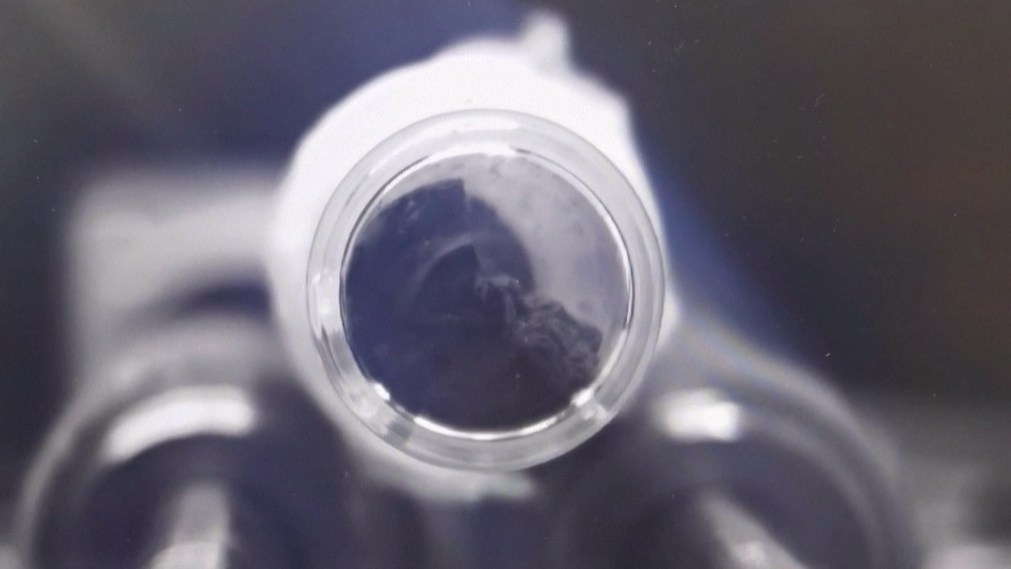
The lunar soil samples brought back by China's Chang'e-6 mission.
During the 14th FYP, China made remarkable progress in strengthening its overall capacity in basic research, with achievements spanning both curiosity-driven exploration and goal-oriented innovation, according to the Ministry of Science and Technology.
In curiosity-driven research, initiatives such as the National Natural Science Foundation supported pioneering studies that produced world-leading results. Notable achievements included the first realization of the fractional quantum anomalous Hall state of photons, providing a theoretical basis for fault-tolerant quantum computing, the first-ever revelation of young magmatic activity on the far side of the moon, refining the framework of lunar evolution, and the development of programmable chromosome-level DNA manipulation technology, realizing precise manipulation of large DNA fragments.
At the same time, goal-oriented research aligned with national priorities achieved breakthroughs in key strategic areas, including a new wireless communication architecture based on information metamaterials supporting 6G technology, green and efficient rare-earth smelting methods facilitating industrial upgrading, and nanoscale confined catalysis advancing energy security and China's dual-carbon goals.
China also strengthened the overall coordination of scientific innovation platforms, reorganizing and optimizing national key laboratories and major research facilities. Academic disciplines developed steadily, with deeper integration of frontier and interdisciplinary fields, further enhancing their international influence. Highly cited Chinese papers accounted for roughly one-third of the world's total, ranking China second globally for four consecutive years.
Talent cultivation played a critical role in the achievements. Between 2021 and 2023, the basic research workforce expanded from 472,000 to 575,000, while the number of highly cited researchers reached 1,405 in 2024, representing 20% of the world's total and a 50% increase over 2021.
China's progress received international recognition. In September 2025, the World Intellectual Property Organization's Global Innovation Index ranked China 10th globally for the first time, topping 36 upper-middle-income economies. Innovation output climbed to fifth worldwide, and innovation input reached 19th. The country hosted the highest number of top 100 global science and technology innovation clusters for the third consecutive year, with 24 clusters among the global top 100. The Shenzhen-Hong Kong-Guangzhou cluster ranked first globally for the first time.
15th FYP: Advancing innovation and self-reliance

Picture by Gong Zhe/CGTN
China's 15th FYP sets a higher benchmark for technological self-reliance. Emphasis will be placed on original innovation, frontier technologies, and the integration of education, science and talent development. Priority initiatives include advancing major scientific missions in AI, quantum technology and other cutting-edge fields, promoting industrial transformation, building world-class innovation ecosystems and strengthening national strategic scientific capabilities.
A diversified investment model, long-term support for leading research teams, and targeted cultivation of young scientists will reinforce the foundation of basic research.
During the 14th FYP, total societal R&D spending grew by an average of 10% annually. In 2025, total R&D investment reached 3.92 trillion yuan (about $568 billion), with an R&D intensity of 2.8%. Funding for basic research reached nearly 280 billion yuan, accounting for 7.08% of total R&D spending, a record high and the first time exceeding 7%.
Over the next five years, nationwide R&D spending is projected to grow by at least 7% annually.
International cooperation will remain a focus of China's strategy. The country has been actively participated in more than 60 international mega-science programs and projects, including China-initiated ones such as ITER, Deep-time Digital Earth and the International Lunar Research Station. It has established collaboration with over 160 countries and regions, with 119 inter-governmental sci-tech cooperation agreements signed.
"China's door to technological collaboration will open even wider," said Yin Hejun, minister of science and technology, reaffirming the country's commitment to deepening international science and technology exchanges and cooperation.