



IT data center server rooms alongside network cabinets of the computing center, Beijing, Decemeber 12, 2022. (Photos: VCG)
On April 27, China ordered a ban on the foreign acquisition of the AI agent company Manus, and demanded that relevant parties immediately terminate the transaction. This marks the first foreign acquisition publicly disclosed in China's AI sector since the Measures for the Security Review of Foreign Investment took effect in 2021.
The deal, first unveiled last December when US tech giant Meta Platforms sought to acquire Manus for over $2 billion (approximately 13.7 billion yuan), was greeted with official pushback and ultimately failed to clear the national security review, in compliance with the 2021 regulations.
Earlier, after the parent company of Manus, Butterfly Effect Technology, completed a $75 million fundraising round in April 2025 and two months after it launched its agentic AI platform, the company relocated its offices from China to Singapore. Meta later put forward a $2 billion acquisition bid.
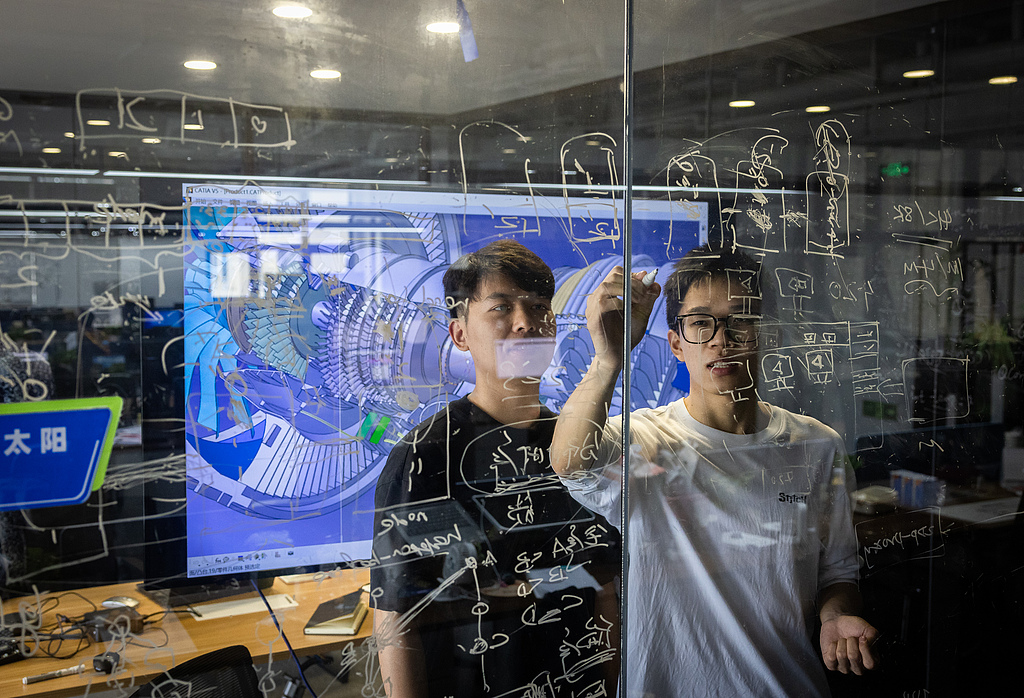
Two staff members of a national high-tech enterprise focusing on hyper-converged cloud computing in Wuhan, Hubei Province, China, June 6, 2023.
As a domestically incubated AI application startup, Manus grew on the strength of Chinese engineers and local infrastructure. The regulatory intervention in this case does not merely focus on a specific legal entity; rather, it deals with what has long been a less addressed area —China's AI firms going global.
In the past, the capital markets had grown on a path where technology was incubated in China, corporate structure was reconfigured offshore, and monetization was done through a sale to US tech giants. China's intervention is not targeted at a single company, but instead serves to formalize previously ambiguous regulatory boundaries — particularly in the emerging field of AI agents. It draws a clear red line: Talent mobility remains permissible, and capital can remain globalized, but core teams engaged in sensitive sector such as technologies must be governed by a compliant regulatory framework.
This regulatory decision further signals China's stance. Firstly, the review and prohibition are grounded in law and therefore carry clear legitimacy. AI agents have been elevated to a national strategic priority and recognized as a core national asset, representing a key interface in the future development of artificial general intelligence. Unlike conventional software, AI agents are designed to autonomously execute tasks such as logging into accounts, calling APIs, running codes, and orchestrating cross-platform operations. As such, they inherently interact with large volumes of user behavioral data, enterprise-level permissions, and cross-border data flows. In any major economy, acquisitions involving such technologies would fall under the highest level of national security scrutiny. Under China's Measures for Security Review of Foreign Investment, the Catalogue of Technologies Prohibited and Restricted from Export, the National Security Law of the People's Republic of China, and the newly revised Foreign Trade Law of the People's Republic of China, the export, cross-border transfer, and related investment activities involving such technologies must undergo security review and assessment and obtain prior approval. The compliance review of the Manus acquisition with respect to export controls, technology import and export regulations, and outbound investment rules conducted by the Ministry of Commerce, together with relevant authorities, is in line with applicable laws and regulations.
Secondly, such regulatory actions align with international practices and are not unique to China. In 2019, the EU introduced the EU Foreign Direct Investment Screening Regulation, explicitly requiring security reviews of factors related to national security and public interest, including access to or control of personal data. In January 2025, the US implemented the Outbound Investment Security Program, restricting US entities from investing in China's key sectors such as AI, semiconductors, and quantum information technology. China's Foreign Investment Law (Article 35) likewise establishes a national security review system, stipulating that decisions made in accordance with the law are final. Besides, China is continuously refining its regulatory framework in alignment with international norms.
Thirdly, intervention in individual cases does not signify a tightening of China's overall business environment. Against the backdrop of intensifying global technological competition and regulatory rivalry, this acquisition dispute is more than a commercial transaction — it reflects a broader reassessment of the boundaries between technology, capital, and national security. Security reviews of technology-related investments are becoming normalized worldwide. While China has historically maintained a relatively cautious approach to foreign investment access, the US has, by contrast, exerted political pressure in cases such as TikTok under a "sell-or-ban" approach.
This regulatory decision clarifies China's boundaries in national securities, reaffirming its commitment to high-standard opening-up, while ensuring that the legitimate rights and interests of foreign investors in China remain protected under the law. Rather than undermining foreign investors' confidence in China, clearer regulatory expectations help to foster more sustainable cooperation, supporting healthier and innovation-driven development of China's AI industry.