


Landbridge, a Chinese-owned company that owns Darwin Port, has launched international legal action to try and stop the Australian government from acquiring the port on so-called "national security" grounds.
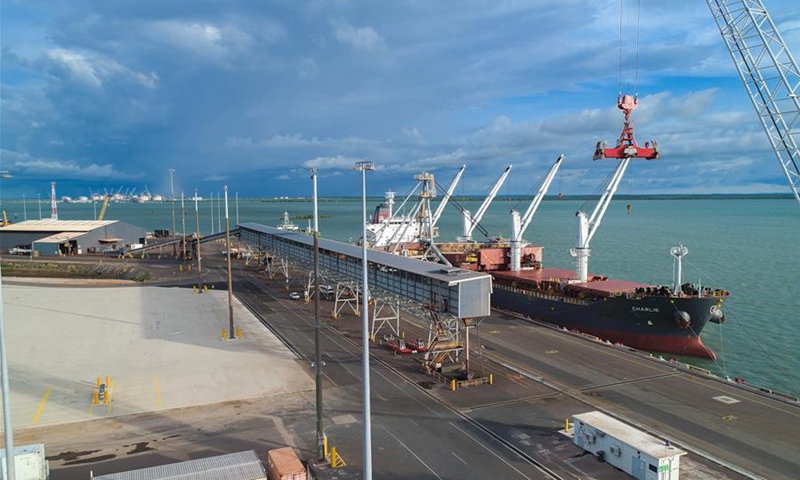
Photo taken on March 14, 2017, shows a bird's eye view of Darwin Port's cargo wharf in Australia. Photo: Xinhua
In a statement posted on its website on Friday, the company said that it considers the Commonwealth's proposed approach to return the Port of Darwin to Australian hands to be discriminatory and inconsistent with Australia's obligations under the China-Australia Free Trade Agreement.
The company said it acquired its interest in the port "through a fair, open and competitive process in full compliance with all applicable Australian laws and regulatory approvals." Multiple Australian Government reviews have confirmed there are no national security concerns.
Having engaged with the Commonwealth in an effort to reach a constructive resolution, Landbridge has regrettably been unable to achieve a satisfactory outcome through dialogue alone and is now taking the necessary steps to protect its legal rights, per the statement.
Australian Prime Minister Anthony Albanese had pledged at the federal election in 2025 that Labor would return the port to Australian hands, saying it was necessary for national security, according to Australian media outlet ABC News on Friday.
The government has since been locked in negotiations with Landbridge as it tries to secure an Australian buyer and has flagged that it is willing to force the company to hand over the port if necessary.
Landbridge Group's filing of the lawsuit with the World Bank's International Centre for Settlement of Investor Disputes is the first time a case has been brought against Australia at the international tribunal, the ABC News report said, citing trade publication Global Arbitration Review.
Chen Hong, director of the Australian Studies Center of East China Normal University, told the Global Times on Saturday that Chinese enterprises' proactive legal action signals that this is more than a commercial dispute over port operating rights - it fundamentally tests Australia's commitment to contractual commitments, the rule of law, and international investment obligations.
"If Australia forcibly reclaims the port without a solid legal basis, it would send a highly negative message: legitimate contracts could be stigmatized as security threats and overturned simply due to political needs. Against this backdrop, the filing of the lawsuit elevates the matter from Australia's domestic political discourse to the framework of international law and investment protection," Chen said.
Once the arbitration proceeds, the Australian government's political promises must be subject to legal constraints and will no longer rely solely on domestic public opinion or security narratives, Chen said.
Before the latest development on Friday, China's Foreign Ministry and Chinese envoy to Australia have expressed firm stance to safeguard the interests of Chinese companies.
China reiterated that the lease of Darwin Port by the Chinese company was obtained through market-based means and that the company's legitimate rights and interests should be fully protected, Chinese Foreign Ministry spokesperson Guo Jiakun said on January 28, when asked to comment on reports suggesting that the Chinese ambassador to Australia had warned of retaliation from Beijing if the Albanese government forces the Chinese company Landbridge Group to divest the Port of Darwin.
China's ambassador to Australia Xiao Qian in January said he questioned the ethics of the Albanese government's efforts to eject Landbridge from the Port of Darwin, arguing that the company had since invested significant money in the facility, according to the Australia-based news outlet AFR.
"Should Landbridge be forced to leave that port, I think it might also affect substantive investment cooperation and trade between Chinese companies in that part of Australia. That is not in the interests of Australia," Xiao was quoted in the report.
In May 2025, Xiao said that it is ethically questionable to lease the port when it was unprofitable and then seek to reclaim it once it becomes profitable during a group media interview, in response to Australian Prime Minister Anthony Albanese's election campaign pledge to revoke the operating rights of China's Landbridge Group over the Port of Darwin.
Xiao noted that a decade ago, the Landbridge Group secured the lease for the Port of Darwin through an open and transparent bidding process, in full compliance with Australian laws and market principles.
If Australia truly values the stability and improvement of bilateral relations, it should avoid turning the Darwin Port issue into a new political flashpoint, especially amid the warming of China-Australia ties and the recovery of economic cooperation, Chen said.
Chen noted that Australia must stop intervening in normal business deals under the pretext of national security and grant Chinese enterprises the with same transparent, predictable treatment as other foreign investors. "Otherwise, Australia will not only bear legal and economic costs through arbitration but also damage its international reputation as an open and reliable investment destination."