


On the first day of the May Day holiday, China's first formally organized traffic management robot squad was officially deployed along West Lake scenic area and surrounding key road sections in Hangzhou, East China's Zhejiang Province, thepaper.cn reported on Friday.
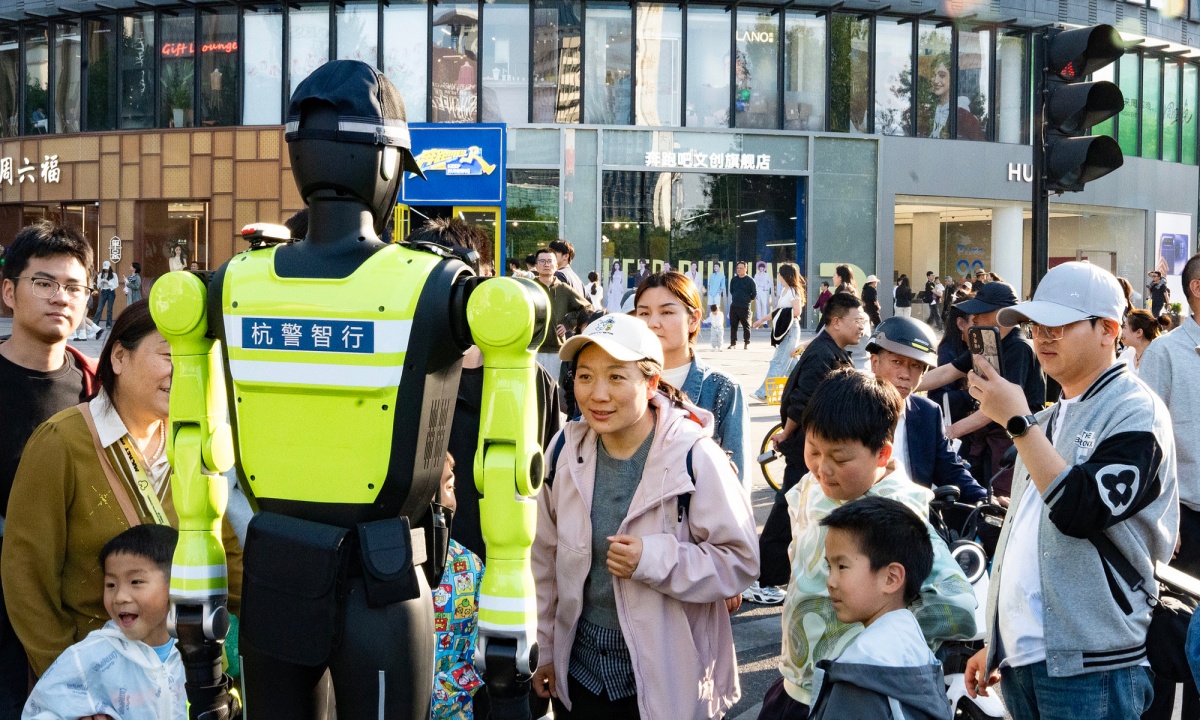
Pedestrians ask a robot traffic management police for directions in Hangzhou, East China’s Zhejiang Province, on May 1, 2026. Photo: CFP
The robot traffic police team consists of 15 intelligent traffic management robots. Their main tasks include guiding non-motorized vehicles and pedestrians away from violations, assisting traffic control, and providing navigation services to tourists. They work in coordination with human police officers to improve overall traffic management efficiency.
Ahead of the May Day holiday deployment, the robot squad had already participated in real-world operations, including traffic support for marathons, gaining operational experience. During the holiday, the robots transitioned from event-based deployment to high-volume holiday traffic management, marking an shift from pilot use to coordinated group operations.
According to the Hangzhou Traffic Police Bureau, the 15 robots have been deployed at key intersections across districts, fully covering key areas such as the West Lake scenic area, lakeside commercial areas and main urban roads. Depending on the functions and scenarios of each intersection, the robots carry out differentiated tasks while working alongside human officers in a new model of human-machine collaboration with complementary strengths..
During holidays, asking for directions is one of the most common needs in the West Lake area. Therefore, the robots stationed there primarily provide navigation services. Visitors can approach a robot and press the "speak" button on its interactive screen to make inquiries. Equipped with a large speech model, the robots can quickly recognize spoken requests and, based on real-time traffic conditions and geographic data, provide optimal walking and public transport routes through voice interaction and on-screen visual guidance.
At key urban intersections, the robots focus on detecting violations by non-motorized vehicles and pedestrians. Equipped with high-performance visual recognition algorithms, they can continuously monitor intersections and accurately identify behaviors such as non-motorized vehicles stopping beyond the line, riders without helmets or carrying passengers illegally, and pedestrians walking or standing in motor vehicle lanes. Once a violation is detected, the robot issues real-time voice warnings. If there is no correction after three reminders, it records the violation and forwards it to the traffic police bureau's early warning center, creating an automated process of real-time perception-precise recognition-immediate warning.
In traffic command functions, the robots are linked in real-time with traffic signal control systems and are equipped with a standardized set of traffic gestures approved by the Ministry of Public Security. They can accurately and smoothly perform eight types of traffic commands, including going straight, stopping and turning left, ensuring synchronization between robot gestures and traffic lights to provide clear and unambiguous instructions for drivers and pedestrians.
According to officials, the primary purpose of establishing the robot traffic management squad in Hangzhou is to free up police manpower. In traditional street-level duty, officers spend long hours on repetitive tasks such as shouting warnings, blowing whistles, and verbal guidance. This is particularly demanding in high-traffic tourist areas. The robots can operate continuously for 8-9 hours per day, effectively replacing these basic and repetitive tasks. Freed up police personnel can then be reassigned to more complex duties requiring human judgment and emergency response, such as rapid accident handling, enforcement against serious violations, and safety hazard inspections.
Chinese netizens in the comment sections of news reports highly praised the application of technology, expressing excitement that "cyberpunk has become reality" and that "technology is changing daily life." They also noted that innovations such as robot traffic police should be promoted nationwide, which can help ease the workload of traffic officers during holiday periods.