


As the risk of disruptions to traditional shipping routes and consequently, global supply chains, continues with the prolonged Middle East and Russia-Ukraine turmoils, the international community is re-evaluating the value of the Belt and Road Initiative.

A satellite view of the Strait of Hormuz between Iran and Oman. (Phot: CFP)
The Trans-Caspian International Transport Corridor, connecting China and Southeast Asia to Europe via Central Asia, was once regarded as a "strategic alternative." But now The Diplomat magazine is calling it "an increasingly necessary component of Eurasian connectivity." The Hambantota International Port in Sri Lanka, previously vilified by some Western media, has expanded amid surging business activity and become a "safe anchor" for regional logistics.
Behind these reversals lies the resilience of the "China solution," grounded in infrastructure connectivity and supported by a robust financial settlement network.
Geopolitical risks have compelled the world to reassess the value of traditional logistics corridors. Since the US-Israel attacks on Iran in February, shipping through the Strait of Hormuz – which carries approximately 20% of global oil supplies – has become precarious, exposing the vulnerability of traditional maritime routes. Data shows that the daily throughput in the strait has plummeted from around 140 vessels pre-war to single-digit numbers, driving up international oil prices and putting pressure on global supply chains.
Due to the conflict, operations at the Hambantota International Port have surged, prompting a new round of capacity expansion, Sri Lanka's Daily Mirror newspaper reported. A key node along the Belt and Road, the port has leveraged its deep-water advantages and operational capabilities to handle cargo transshipment demands diverted from traditional routes, establishing itself as a safe harbor in the Indian Ocean.
Multiple ports developed by Chinese companies with local partners along the Belt and Road, such as Pakistan's Gwadar Port and Greece's Piraeus Port, are also providing safe harbors for global trade during the crisis.
When traditional maritime transport faces delays and soaring costs due to shipping route risks, the time efficiency advantage of the Belt and Road land corridor – a vast network of railways, pipelines, highways, and utility projects connecting China to Central Asia, Europe, and the Gulf – is beginning to reshape the Eurasian logistics landscape.
An article in The Diplomat magazine on April 9 noted that the first trans-Caspian China-Europe freight train journey from Xi'an in northwest China to Baku in Azerbaijan in 2026 took only 11 days – about two months shorter than traditional maritime transport time. This figure not only demonstrates the competitiveness and strategic resilience of the Belt and Road land corridor but also the strategic logic of "time equals security," mitigating shipping route risks through rail transport for stable "door-to-door" delivery.
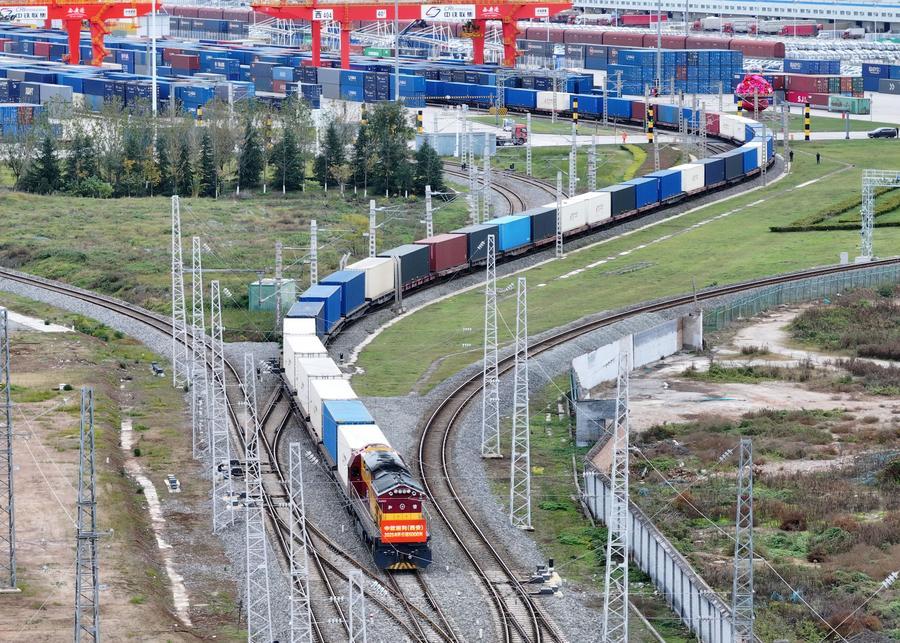
A China-Europe freight train departs from the Xi'an International Port Station in Xi'an, Shaanxi Province in northwest China, November 17, 2025. (Photo: Xinhua)
The interconnectivity of infrastructure is supported by the Cross-Border Interbank Payment System (CIPS), the financial lifeline of the Belt and Road Initiative. It has demonstrated its strategic significance with its daily transactions covering 185 countries and regions and exceeding 920 billion Chinese yuan ($134.7 billion) in March. While traditional cross-border payments face risks such as settlement delays and exchange rate fluctuations due to geopolitical conflicts, CIPS enables "instant fund transfers" through its distributed architecture, standardized interfaces, and intelligent services, providing a dual safeguard for payment and financing in Belt and Road trade.
The development of the digital Chinese yuan cross-border payment platform – through integration with Hong Kong's financial system and cooperation with multilateral central bank digital currency bridges – is expected to further reduce reliance on the traditional US dollar system for international settlements, offering a "China solution" for global trade.
From the surge in business volume at the Hambantota International Port to the timeliness of the Trans-Caspian International Transport Corridor, and the settlement guarantees provided by CIPS, the Belt and Road Initiative is achieving a reversal of its strategic value amid geopolitical challenges. It represents not only the physical connectivity of infrastructure but also a safety net for logistics corridors and a stabilizer for financial settlements amid the current geopolitical risks and globalized demands.
The advancement of civilization has never been a single-choice question but finding optimal solutions through diverse coexistence. As the traditional order wavers due to conflicts, the integrity of the "China-manufactured" industrial chains, the delivery stability of "China-cooperative" initiatives, and the systemic resilience of "China-driven solutions" are delivering irreplaceable "security dividends" to the global value chains.