


URUMQI, May 4 (Xinhua) -- Ili, in northwest China's Xinjiang Uygur Autonomous Region, is often called a land of green valleys and flowing rivers. Framed by the Tianshan Mountains and bordering Kazakhstan, it was once distant and less developed. Today, with growing support including government assistance programs, more young people are looking beyond the mountains and stepping onto a wider stage.
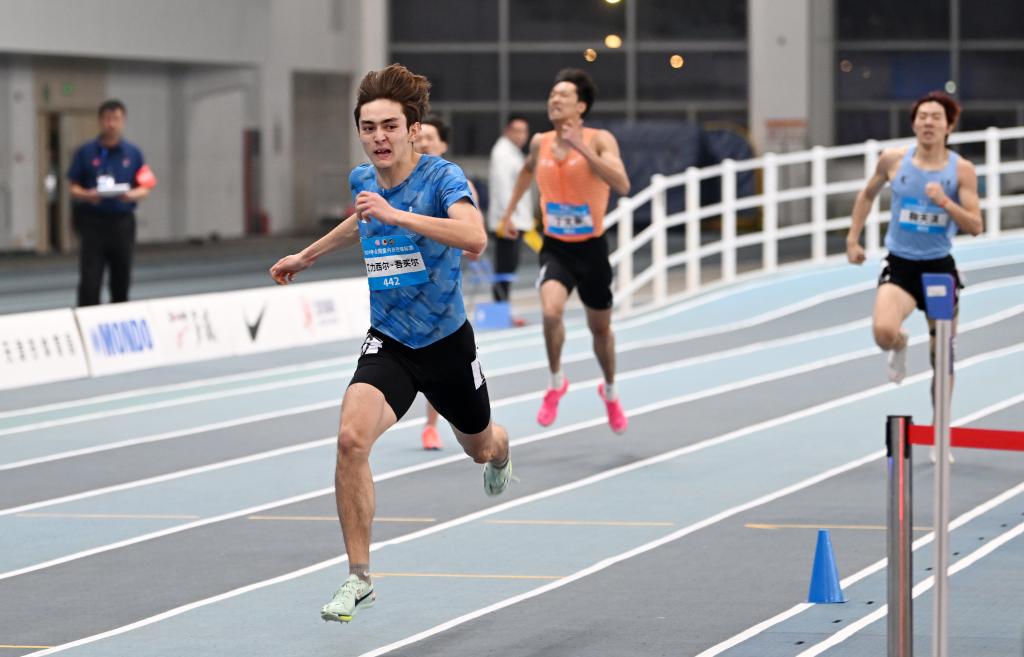
Alixr Omar of Xinjiang competes during the men's 400m final at the Chinese National Indoor Athletics Championships 2024 in north China's Tianjin Municipality, March 31, 2024. (Photo: Xinhua)
For marathon runner Anubek Kuwan, that journey has become a reality, taking him from his hometown to cities across China and onward to Asia, Europe and Africa.
"It feels unbelievable that I can now travel so far and to so many places," Anubek said. "My dream is coming true, but I believe I can go even farther."
RUNNING INTO DREAMS
In April, Anubek set a new course record in Kazakhstan by winning the Almaty Half Marathon, then returned to his hometown of Ili to win another local marathon, as such tightly scheduled races have become routine for him.
"My first time going abroad was because of running," the 30-year-old recalled.
In 2015, he traveled with the Xinjiang track and field team to Kyrgyzstan for competition, where racing alongside athletes from different countries and regions and interacting off the track fueled his ambition.
Anubek began running on a dirt field at a township school, encouraged by his father and supported by school coaching, progressing through disciplined training to win medals at various levels.
In 2018, he joined clubs in cities such as Beijing and Kunming for more scientific training, and in 2022 won the men's title at the Beijing Marathon, as more runners from Xinjiang have formed a growing presence in China's distance running scene.
Last year, Anubek trained in Kenya alongside thousands of elite runners.
"At dusk, when I'm exhausted and looking at the red soil flying beneath my feet, I think of the countryside where I first ran," he said. "Kenyan runners are talented and hardworking. In some ways, we're alike, as running has changed our destiny."
Back in his hometown, Anubek has become a local hero, with his former school inviting him to share his experiences and encourage students to persevere and challenge themselves, while kids gather around him shouting, "Our champion is back!"
"The dusty playground I ran on has been replaced by a standard track," Anubek said. "The new generation has better facilities and more choices, but the spirit of striving forward must never be lost."
YOUNG COACH, BIG CHOICE
On a football field in Ili, coach Zhong Doudou shouts instructions as boys practice passing drills, while a girls' team she has put through penalty laps runs nearby, contrasting with her gentle appearance.
Zhong, a former player from east China's Jiangsu Province, now works as a full-time coach at the Ili Sports School. Two years ago, she answered a government call to support sports development in Ili.
China's "pairing-assistance" program for Xinjiang, in place for decades, has aimed to promote development across sectors including sports, as many local children have natural athletic talent but limited access to professional coaching.
For Zhong, still under 25, the decision meant leaving her family behind. "But I want to provide a few more assists for the kids' future," she said.
Initially drawn by a short-term opportunity, she planned to gain experience while exploring the region but instead found herself immersed in a vibrant football culture of packed village matches and children playing in streets and alleys.
When Zhong began coaching in matches, she admitted feeling more nervous than as a player.
In one crucial match, her team scored twice in three minutes, and she fainted from excitement on the sidelines, before guiding the team to multiple titles, including the Xinjiang Youth Football Championship.
Over time, the players grew attached to her. The captain pleaded for her to stay, promising goals in exchange for her decision, while others even suggested pooling money to pay her salary.
Zhong declined offers from universities and clubs back home, choosing instead to stay.
"The children are pure and sincere. I truly can't bear to leave them," she said.
In the past three years, Zhong's hometown, Jiangsu, has organized large-scale youth football exchanges with Ili, the counterpart aid region, while also investing heavily in improved sports infrastructure.
"Not every child will become a professional athlete," she said. "But football gives them courage, resilience and vision to light their path forward."
LESSONS IN TAIJI
At Tekes No. 1 High School in Ili, physical education teacher Hauziyat Sieran moves easily between football drills, group exercises and the slow, deliberate motions of Taiji.
In Tekes, a small county, sport is more than competition. It is a way to shape character, connect cultures and guide youth as they come of age.
Tekes is known across China for its distinctive urban layout. Planned by local officials in the 1930s, the town gradually developed into a complete "Bagua" city, its streets radiating in patterns inspired by traditional Chinese philosophy.
More than 30 ethnic groups, including Han, Kazakh, Mongolian and Uygur, live here, where about 8,000 residents regularly practice Taiji, a traditional Chinese discipline with a long history. At the central square, people gather to stretch, breathe and move in unison, weaving it into daily life.
"Given Tekes' unique layout and its connection with Chinese culture, we hope to encourage more participation," said Shakenaily Manasi, a local culture and sports official. "It is not only about fitness, but also a natural way to understand Chinese culture."
On campus, the practice has taken on a deeper meaning.
For Hauziyat, Taiji is a way to cultivate calm. Once quick-tempered, he began to rethink his approach after becoming a homeroom teacher in 2019 and taking responsibility for more than 50 teenagers, learning to slow down, and balance firmness with flexibility.
"Every movement in Taiji reflects balance, mutual support and inclusion," he said, referring to the balance of yin and yang.
In his class, students from six ethnic groups and diverse family backgrounds learn side by side. He hopes they can embrace differences and build unity.
"I tell them that being a person is like practicing Taiji," he said. "You need to calm your mind and stand firm, find balance through respect and learn unity through inclusion."
That strength is quietly taking root in places like Tekes.
For Madina Sadatbek, the influence is personal. Drawn to traditional Chinese culture, she often practices Taiji with her classmates on the school field, moving through each posture with growing confidence. During summer breaks, she speaks with visitors from across the country, learning about the wider world beyond her hometown.
The 16-year-old also dreams of the future. "I hope to attend university in Shenzhen, a city known for its strong tech sector, and explore a broader horizon," Madina said.