


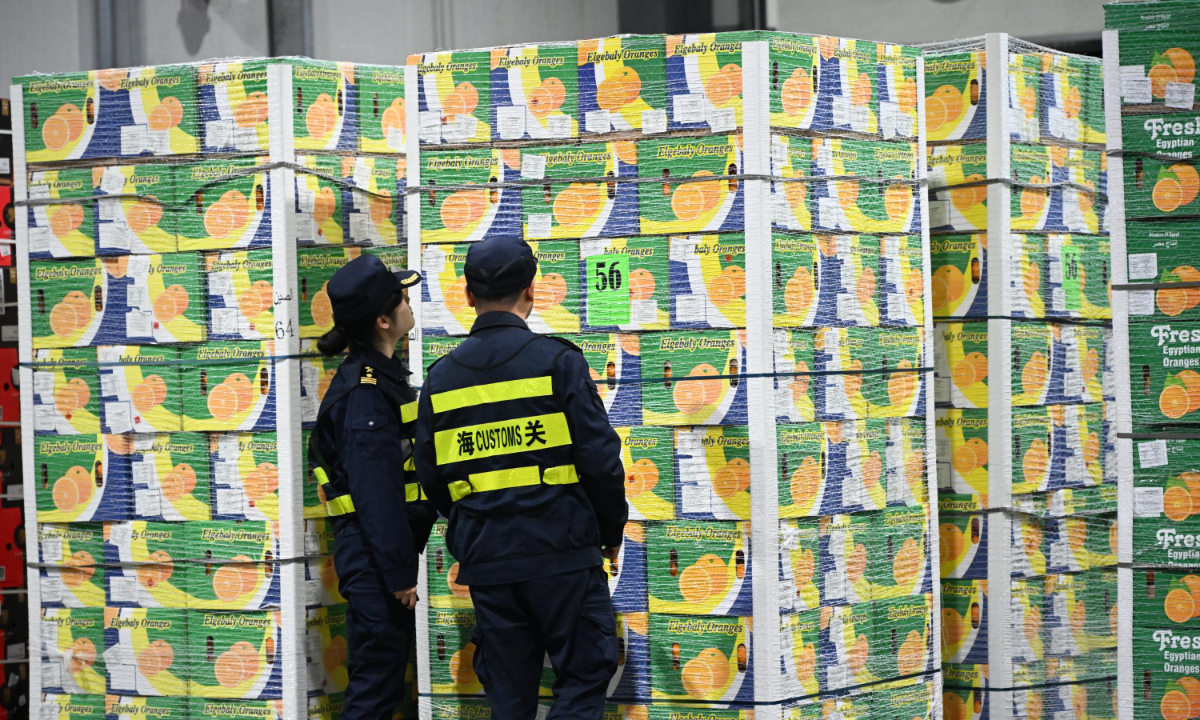
Fresh oranges from Egypt, among the first imports to benefit from China's zero-tariff policy for all African countries with diplomatic ties, clear customs at the Waigaoqiao Free Trade Zone in Shanghai on May 1, 2026. (Photo: VCG)
China’s decision to extend zero-tariff treatment to all African countries with diplomatic ties sends a strong signal of support for multilateralism and fair trade at a time of rising protectionism, while opening wider opportunities for Africa’s exports, industrial upgrading and poverty reduction, a former senior Ethiopian official told the Global Times.
Arkebe Oqubay, a former Senior Minister and Special Adviser to the Prime Minister of Ethiopia, said in an exclusive interview with the Global Times that the policy is particularly meaningful as sweeping US tariffs and growing protectionist pressure globally are adding strains to Africa’s trade position, with many African economies continuing to face trade deficits with some developed markets.
“China’s zero-tariff position reinforces multilateralism and free trade,” Oqubay said, noting that the treatment will encourage more African exports to China, help improve the balance of trade and unleash the full growth potential of bilateral trade, while contributing to trade diversification.
Oqubay, now a British Academy Global Professor at SOAS University of London, noted that the resulting trade expansion will strengthen African countries’ capacity for growth and poverty reduction, as many of their exports are agricultural products that support farmers’ incomes.
Starting May 1, China has granted zero-tariff treatment to 20 African countries with diplomatic ties with China that are not classified as least developed countries (LDCs), following its tariff removal on all tariff lines for imports from 33 African LDC with diplomatic ties since December 1, 2024.
With the latest step, China becomes the world’s first major economy to unilaterally grant tariff-free treatment to all African countries with diplomatic ties, according to the Ministry of Commerce (MOFCOM).
The policy has already entered the operational stage. In the early hours of Friday, 24 tonnes of South African apples became the first batch of imports to enter China under the expanded zero-tariff arrangement after clearing customs in Shenzhen, South China’s Guangdong Province, Xinhua reported.
For African exporters, Oqubay said the most immediate gains are likely to be seen in sectors where the continent already has strong export potential.
“These mainly include agriculture, which has diverse sub-sectors such as livestock, oilseeds and horticultural products,” he said. “The broader mining sector will also benefit, including exports of precious metals, industrial minerals and critical minerals to China.”
But the policy’s longer-term value, Oqubay said, lies in helping Africa move beyond its current reliance on primary exports and build greater capacity in processing and higher-value production.
“It will also encourage exports related to services and value-added goods, which are currently limited,” Oqubay said. “Such value-added exports promote Chinese overseas investment in Africa and contribute to employment creation.”
To seize those opportunities, some African countries are already moving to prepare their exports for the vast market opportunities created by the policy.
In Kenya, Cabinet Secretary Lee Kinyanjui said the country must “urgently bridge the readiness gap,” as the government scales up support through agencies such as the Kenya Export Promotion and Branding Agency to train exporters, facilitate certification and connect companies with Chinese buyers, Kenyan newspaper The Star reported.
South Africa has also moved to align customs procedures with the new policy. Its Department of Trade, Industry and Competition is working with the South African Revenue Service to finalize customs procedures and legislative adjustments required for issuing the new certificates of origin, Xinhua reported on Sunday.
South African Minister of Trade, Industry and Competition Parks Tau said on Friday that China’s new zero-tariff policy will significantly enhance South Africa’s export competitiveness and create unprecedented opportunities for market expansion, according to Xinhua.
Beyond the immediate boost to exports, Oqubay said, broader access to the Chinese market could generate wider “spillover effects” across manufacturing, agriculture and minerals-based industries for African economies.
“The zero-tariff treatment will contribute to increased investment in manufacturing and value addition based on inputs from agriculture and mineral resources,” Oqubay noted.
He added that stronger export growth could also ease long-standing macroeconomic bottlenecks. “It also contributes to the expansion and diversification of exports, which helps relax the constraints of balance-of-payment pressure and foreign exchange shortages,” Oqubay said, noting that the policy could also help develop productive capacity across the continent.
China’s landmark move has also been seen as a boost to openness and Global South cooperation. African Union Commission Chairperson Mahmoud Ali Youssouf hailed the policy as “very timely” for a continent bearing the brunt of global crises and vulnerable to isolationism, Xinhua reported.
While some major economies are raising trade barriers, China is opening its market to create wider development space for partners in the Global South, Oqubay said.
Such openness will also add momentum to China-Africa collaboration in sustainability and green energy, “as energy affects all sectors including commercial farms, industrialization and transportation,” he noted.
As protectionism and unilateralism are on the rise, and continents near the Middle East are hit by spillovers of the situation there, China shares opportunities and pursues common development with Africa through the zero-tariff policy, and contributes to global peace and development with greater stability in China-Africa ties, Chinese Foreign Ministry spokesperson Lin Jian said on Wednesday.
China will continue to sign agreements on economic partnership for shared development with African countries and at the same time upgrade the “green lanes” for import of African agricultural and food products to China, so as to further improve China-Africa trade facilitation, Lin said.