


"I am not a revenge seeker. I have no intention of charging the Japanese people with the blood debt owed by Japanese militarism. However, I believe that forgetting past suffering may lead to future disasters."
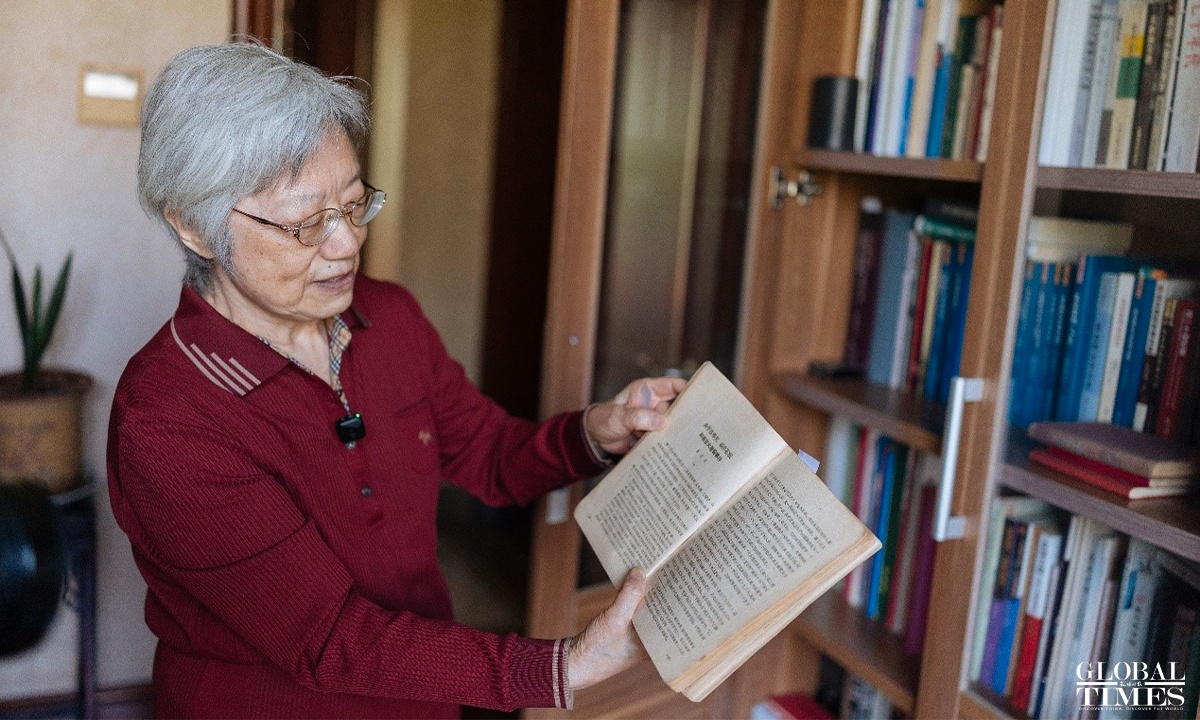
Mei Xiaokan, daughter of Chinese judge Mei Ru'ao at the Tokyo Trial, shows her father’s memorable words to the Global Times reporter at her home in Beijing on April 21. Photo: Li Hao/GT
On the 80th anniversary of the opening of the International Military Tribunal for the Far East (IMTFE, also known as the Tokyo Trial), Mei Xiaokan - daughter of Chinese judge Mei Ru'ao at the Tokyo Trial and China's first female Doctor of International Law - shared these words, written by her father and long since woven into her very being, during an exclusive interview with the Global Times. Her words reflected not only a profound tribute to her father, but also a steadfast commitment to safeguarding historical memory.
In the early 1960s, a tiny handful of right-wing elements in Japan brazenly erected monuments and compiled hagiographies in Nagoya for seven Class-A Japanese war criminals - including Hideki Tojo and Iwane Matsui - who had been sentenced to death by the International Military Tribunal for the Far East, glorifying these war criminals steeped in blood as "martyrs" and "national heroes." Drawing on the first-hand evidence he had gathered during the Tokyo Trial, Mei Ru'ao authored the seminal article On Tani Hisao, Iwane Matsui, and the Nanjing Massacre, documenting the atrocities committed by these two chief criminals behind the massacre. Published in October 1961 in the 22nd volume of the Selected Historical Materials, this article became a powerful weapon rebutting Japan's right-wing forces.
Seventy-six-year-old Mei Xiaokan has a gentle, refined appearance and a warm, approachable demeanor. She told the Global Times that she first read the words when she was a sixth-grade elementary school student, and as a young pupil, she could not fully grasp the gravity of the word "disasters," but she felt her father's tone in the book was exceptionally serious.
The weight of those sentences and the image of her father remain vivid more than half a century on. That maxim from the old book serves as a silent bond, linking the solemn moments of the International Military Tribunal for the Far East with the quiet hours in a tranquil study in Beijing.
"My father believed that if he could not properly punish war criminals, he would have no face to meet his countrymen. Through his persistence and reasoned arguments, the judges eventually sentenced seven Class-A war criminals to death," she said.
"That book stayed with me for a long time. I read it over and over again. Now I deeply regret that I did not talk more with my father about what he experienced back then. I was simply too young at the time and did not have a profound sense of history. Young people tend to think more about what they will do in the future, without realizing how history relates to us or what role our parents played at a certain moment in history."
As one grows older, the feeling becomes more personal. "Now I realize that historical events are connected to myself. In the long river of history, we are just a fleeting moment. We ourselves will soon become history. History and reality are often inseparable - they form one continuous process. My father played his role at that critical moment, and we really should learn about him. If we as descendants do not understand him, others will be even less likely to," Mei Xiaokan said.
In her memory, her father always kept a diary. It is precisely this habit that allows later generations to access this period of history. The only surviving diary manuscript of Mei Ru'ao covers the period from his arrival in Tokyo on March 20, 1946, to May 13 of that year. Spanning more than 200 pages and over 50,000 characters, with some days missing or incomplete, it captures the first 50-plus days of the Tokyo Trial. While not a comprehensive record, it records the most authentic inner journey of Mei Ru'ao as a direct participant - powerful testimony to his unwavering pursuit of justice and a lawful trial.
Every page is a fragment of history. It includes unvarnished records of the first four court sessions, describing the entry of the 28 major war criminals. Mei noted Hideki Tojo looking "like a plaster statue," Kenji Doihara with his "plump, round face," and paying special attention to Seishiro Itagaki, writing "I must watch him more closely." It also reveals Mei Ru'ao's righteous indignation upon first seeing the group of war criminals in court. These entries serve as a stark reminder to later generations: history must be recorded truthfully, and justice must be upheld, and the historical view of World War II must not be distorted or tampered with.
After the court hearings ended in April 1948 and before the verdict was issued in November, there was a six-month period when the judges worked behind closed doors to draft the judgment and determine the convictions and sentences. "The judgment was very long and detailed, and a large part concerning Japan's aggression against China was drafted by my father," she said.
"Many judges initially knew little about China or the atrocities committed by the Japanese army there. My father kept communicating with them, explaining the War, Chinese culture, and the land and people of China, so they would develop feelings for China and its people. In the final crucial moments, he gave everything to win their support, ensuring that the war criminals received the punishment they deserved," she added.
Mei once worked at a US law firm and later served as legal counsel for a multinational corporation for many years. She retired in 2010 at the age of 60. After retirement, she joined the Center for the Tokyo Trial Studies at Shanghai Jiao Tong University (now Research Institute of War Trial and World Peace), where she has been engaged in translating and proofreading historical materials and related writings.
She believes that rescuing and preserving history is an urgent task. "The elders are gone. In studying and remembering history, translation is extremely important. We need to make better use of foreign historical materials, introduce overseas research achievements to China, and present domestic research to the world."
Among all her translation and compilation work, she considers the book her father began writing in 1962, The International Military Tribunal for the Far East, the most precious. "I remember him working at his desk, but at the time I didn't know what he was writing. The manuscript was retrieved by my brother from the Ministry of Foreign Affairs. My father did not have time to finish it. Later, when I went abroad, my brother handled the editing and compilation."
The book is included in The Tokyo Trial Manuscripts of Mei Ru'ao and Personal Accounts of the Tokyo Trial. Speaking of the manuscripts, which she values the most, Mei said, "While compiling it, reading my father's articles made me feel as if I were with him. Although he did not tell us much about the Tokyo Trial when he was alive, his writings seem to tell us everything." In the foreword to the book, Mei Xiaokan and her brother Mei Xiao'ao wrote a deeply moving piece titled "In Memory of Our Father."
"The Tokyo Trial and the Nuremberg Trial together set a precedent by clearly defining aggressive war as a crime under international law. Through these two trials, the crime against peace was established, and individuals must bear criminal responsibility. One cannot escape liability by citing state acts, official position, or superior orders," Mei Xiaokan said. "We use institutional arrangements and intellectual understanding to prevent crimes in history from happening again, to promote civic responsibility, to improve society, and to help the world move toward peace."