


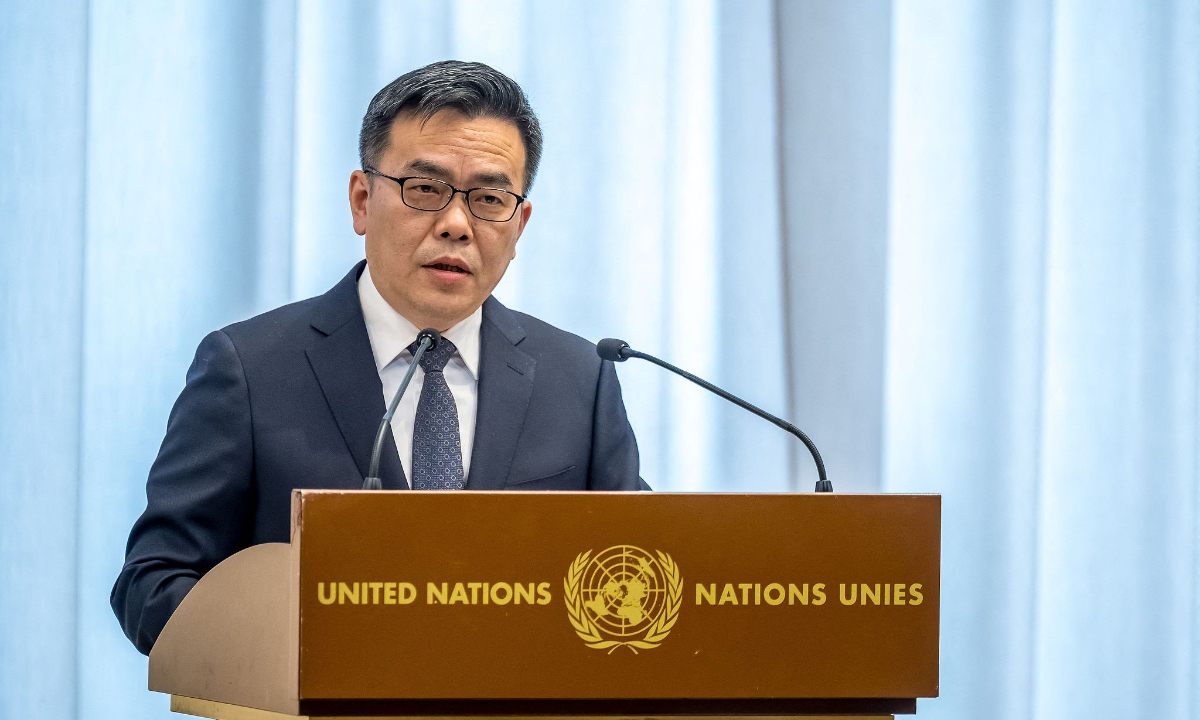
China's ambassador Shen Jian Photo: VCG
Stepping up its diplomatic efforts, China has once again sounded the alarm at the United Nations over Japan's potential nuclear ambitions, urging the global community to remain highly vigilant.
The warning was delivered Monday in New York by Shen Jian, China's Ambassador for Disarmament Affairs, during a review conference on the Non-Proliferation of Nuclear Weapons (NPT). Highlighting China's rising unease, this marks the third time in recent days that China has used the UN stage to call out Tokyo's nuclear-related developments.
Chinese experts point out that the UN-centered international system, combined with Japan's pacifist Constitution and its "three non-nuclear principles," are hard-won triumphs of World War II. China's persistent warnings at the UN, analysts say, reflect its determination to safeguard that postwar order and preserve global stability.
They added that, as this year marks the 80th anniversary of the beginning of the Tokyo Trial, Japan's recent maneuvers - from constitutional revision efforts to shifting nuclear policies - signal a dangerous drift toward neo-militarism. By actively raising the alarm at the UN, China aims to awaken the international community to Tokyo's attempts to shed its post-WWII constraints, while simultaneously applying deterrent pressure on Japan's emboldened right-wing factions.
Frequent mentionsShen on Monday outlined China's position on preventing nuclear proliferation, stating that certain countries are pursuing double standards on non-proliferation, thereby undermining the authority of the treaty and the safeguards and supervision system of the International Atomic Energy Agency (IAEA), according to the website of the Permanent Mission of China to the UN.
Shen specifically pointed to Japan's recent negative developments regarding nuclear armament, stressing that the international community should remain highly vigilant.
In recent years Japan has made a series of negative moves and statements regarding the possession of nuclear weapons, including promoting the revisions to the pacifist Constitution and the "three non-nuclear principles," seeking the deployment of nuclear weapons by allies on its territory, Shen said.
Shen said that China firmly opposes the proliferation of nuclear weapons, advocates the comprehensive, faithful and balanced implementation of all obligations under the NPT, and stands ready to work with the international community to uphold and strengthen the international nuclear non-proliferation regime with the treaty as its cornerstone.
Shen's remarks are not the first at the UN in recent days. On April 29, Sun Xiaobo, director-general of the Department of Arms Control of China's Foreign Ministry, also warned at an NPT review conference that the international community should remain highly vigilant and resolutely curb attempts by certain countries to acquire nuclear weapons, according to the website of the Permanent Mission of China to the UN.
In a separate statement at the NPT review conference on April 29, the Chinese delegation listed several concerns, including Japan's status as a "threshold nuclear state," its possession of reprocessing technology, and its ability to extract weapons-grade plutonium. Japan currently holds about 44.4 tons of separated plutonium under domestic and international management, far exceeding civilian needs, according to the website of the Permanent Mission of China to the UN.
The delegation warned that Japan's stance on non-proliferation is contradictory: while portraying itself internationally as a victim of nuclear weapons and an advocate of a nuclear-free world, it has strengthened reliance on extended deterrence and shown eagerness to replicate "nuclear sharing" arrangements.
Xiang Haoyu, a distinguished research fellow at the China Institute of International Studies, told the Global Times on Tuesday that China's repeated warnings at the UN aim to draw international attention and apply moral and rules-based pressure to deter Japan's nuclear ambitions.
"The international community, especially regional countries, should remain alert to early signs of risk and right-wing adventurism, and take preventive measures," Xiang said.
Key historical junctureChina's repeated references to Japan's nuclear issue at the UN come at a critical historical moment - the 80th anniversary of the beginning of the Tokyo Trial. Chinese experts said Japan's push toward neo-militarism around this time reflects a failure to fully reflect on its wartime crimes, and that the international community must act decisively to prevent any resurgence of militarism.
On May 3, 1946, pursuant to the terms of Japan's unconditional surrender and the IMTFE Charter issued by the Supreme Commander for the Allied Powers, the International Military Tribunal for the Far East (IMTFE) began prosecutions, a Chinese Foreign Ministry spokesperson said on Sunday, according to the ministry's website.
The Tokyo Trial was held to implement the Cairo Declaration and the Potsdam Proclamation and embodied the collective will of both the victorious nations and the victimized peoples. Through the trials, the purposes and principles of the UN Charter were upheld, and the fruits of victory in WWII were honored, according to the Foreign Ministry spokesperson.
Accepting the judgment of the Tokyo Trial was the prerequisite for Japan's postwar return to the international community. Eighty years on, however, to people's indignation, the specter of Japanese militarism remains and continues to breed. Japan's right-wing forces are still trying every possible means to deny and distort the judgment of the Tokyo Trial and the irrefutable evidence, and even whitewash the crimes committed during the war of aggression, including by revising history textbooks and indoctrinating the Japanese people with a wrong perception of history, said the spokesperson.
As a defeated nation in WWII, Japan should remain bound by its pacifist Constitution and "three non-nuclear principles," limiting its military posture to exclusive self-defense and adhering to the UN-centered international system, Lü Chao, a professor at the Liaoning Academy of Social Sciences, told the Global Times on Tuesday.
"Japan moving toward nuclear armament would be a very dangerous trend for the international community," he said.
Lü warned that some countries, driven by self-interest, appear to tolerate or even encourage Japan's expanded military role in the Asia-Pacific, which risks repeating historical mistakes.
"Such trends are dangerous. Pre-WWII appeasement of militarism led to its rapid expansion and ultimately catastrophic consequences," Lü said.
"We must remind the international community not to forget the lessons of history. Especially on nuclear development, Japan has no qualification to pursue nuclear weapons. Any such moves should be firmly stopped," Lü said.
Beyond nuclear issues, Japan has also taken controversial steps in military issues. According to Japanese media outlet Mainichi Shimbun, a newly unveiled logo by a Ground Self-Defense Force regiment sparked widespread criticism online for being "militaristic," leading to its withdrawal within three days.
The design featured an elephant in camouflage holding a rifle, with blue flames appearing in the background and in its left eye. A human skull was also depicted on the elephant's left chest, prompting online criticism that the imagery appeared "militaristic," according to a report by Mainichi Shimbun.
"Please stop using a logo that looks like it represents a military for killing people. The once gentle image of the Self-Defense Forces has collapsed," one comment read. "I have always felt gratitude and respect toward the Self-Defense Forces, but I was shocked. Has an atmosphere that allows such aggressive logos to emerge already spread?" harsh reactions alike abound online, the report said.
Earlier, responding to a Global Times question on April 30, regarding Japan's plan to revive WWII-era military rank titles in the Self-Defense Forces, Chinese Foreign Ministry spokesperson Lin Jian said that such changes are not merely technical but carry historical and political implications.
After WWII, as a defeated nation, Japan was required to disarm its military forces and dismantle its war machine. Several years later, in 1954, when establishing the SDF, Japan chose to name the ranks using numbers and stopped using the military-style ones used in the old army. Many in Japan believe that by adopting a non-military-style rank system, Japan intended to make a clear cut with the wartime military in line with the spirit of the pacifist Constitution. It shows that the rank titles are absolutely not just a technical issue for Japan, Lin said.
In recent years, however, Japan has been pushing for a more offensive, expansionist, and dangerous defense policy and has torn up its "pacifist" rulebook. Japan's latest move to reinstate WWII military ranks out of "a sense of honor" is a breach of long-existing rules and will instill a wrong perception, Lin said.