


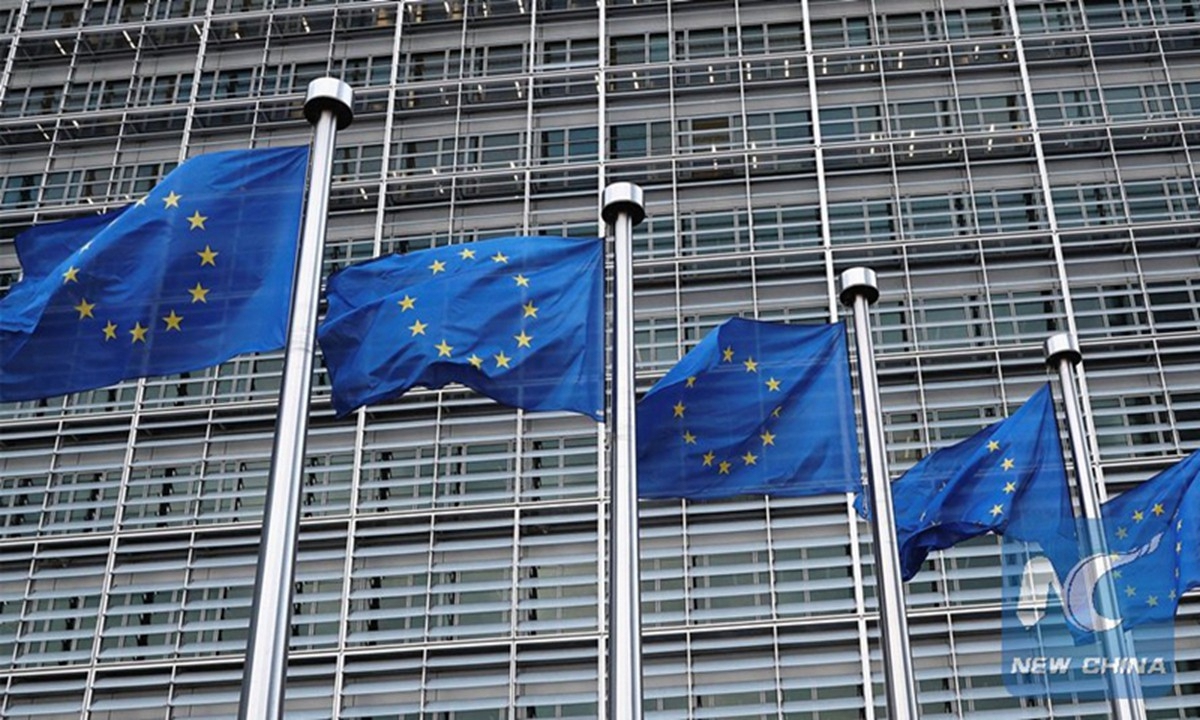
The European Union flags in front of EU headquarters in Brussels, Belgium. (Photo: Xinhua)
The EU's proposed revision of the Cybersecurity Act (CSA2) could carry a price tag of nearly €367.8 billion ($431.5 billion) if it forces the replacement of Chinese suppliers across 18 critical sectors, a report that the China Chamber of Commerce to the EU (CCCEU) sent to the Global Times on Wednesday showed.
The report came as the European Commission (EC) proposed a new cybersecurity package including a "Proposal for a Regulation for the EU Cybersecurity Act" on January 20, which aims to gradually phase out components and equipment from "high-risk suppliers" in critical infrastructure. This move is widely seen as targeting Chinese companies and forms part of a broader set of EU protectionist tools targeting China. A Chinese expert on Wednesday said that the bloc's moves once again highlight the EU's growing tendency to politicize economic and trade issues, warning that it will inevitably disrupt and undermine the atmosphere of China-EU economic and trade cooperation.
The report, released by the CCCEU and KPMG, estimates cumulative economic losses of €367.8 billion over five years for EU member states — equivalent to nearly two full years of the EU's annual budget — if mandatory replacement is enforced across sectors including energy, telecoms, manufacturing and financial infrastructure.
The report warns that proposed CSA2's mandatory replacement provisions take no account of differences among member states in industrial structure, fiscal capacity and digital readiness. The result would be highly asymmetric economic pain.
Six countries would face losses above €10 billion: Germany, France, Italy, Spain, Poland and the Netherlands. Germany would bear the heaviest burden at €170.8 billion — reflecting the sheer scale of its industrial base and its deep integration with Chinese supply chains across manufacturing, telecoms and energy. France would follow at €46.3 billion, then Italy at €36.5 billion, Spain at €25.7 billion, Poland at €21.3 billion and the Netherlands at €20.1 billion, according to the report.
In addition, the report notes that there is no substantiated evidence to date of a "technical backdoor" or violation of EU cybersecurity rules by Chinese companies operating in the EU.
Over the past decades, China and the EU have developed extensive industrial linkages in green transition, digital infrastructure, intelligent manufacturing and energy efficiency. These linkages have contributed to the EU's goals of economic competitiveness, digital transformation and the green transition, the report says.
The report calls on EU institutions to return to technological neutrality, evidence-based regulation, proportionality and non-discrimination. "We firmly oppose a one-size-fits-all, mandatory exclusion policy. Rational dialogue, not security-driven decoupling, should guide cooperation between China and the EU in key industries," Liu Jiandong, Chairman of CCCEU, was quoted as saying in the report.
"The proposed revision of the CSA2 forms part of the EU's moves to politicize its economic and trade issues with China. However, these measures will not only cause economic and technological harm to EU itself, but will also negatively affect and disrupt the atmosphere of mutually beneficial and win-win cooperation between China and Europe," Cui Hongjian, professor at the Academy of Regional and Global Governance at Beijing Foreign Studies University, told the Global Times on Wednesday.
Cui noted that the CSA2's mandatory replacement provisions would lead to high equipment replacement costs. Moreover, new suppliers may charge higher prices while offering relatively lower quality or performance. Overall, this is not cost-effective from either an economic or technological perspective.
Previously, China's Ministry of Commerce (MOFCOM) responded that the proposed revision would cause substantial harm to China-EU economic and trade relations, deliver a severe shock to global production and supply chains, and inevitably hinder the EU's own digital and green transformation processes.
In addition to the proposed revision of the CSA2, the MOFCOM on April 27 expressed China's position and serious concerns over the EU's Industrial Acceleration Act (IAA), which imposes restrictive requirements on foreign investment in four key strategic sectors - batteries, electric vehicles, photovoltaics and critical raw materials - and introduces "EU-origin" clauses in public procurement and support policies, constituting significant investment barriers and institutional discrimination, said the MOFCOM.
An insider told the Global Times recently that if the EU continues to escalate protectionist measures, China has a broad policy toolkit. "China is neither unfamiliar with nor afraid of trade frictions," the insider said, adding that any escalation would harm both sides, disrupt global industrial and supply chains, and weigh on global growth," the insider said.
"EU's recent actions represent a continuation of its institutions' established policy direction. However, some European countries are beginning to return to a more rational approach at the bilateral level, placing greater emphasis on market principles and real economic interests, and expressing a willingness to maintain cooperation with China," Cui said.
For instance, Spanish Prime Minister Pedro Sanchez visited China in April, his fourth trip since 2023. Leaders from France, Finland and Germany have also visited China in late last year or early this year.
"While Brussels prioritizes regulatory tools and risk control, member states continue to emphasize supply chain resilience and economic interests, rendering decoupling from China an unrealistic prospect," Cui said, urging the EU to respect the willingness of both sides to cooperate based on mutual needs, creating a fair environment and a positive atmosphere for further deepening economic and trade cooperation.