


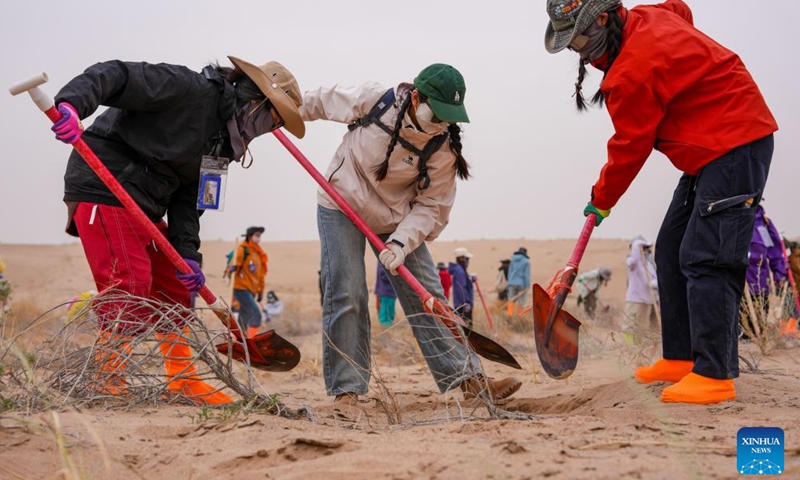
Volunteers from Hunan and Jiangxi provinces dig a pit for water storage at the Zhonglin ecological public welfare forest base of Minqin County, northwest China's Gansu Province, April 20, 2026. (Photo: Xinhua)
For years, Western media have had a fixed narrative about Chinese youth: They are either the "lying flat" generation crushed by intense competition, or "sophisticated egoists" lost in consumerism and digital entertainment. Some outlets even interpreted the "Buddhist" attitude of young Chinese as a collective slump into cynicism and withdrawal.
But the saplings in Minqin, Northwest China's Gansu Province, a county known as a place about to be swallowed by sand, reveal another side that deserves more attention. The young people from all over the country are much more down-to-earth than any individualistic Western narrative can capture. Just after the May Day holidays, while most people were still reminiscing about their trips, a group of young people quietly returned from the desert in Minqin.
Instead of posting polished travel selfies, they showed off sunburned skin and blisters on their palms. They spent their holidays - a time usually reserved for sleeping in, sightseeing or binge-watching TV shows - out in the desert, maintaining the saplings of Haloxylon ammodendron (a desert shrub) that had been planted earlier that spring.
I went there in May a few years ago. The wind and sand in Minqin were still fierce. Yet, a large number of young people made the journey - at their own expense and entirely voluntarily - to this oasis nestled at the northeastern tip of the Hexi Corridor, squeezed between the Badain Jaran and Tengger deserts. They crouched beside saplings planted last year or the year before, checking survival rates, replacing broken pipes, and getting things ready for the scorching summer ahead.
In 2025 alone, the campaign inviting people to come to Minqin to plant trees attracted about 41,000 volunteers. In spring 2026, online registrations surpassed 33,000. Over the years, volunteers have planted more than 1 million drought-tolerant plants in Minqin. The average survival rate of new saplings has hit an astonishing 85 percent. Minqin county's forest coverage has risen from 3 percent in the 1950s to 18.28 percent in 2022. A 380-kilometer green belt along the edge of the oasis has taken shape, successfully holding back the merger of two major deserts.
I have seen plenty of grand state-led projects, but this kind of grass-roots desert-control success - achieved by young people shoveling sand on their holidays - truly moves me. So what drives them?
I read a story online about Jiao Lina, a young woman from Xining, Northwest China's Qinghai Province. As a senior college student, she went to Minqin for the first time in 2025 and spent a month in the wind and sand. A year later, she returned on March 8, the International Women's Day, marking it as her "anniversary" with the desert.
Looking at the Haloxylon trees she had planted the previous year, she said, "Watching life grow - it's just like us. Taking root slowly, growing slowly. Just surviving, being strong, that's already something remarkable."
This spirit may be hard for Westerners to fully grasp. It's not about the collective swallowing the individual, nor is it pure individual heroism. It's a spontaneous "communal action" rooted in shared goals and emotional bonds.
Planting trees in Minqin also punctures another common Western stereotype: That young Chinese don't care about public affairs.
In the Western view, caring about the environment, climate change or social justice means taking to the streets with signs. But those young people don't go in for slogans; they do the work. Instead of reposting on social media, they'd rather buy a train ticket to Minqin, dig a hole in the sand, plant a seedling and make that small patch of land a little bit better.
This is an extremely pragmatic philosophy of action, yet underneath it lies a deep-seated sense of connection to their country - not nationalistic slogans, but the quiet belief that their own hands can make one corner of their country a little less barren.
Sometimes I think: If those Western commentators who love to slap labels on young Chinese could actually visit Minqin, if they could see in the evening before the end of the May Day holidays a group of dust-covered young people crouching in front of the newly planted forest, smiling without a trace of performance, they might realize how to give young Chinese people the full and accurate recognition they deserve.
With every holiday, with every drop of sweat, in a desert that few people pay attention to, they quietly store away a little bit of green for their country and the planet.
The author is a senior editor with the People's Daily and currently a senior fellow with the Chongyang Institute for Financial Studies at Renmin University of China. dinggang@globaltimes.com.cn. Follow him on X @dinggangchina