


Every government service hall has one: the case that doesn't fit any category, the resident who has been turned away before, the problem no standard procedure can solve.
In Jiande, a small city tucked among the mountains of East China's Zhejiang Province, officials decided to give that problem a name — and a window. They call it the "ban bu cheng shi" window, which translates bluntly to the "Can't-Get-It-Done" window. The concept has recently gone viral in China, garnering significant praise.
Behind the window sits Hong Guoqiang, a frontline police officer from the Jiande Public Security Bureau. He has been there since the early days — and still remembers his colleagues' initial skepticism.
"If it can't be done, what exactly are we supposed to do?" they asked.
"Many problems are not truly unsolvable," Hong said.
"What they lack is someone willing to step forward and push a little harder."
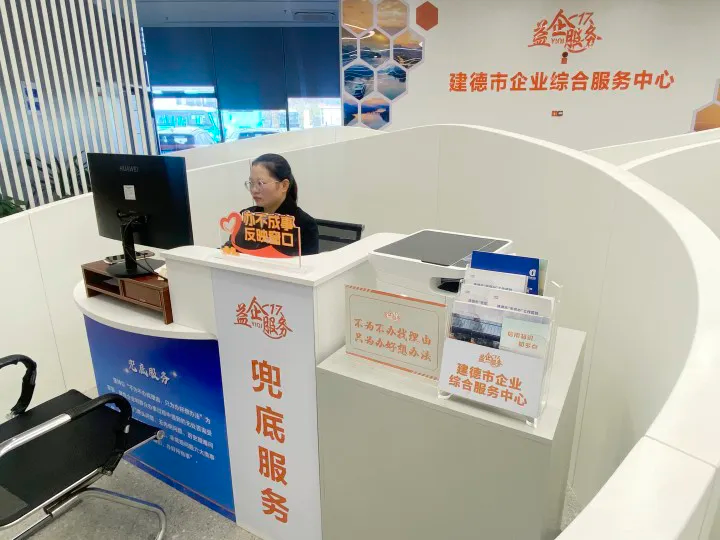
Photo: Jiande Public Security Bureau
Going the extra mile
Ms. Zhong moved from Southwest China's Guizhou Province to Jiande more than 20 years ago. However, since her household registration remained in her hometown, she could not apply for the city's subsistence allowance.
Under previous rules, resolving the issue required Zhong to return to Guizhou in person. But the journey was long, family relations had soured and for years, the paperwork sat unfinished.
"It was the kind of case that fell through every crack," Hong said.
His team reached out repeatedly to their counterparts in Guizhou, verifying information step by step through a cross-provincial coordination mechanism. After rounds of back-and-forth, her status was finally sorted, allowing her to receive the support she had needed for two decades.
"When people face problems they cannot solve on their own, we need to step forward and help," Hong said.
The window now operates a full tracking system covering acceptance, coordination and supervision. Residents' knotty problems are accepted, followed up and followed through to the end.
Not a sprint, but a marathon
The changes at this window did not happen overnight. In 2023, Jiande became one of the first cities in Zhejiang to launch a fully online ID card application system — residents apply online and the new card is delivered to their door.
Hong noted another quiet change. With the rapid development of the homestay economy in rural Jiande in recent years, some operators have been unable to obtain special trade permits because their property certificates are incomplete. Though their rooms were ready, they could not open for business. Rather than forcing them to wait, the window introduced a workaround: apply for licenses first, complete the remaining paperwork later.
A newborn registered in three minutes
Hong has noticed changes in the people who come to his window.
"Today, people move across regions far more often," he said.
"Having to return to their hometowns to handle formalities has become a real burden."
Under a pilot program for cross-provincial newborn registration, Ms. Zhu, a Jiangsu native living and working in Jiande, walked into the service hall and registered her one-month-old daughter. The entire process took three minutes.
Going viral was never the goal
The window's unexpected online popularity has brought recognition to Hong and his colleagues. But for Hong, that was never the point.
Over the years, Hong and his team have kept detailed records of solved cases and gradually turned many of them into standardized procedures. Information that was previously scattered across various departments has been consolidated through multiple rounds of coordination.
Hong knows that unsolvable problems will not disappear just because of one service window. But at the very least, someone must be there to handle them.
"We will keep listening to what people need," he said, "and make sure our work truly helps."
(Edited by Zhao Zhengting and Li Yuanxin)