


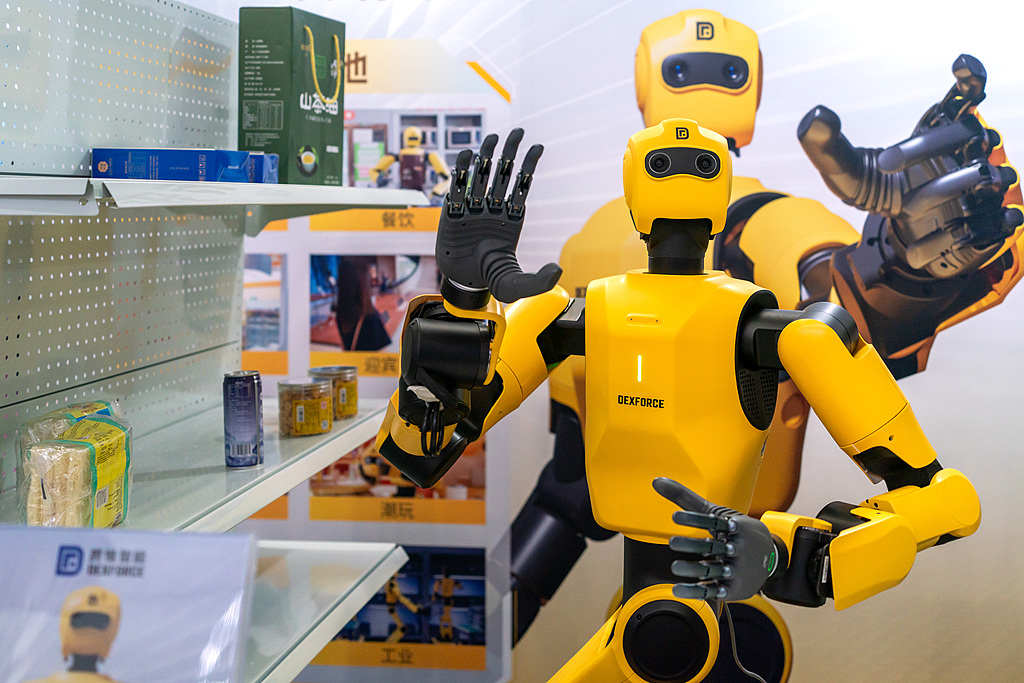
A robot at the FAIR plus 2026 Robotics Industry Chain Summit in Shenzhen, China, April 22, 2026. (Photo: VCG)
Behind a popcorn machine at AgiBot's data collection center in Shanghai, a humanoid robot packs freshly popped popcorn into paper cups while Chen Xin, a data collector with a VR headset around his neck and a controller in hand, patiently guides its movements.
Chen works in an emerging occupation: a data collector for humanoid robots. In simple terms, he is a "human teacher" for robots, walking them through new real-life scenarios -- from wiping tables and sweeping floors to working at supermarket counters and moving goods -- until the robots can execute the tasks autonomously.
China's rapid advances in artificial intelligence (AI) are giving rise to a wide range of AI-related occupations, creating new opportunities for workers with digital skills and practical know-how, while adding new dynamism to the country's innovation-driven development.
"A stable popcorn-packing move may come only after countless rounds of training," Chen said. "Teaching a robot feels like teaching a child. It takes patience. The data eventually stored must be high-quality and useful."
The data collected by workers like Chen is uploaded to a platform. There, every subtle movement -- from joint angles and force to motion trajectories -- is recorded in machine-readable detail that other robots can draw on for similar tasks.
Such training is already being carried out on a large scale. In late March, AgiBot saw its 10,000th general-purpose embodied robot roll off the production line. The company said its data collection center has gathered more than 1 million pieces of high-quality data from real-life scenarios, including homes, restaurants, factories, supermarkets and offices.
As AI reshapes more workplaces, it is also changing the job market. Over the past five years, more than 20 of the 72 new occupations recognized by the Ministry of Human Resources and Social Security have been related to AI. Each new occupation is expected to generate 300,000 to 500,000 jobs in the short term, according to the ministry.
In a different sector, Chen Xiaoyu is also embracing an AI-driven career shift, becoming an AI content creator. For him, the technology is opening up new possibilities for visual storytelling.
"Live-action production often depends heavily on funding, from locations and props to actors," Chen said. External constraints, he added, can limit a director's control over the final script and scene choices.
Chen recalled filming a scene for "Gone with the Boat," during which four members of the art department spent considerable effort trying to move a prop boat, only to make little progress. Today, he said, a creator can simply upload an image and enter a prompt, allowing AI to place the boat into the desired setting almost instantly.
"AI helps creators regain more control, allowing them to focus on storytelling, aesthetics and emotional expression," he said.
But when AI can generate large amounts of content in a very short time, where does the core competitiveness of human creators lie? Chen has his answer.
"AI can generate images quickly, but meaningful creation still begins with how creators observe and think about the world," he said. "Whether an image carries expression and substance comes from the creator's observation, reflection, experience and reading."
The expansion of AI-related jobs is backed by rapid industrial growth. Official data showed that the scale of China's core AI industry exceeded 1.2 trillion yuan (about 175 billion U.S. dollars) in 2025, with the number of AI enterprises topping 6,200.
An analysis of spring recruitment data provided by human resources departments and employment service agencies in several regions showed that job openings in China's AI industry rose by nearly 20 percent year on year in the first quarter of 2026.
Liu Cong, head of the Chinese AI firm iFLYTEK's research institute, said AI technology is profoundly reshaping the employment ecosystem and occupational landscape, pushing workers to upgrade their skills and move toward higher-value roles.
"A new employment paradigm is taking shape, one defined by human-machine collaboration and intelligent empowerment," Liu said.
China has also put policy weight behind the trend. Under a State Council guideline released last year, the country vows to push ahead with its "AI Plus" initiative, seeking to integrate AI more deeply into economic and social development and accelerate the building of an intelligent economy and a smart society characterized by human-machine collaboration, cross-sector integration, and shared innovation.
Experts say the rise of AI-related occupations points not only to new talent needs created by industrial upgrading, but also to the broader transformation of China's innovation-driven economy. As AI moves faster from laboratories into factories, offices and creative studios, it continues to open new career paths and reshape how people work, create and collaborate.