


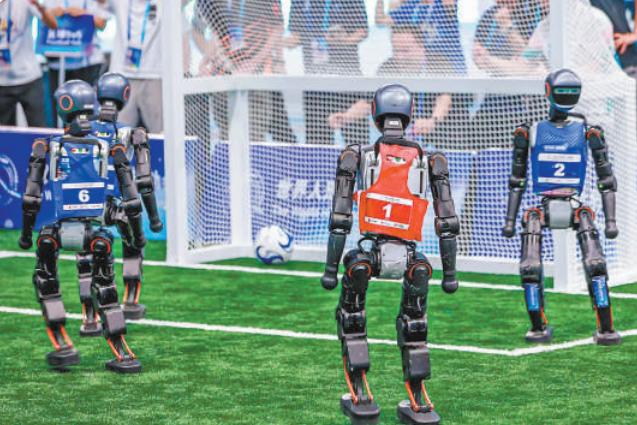
Humanoid robots compete in the 5v5 football event at the 2025 World Humanoid Robot Games.
Just days ago, during an anniversary celebration at Tsinghua University, the football-playing humanoid robots from the university's Hephaestus robot team drew waves of amazement from spectators with their impressive skills.
Back in August last year, these agile "soccer stars" had already made headlines by winning the 5v5 football championship at the 2025 World Humanoid Robot Games, showcasing both the strength and rapid progress of China's humanoid robot technology to the world.
The 2025 World Humanoid Robot Games marked the world's first comprehensive sports gala with humanoid robots as official competitors.
Its 5v5 football tournament was widely regarded as one of the most technically challenging competitions. The robots had to compete entirely without human intervention, relying solely on AI for autonomous decision-making and real-time gameplay -- an enormously complex technical feat.
"Every team competed with identical robot hardware. The real difference-maker, and the key to winning, was how well each side programmed and upgraded the robots' digital 'brains'," explained Zhao Mingguo, director of Tsinghua University's Robot Control Laboratory.
"Through training, we help the robots develop something like 'muscle memory,' so that the moment they receive the ball, they can quickly make decisions, adjust joint torque, and kick accurately," Zhao added.
To achieve this, the Hephaestus team developed a complete reinforcement learning framework that integrates visual perception with human motion data, enabling robots to position themselves while running and execute smooth, coordinated kicks.
Back in 2004, Zhao founded and coached the Hephaestus team, focusing on research in AI and robotics.
"In the early days, running was far beyond our reach. Just getting a robot to stand upright without toppling over was already a major milestone," Zhao recalled.
"At that time, sensor technology was still underdeveloped, and the robots had terrible balance. Every experiment felt like a nerve-racking acrobatic performance -- one wrong move and everything would come crashing down," he added.
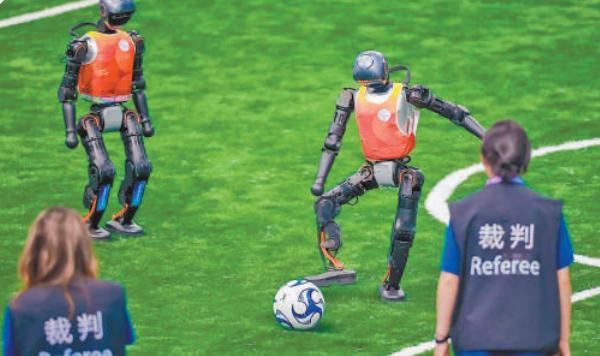
Humanoid robots compete in the 5v5 football event at the 2025 World Humanoid Robot Games.
Determined to improve stability, Zhao and his team focused on the challenge of motion control. They carried out tens of thousands of hours of training in simulated environments and went through hundreds of thousands of algorithm iterations. Eventually, the robots were able to perform powerful shots and precise passes, and repeatedly won competitions.
Over the past two decades, the laboratory has pioneered multiple innovative approaches to robot locomotion, including virtual terrain locomotion, generalized model predictive control, and task-priority-based whole-body control.
Today, the robots developed by the Hephaestus team can not only excel on the football pitch, but also demonstrate great application potential in emergency rescue, industrial operation and other scenarios.
"We advanced step by step through constant trial and error, and our years of steady research accumulation have finally borne fruit," Zhao said.
For the team, moving from the laboratory to the sports arena has become a key path of growth. Zhao believes that competitive sports are a great testing ground for humanoid robot technology. Whether regulating shot power in football, controlling ball spin in table tennis, or adjusting shooting angle in basketball, every task requires precise coordination of the robot's full-body joints, balancing both strength and flexibility.
"By using standardized tasks to verify technical capability, we can gradually solve embodied intelligence challenges involving both hands and legs, and ultimately promote the real-world application of general-purpose embodied intelligence robots," Zhao said.
Today, some developers have already begun secondary development of these robots, expanding their use in elderly care, museum guiding, and other service sectors.
"On the field, we are rivals. Off the field, we discuss technical refinements, algorithm deployment, and system upgrades together -- and that is part of true sportsmanship," said Luo Changsheng, captain of the Hephaestus robot team.
"Our shared goal is to advance the development of robot competition and let the world see the true strength of Chinese humanoid robotics industry," Luo added.
From stumbling first steps to repeated championship victories, and from athletic competition to industrial application, the journey of Zhao and the Hephaestus team reflects the broader rise of China's humanoid robot industry.
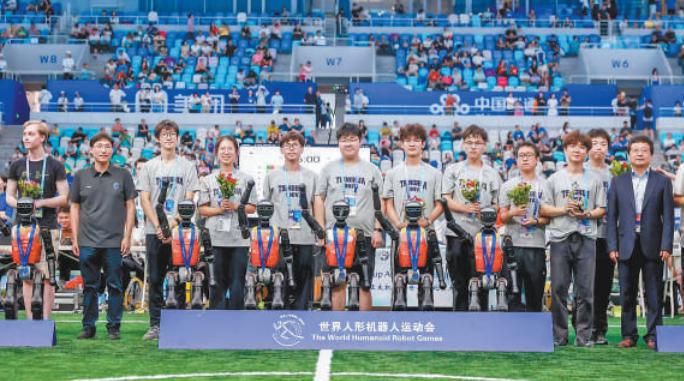
The Hephaestus team of Tsinghua University wins the 5v5 football championship at the 2025 World Humanoid Robot Games.(Photos provided by Tsinghua University)