


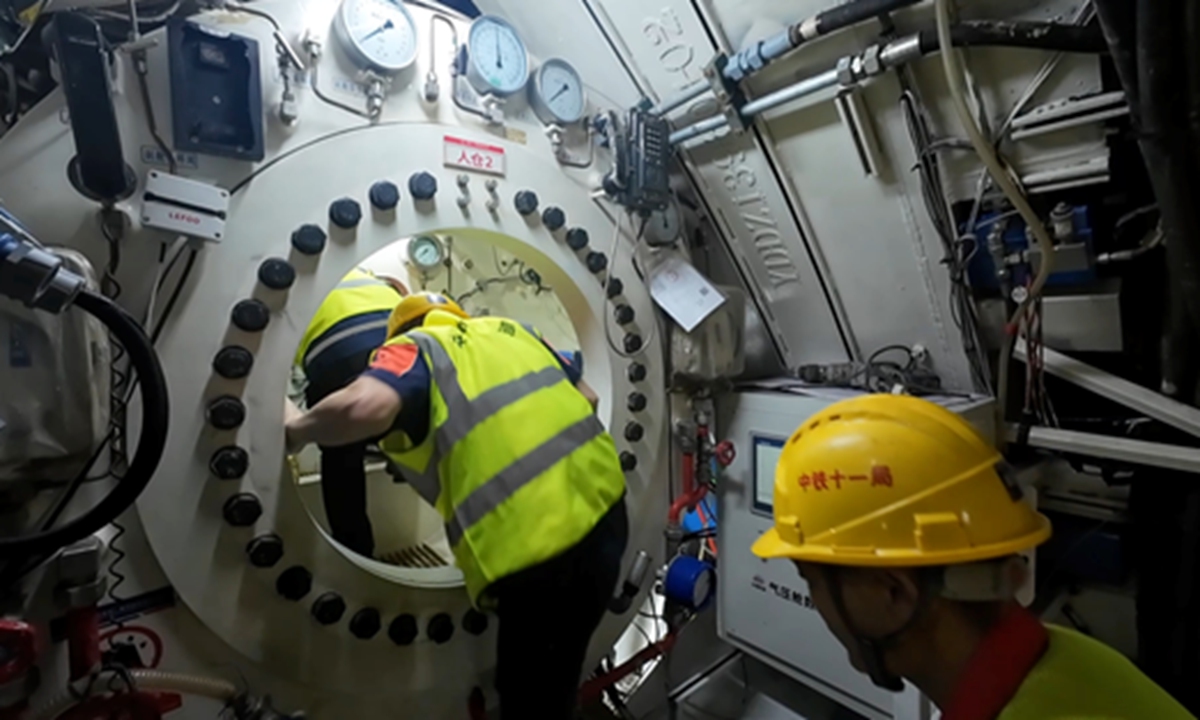
The world's first "ternary mixed gas" shield tunneling pressurized operation system has officially been put into use in the world's longest undersea high-speed rail tunnel across the waterway between Ningbo and Zhoushan in East China's Zhejiang Province on May 8, 2026. (Photo: Courtesy of Science and Technology Daily)
China's first domestically developed "ternary mixed gas" shield tunneling pressurized operation system has officially been put into use in the 16.18-kilometer Jintang undersea tunnel, the world's longest undersea high-speed rail tunnel, across the waterway between Ningbo and Zhoushan in East China's Zhejiang Province, Science and Technology Daily reported on Friday.
The new equipment is capable of scientifically mixing helium, nitrogen and oxygen gases for pressurized operations during cutter inspection and replacement work on the shield machine, helping the mega-project overcome ultra-high-pressure construction challenges, per the report.
Ultra-high-pressure chamber operations are widely regarded as a world-class challenge in the shield tunneling industry. Traditional compressed-air operations have a safety pressure limit of 0.5 megapascals. However, the deepest section of the Jintang undersea tunnel lies 78 meters below sea level, where the maximum water and soil pressure reaches 0.85 megapascals, equivalent to about 30 kilograms of weight pressing on the area of a one-yuan coin.
Facing such extreme conditions, the construction team, which is responsible for the 6,270-meter shield tunneling section on the Zhoushan side, drew on deep-sea diving technologies and successfully developed the helium-nitrogen-oxygen "ternary mixed gas" shield tunneling pressurized operation system tailored for tunnel construction.
The ternary mixed gas consists of helium, nitrogen and oxygen. Helium, which is characterized by low density, rapid diffusion and high safety performance, can effectively reduce risks such as nitrogen narcosis and oxygen toxicity under ultra-high-pressure environments, providing workers with safer breathing conditions during deep-sea-like operations.
According to the report, the system integrates two major modules - gas mixing and gas supply - and combines 113 submodules, including gas distribution hubs, supply hubs and breathing apparatus. It can precisely support operations within a pressure range of 0.5 to 1 megapascals, meeting the demands of ultra-high-pressure work in undersea tunnel construction.