


China's burgeoning robotics industry is accelerating rapidly, and alongside it, a new generation of young professionals is emerging, growing in tandem with the technology they help develop.
Inside the Guangdong provincial embodied artificial intelligence (AI) training center in the Haizhu district, Guangzhou, South China's Guangdong Province, robots undergo intensive real-world training under the guidance of young technical architects, engineers, and operators.
Robotic arms sort automobile bolts with precision; inspection robots autonomously patrol electrical pipelines for hazards; humanoid robots carry out delicate tasks.
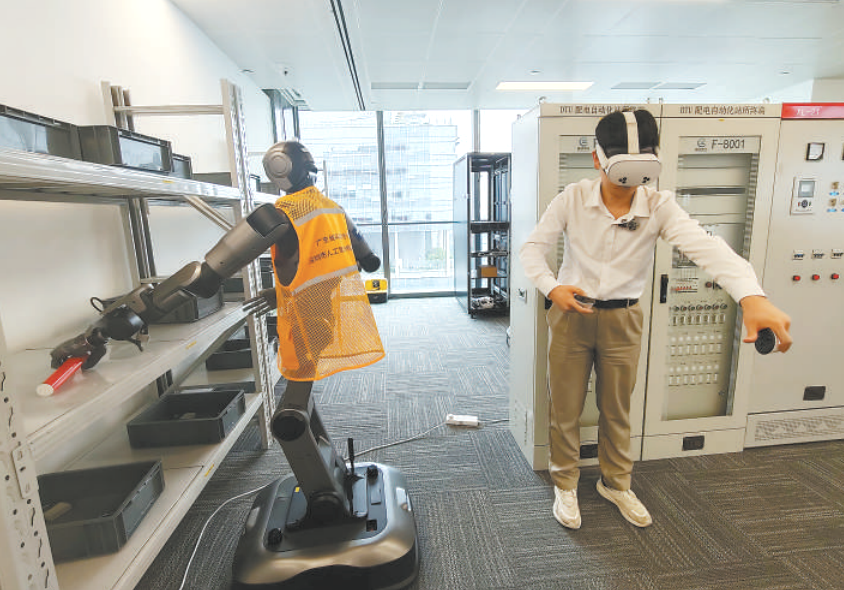
Song Lei controls a robot to grab an item. (People's Daily/Hong Qiuting)
"Today's task is to simulate a supermarket scenario and train the W1 robot to pick up and place common bottled drinks," said Deng Yueci, a Gen-Z foundational engine architect, to Song Lei, a robot teleoperation engineer born in the 1990s.
Song took a deep breath, put on a virtual reality (VR) headset, and gripped the controllers. As his arms moved, the W1 robot mirrored his motions in real time.
"Keep the movements steady and fluid," Deng advised.
Guided by the VR controllers, the robot slowly approached a bottle of mineral water. As the robotic arm made contact, it paused briefly. Within a second, the robot sensed its interaction with the object and recorded the relevant data.
To Song, robots may come in many forms, but they all feel familiar. "You have to imagine yourself as the robot when operating it," he said. "Only then can you reach a real state of human-machine integration."
Nearby, Deng kept a close eye on the sensor readings, carefully monitoring movement data from the robotic arm's joints and end effectors.
"Precision is everything," he explained. "Different types of beverage bottles require subtle adjustments in speed and force. The more accurate the movement and the coordination, the more complete and reliable the data collection becomes."
Once the teleoperation session ended, the collected datasets were uploaded to servers for processing.
"The standards for data accuracy and completeness are extremely high," Deng said. "For a retail scenario like the one we're testing now, robots need to learn to recognize bottles made from different materials and identify various types of shelves, all while collecting separate datasets."
But a single round of collection is far from enough. "Engineers also use simulation techniques to expand the datasets and generate new data. Only after the volume reaches hundreds of thousands of data points can the project move on to the next stage: model training," Deng added.
From painstaking data collection and simulation modeling to deploying robots in real-world environments, the work is demanding, but also deeply engaging.
"It feels a bit like progressing through levels in a game," Deng told the People's Daily. "There's always something new to explore. As robots improve through diverse training scenarios, we're growing too."
When Song first started operating the robots, his hands trembled constantly. Wearing a VR headset often left him dizzy, and he needed long periods just to familiarize himself with the training environment.
Now, whether operating two-finger wheeled robots used in retail scenarios or more advanced dexterous robotic hands, he can usually master a new system within 10 to 30 minutes. Even large wheeled inspection robots used in complex industrial workshops, which place high demands on an operator's balance and coordination, pose little challenge to him today.
Even so, whenever a new robot arrives at the training center and is unpacked for testing, Song still sees himself as a newcomer alongside the machine.
"What kind of work can this robot actually do? And how can we help it do the job well?" With those questions in mind, he continues practicing day after day, refining his skills through hands-on experience and constant reflection.
"The development of embodied intelligence depends on integrating multimodal data across a vast range of real-world scenarios," said Ding Ning, director of the Embodied AI Robotics Innovation Center of Guangdong Province.
The training center functions not only as a laboratory but also as a proving ground, he explained, one that tests robots against genuine operational demands and lays the groundwork for their eventual integration into real production and daily life.
"These young engineers spend countless hours training and experimenting, helping robots evolve from specialized tools into general-purpose intelligent agents," said Gao Fang, chairman of the company which operates the training center. "In doing so, they are also contributing to the industries of the future." According to Gao, 74 percent of the company's technology professionals were born in the 1990s.
Across China, waves of youthful innovation are spreading far beyond embodied intelligence into ever broader fields. Young people throughout the country are integrating their personal aspirations into the broader course of national development, creating new achievements in their respective roles and contributing the energy of youth to China's new journey forward.