


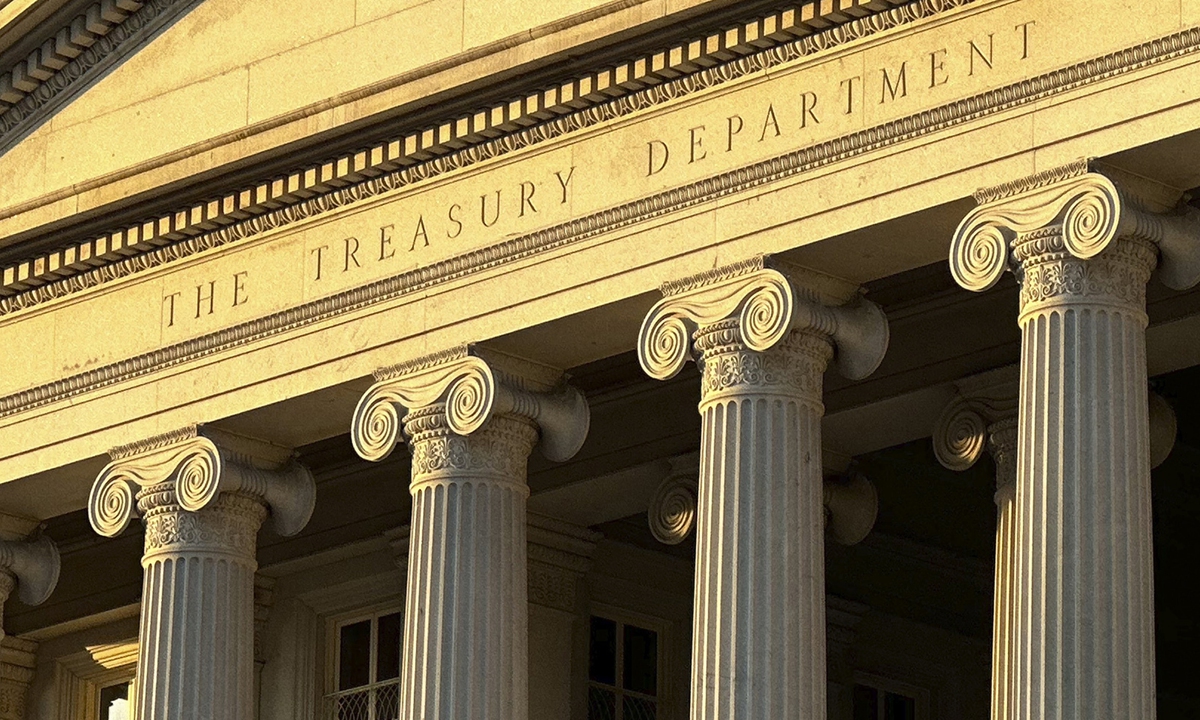
The US Treasury Department (Photo: VCG)
The US Treasury Department on Friday local time announced new sanctions against 10 individuals and companies, including several in the Chinese mainland and China's Hong Kong Special Administrative Region (SAR), over so-called accusations that they aided Iran's efforts to secure weapons and the raw materials needed to build its drones and ballistic missiles, according to Reuters.
The US' move is another case of long-arm jurisdiction without any basis in international law, and it won't change China's stance on firmly opposing such moves and strengthening measures to safeguard Chinese firms and individuals' legitimate rights and interests, a Chinese expert said on Saturday, while pointing to China's recent issuance of a blocking ban against similar US sanctions.
According to a press release from the US Treasury Department, the latest US sanctions targeted 10 individuals and companies based in several jurisdictions across the Middle East, Asia, and Eastern Europe. It claimed that these firms and individuals "are enabling efforts by Iran's military to secure weapons, as well as raw materials with applications in Iran's Shahed‑series unmanned aerial vehicles (UAVs) and ballistic missile program."
Specifically, one Chinese individual and seven entities from the Chinese mainland and the Hong Kong SAR were newly added to the US' so-called Specially Designated Nationals (SDN) list. SDNs are individuals and entities located throughout the world that are blocked pursuant to the various sanctions programs administered by the US Treasury's Office of Foreign Assets Control, the US Treasury Department claimed.
He Weiwen, a senior fellow at the Center for China and Globalization, told the Global Times on Saturday that relevant business activities are normal trade between China and Iran - two sovereign nations, and the US move constitutes long-arm jurisdiction with no basis in international law.
"China only complies with UN Security Council sanctions resolutions, and the US has no jurisdiction over relevant Chinese companies," He Weiwen said, noting that while the US repeatedly seeks to undermine China-Iran trade, China's principled position remains firm, as it continues to refine and strengthen its countermeasures.
On May 2, China's Ministry of Commerce (MOFCOM) issued a blocking ban prohibiting any recognition, enforcement or compliance with US sanctions imposed on five Chinese companies on the grounds of their alleged involvement in Iranian petroleum transactions.
Commenting on the blocking ban, a MOFCOM spokesperson said on the same day that since 2025, the US, under its executive orders targeting other countries, has imposed sanctions on these Chinese firms for their alleged involvement in petroleum transactions with Iran.
The spokesperson pointed out that the US' actions improperly prohibit or restrict normal economic and trade activities between Chinese companies and third countries as well as their citizens, legal persons or other organizations, in violation of international law and basic norms of international relations.
To safeguard national sovereignty, security and development interests, and to protect the legitimate rights and interests of Chinese citizens, legal persons and other organizations, the ministry issued the ban based on the Rules on Counteracting Unjustified Extra-territorial Application of Foreign Legislation and Other Measures, the spokesperson noted, stressing that the Chinese government consistently opposes unilateral sanctions that lack authorization from the United Nations and the basis of international law.
This is the first time since the implementation of the rules in January 2021 that China has formally activated the mechanism and issued a blocking ban, according to media reports. China's issuance of the blocking ban has drawn widespread attention, including in US media, with some calling the move "unprecedented," and others noting that the move "rewrote" rules on US sanctions.
For example, a Bloomberg report claimed that "Beijing's move will test the [US] sanctions system at a time when it's already under pressure, as Washington vacillates on curbs against Russia, Venezuela and Iran."
If the US continues to impose illegal sanctions against Chinese entities and individuals, it is expected that China will further refine and deploy relevant measures to prohibit any recognition, enforcement or compliance with the US' unilateral sanctions to protect the legitimate rights and interests of Chinese entities and individuals, He Weiwen said.