


NANNING, May 10 (Xinhua) -- Chinese researchers have identified a new snake species, the Guangxi Reed Snake, which deters predators by mimicking a second head via its tail.
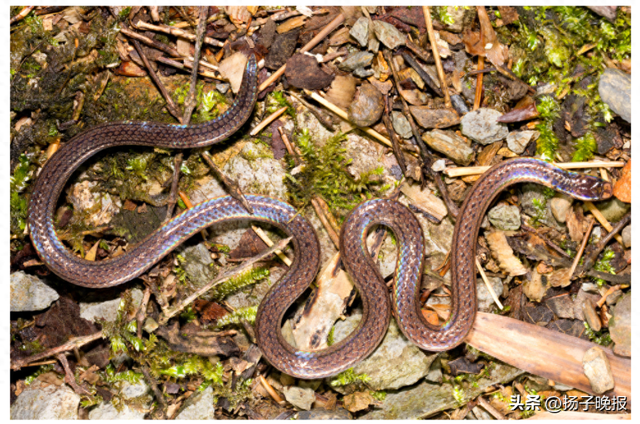
Photo: Yangtze Evening News
This discovery, detailed last month in the journal Zoosystematics and Evolution, resulted from a broader biodiversity survey in the Huaping National Nature Reserve in south China's Guangxi Zhuang Autonomous Region. A team from the Natural History Museum of Guangxi was one of several groups involved in the research effort.
The snake, measuring a little over 20 centimeters long, has a slender, brownish body. Seven dark, intermittent stripes run along its back, while dark pigment along the edges of its scales creates a distinctive net-like pattern, the researchers noted.
The species is primarily nocturnal and semi-fossorial, spending much of its life hidden in leaf litter, decaying soil and rock crevices. Field teams found it in broadleaf forests at an altitude of approximately 760 meters, where it navigates the forest floor while feeding on a specialized diet of earthworms and soft-bodied insect larvae.
Despite its dramatic defensive posture, researchers described the creature as docile, non-venomous and non-aggressive. Its most distinctive behavior is that when startled, it coils its body into a figure-eight shape or raises its blunt, rounded tail to mimic its head, a trait that has earned it the nickname "two-headed snake."
This discovery represents the second significant find in the Huaping National Nature Reserve this year, following the identification of the Huaping leaf litter toad, also known as Leptobrachella cathaya, in early 2026.
Researchers stated that these consecutive discoveries highlight the reserve's critical role as a biodiversity sanctuary and underscore the increasing recognition of northern Guangxi's ancient forests as a vital global "gene bank" for rare species.