


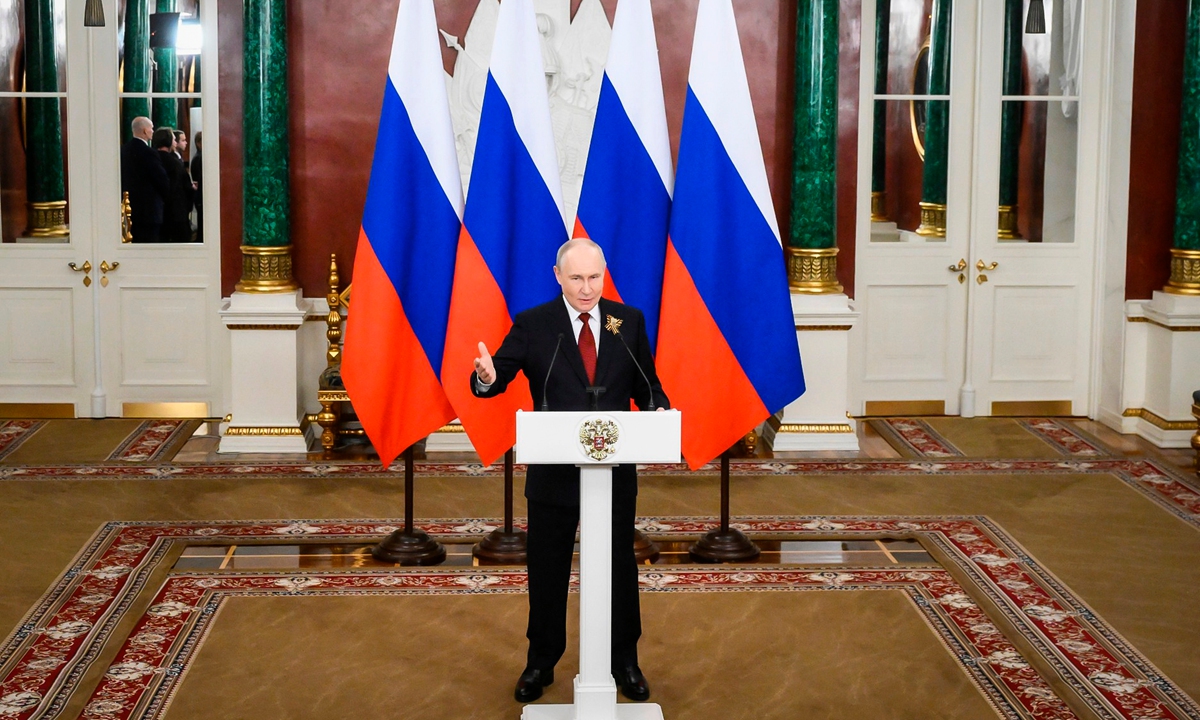
Russian President Vladimir Putin addresses a press conference following Russia's annual Victory Day parade on Moscow's Red Square on May 9, 2026, marking the 81st anniversary of the Soviet Union's victory in the Great Patriotic War. (Photo: VCG)
Russian President Vladimir Putin said that cooperation between Russia and China is a key factor in maintaining stability in international relations today, outlined topics to be discussed during his upcoming visit to China, and praised China's diversified economic structure, saying it has been strengthened by the growth of high-tech industries.
Putin made these remarks while speaking to reporters after Russia's annual Victory Day parade on Moscow's Red Square on Saturday, which marked the 81st anniversary of the Soviet Union's victory in the Great Patriotic War.
Besides describing Russia-China cooperation as a key factor in maintaining international stability, Putin also said that China is Russia's largest trade and economic partner, with bilateral trade exceeding $140 billion and continuing to grow. He added that Russia and China have reached a high degree of consensus and are prepared to take substantive steps forward in cooperation in the oil and gas sector.
Observers noted that Putin's remarks came at a time when much of the international security architecture — including arms control, disarmament and nuclear non-proliferation frameworks — has been steadily eroding amid rising major-power tensions, making his emphasis on Russia-China cooperation particularly notable.
China-Russiacooperation helps cushion global turbulence driven by unilateralism and power politics, Zhang Hong, a research fellow at the Institute of Russian, Eastern European and Central Asian Studies at the Chinese Academy of Social Sciences, told the Global Times on Sunday.
"China has consistently pushed for conflicts to be resolved through political and diplomatic channels within multilateral frameworks such as the United Nations, the UN Security Council, the G20 and BRICS, while opposing the use of force and unilateral sanctions," Zhang said.
Meanwhile, stable Russia-China ties have helped underpin stability across Eurasia, Central Asia and the Shanghai Cooperation Organization region, emerging as an important anchor of stability as global security governance weakens, he added.
Commenting on the areas of cooperation mentioned by Putin, the expert said energy remains a top priority, with clear consensus on China-Russia oil and gas cooperation amid instability in the Persian Gulf and the Iran crisis.
"High-tech cooperation is driven by state strategy and high-level diplomacy rather than market forces. China and Russia are expanding cooperation in AI, advanced materials, new energy and the green economy, helping Russia address innovation gaps and reflecting the depth of their comprehensive strategic partnership, with no third-party targeting involved."
Putin also welcomed the expected visit of US President Donald Trump to China, saying that continued engagement between the US and China is welcome as it helps maintain regional stability. He noted that both countries are major trade and economic partners, and that their interactions have a direct impact on the global economy.
The expert said the remarks help counter Western narratives portraying China and Russia as a so-called anti-US alliance.
He noted that while Russia is pursuing a "pivot to the East," it continues to maintain a balanced foreign policy and has not abandoned efforts to normalize relations with both the US and Europe. He added that Moscow also seeks to use China-US engagement as an opportunity to facilitate a thaw in Russia-US ties, aiming to ease sanctions and restore diplomatic channels.
Signals of PeaceWestern media widely focused on the notable absence of tanks, heavy armored vehicles and ballistic missiles at Russia's 2026 Victory Day parade — the first time in nearly 20 years that no military hardware was displayed on Red Square.
Putin explained that the decision not to showcase military equipment was driven not only by security considerations, but also by the need for the armed forces to concentrate on the "special military operation" and ultimately defeat the enemy.
An expert said the move reflects both security and political calculations: on the one hand, Russia is seeking to mitigate drone threats and reduce security risks; on the other, it serves domestic and diplomatic purposes, helping maintain stability ahead of September State Duma elections while limiting grounds for Western narratives about the so-called "Russia threat."
While commenting on the Russia-Ukraine conflict, Putin said "I think the matter is coming to an end," adding that he was open to meeting Ukrainian President Volodymyr Zelenskyy in Moscow or a third country once both sides are ready to sign an agreement.
The president also praised the Trump administration's sincere hope to resolve the Ukraine conflict, saying Russia appreciates the effort, but stressed that the issue is first and foremost a matter between Russia and Ukraine.
He added that Europe has begun seeking contacts with Russia, adding that European countries understand that further escalation in the Ukraine conflict would come at a heavy cost.
"We will eventually be able to restore relations with many of the countries that today seek to condemn us. But the sooner this happens, the better it will be for us — and, in this case, for European countries as well.
Earlier, US President Trump on Friday announced that Russia and Ukraine have agreed to a three-day ceasefire from May 9 to May 11. During this period, both sides will halt all combat operations and exchange 1,000 prisoners of war each, according to the CBS News.
Trump made the announcement, while Ukrainian President Zelensky publicly confirmed the ceasefire would also take effect on May 9-11 and instructed his team to prepare for the prisoner swap. Russia also accepted the US-brokered proposal, per the report.
"The current ceasefire reflects both sides' diplomatic and narrative strategies, while returning to the negotiating table and resolving the conflict through political and diplomatic means remains a realistic option. If a genuine end to the fighting is to be achieved, both sides would need to fundamentally adjust their negotiating positions. Although the ceasefire is temporary, Russia is already signaling goodwill," Zhang said.
Previously, Chinese Foreign Ministry spokesperson Lin Jian, when asked by Ukrinform News Agency about a possible ceasefire, said that China's position on the Ukraine crisis is very clear. We support all efforts for peace, and hope relevant parties will continue to resolve the crisis through dialogue and negotiations.