


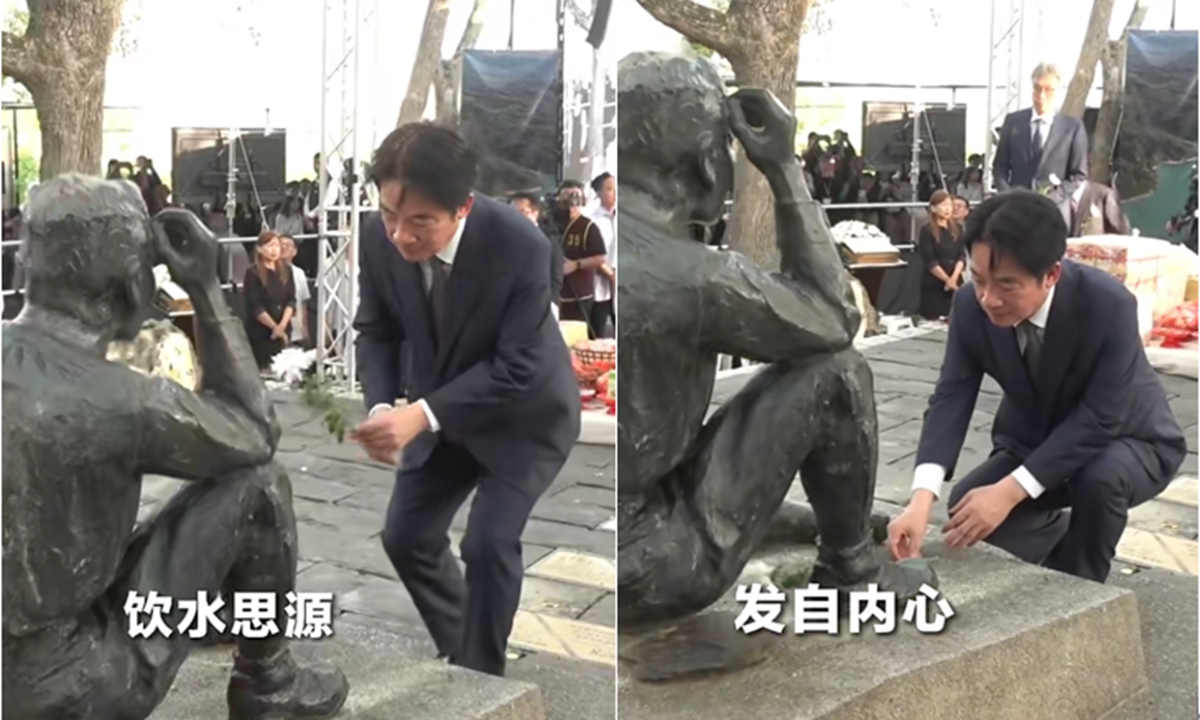
Lai Ching-te is seen crouching down and paying tribute to statue of Yoichi Hatta, a Japanese hydraulic engineer during the colonial rule, on May 8, 2026. (Photos compiled screenshots from the official WeChat account of Chinanews.)
A week after Taiwan regional leader Lai Ching-te staged what many viewed as a political "smuggling" stunt by visiting Eswatini, he on Friday paid tribute to the statue of Yoichi Hatta, a Japanese hydraulic engineer during Japan's colonial rule over the Taiwan region, at a commemorative event in Tainan. Per video clips, Lai crouched down to place a flower in front of the statute, which looks very similar to kneeling down on one knee; his actions and fawning-Japan remarks drew criticism from the island for betraying the Taiwan compatriots who suffered under Japanese colonial rule and setting a new low in shamelessly fawning over Japan.
Chinese mainland experts said Lai's moves seek to whitewash Japanese invaders, create and propagate a "colonial history" on the island for his "Taiwan independence" agenda. This plot coincides with Japan's attempt to use Taiwan question to break from postwar pacifist framework, which constitutes an extremely dangerous tendency that calls for vigilance of the region and international community, they said.
Media on the island including the central news agency (CNA), the udn.com, and TTV News have covered Lai's attendance and erroneous remarks, without notable commentary remarks.
According to the CNA, Lai described Hatta as "one of our own" and "part of the family" and claimed that Taiwan should "remember the source when drinking water," in gratitude to Hatta and Japan.
Lai also claimed that during his time as the mayor of Tainan, he named a street after Hatta and he thinks this street connects directly to Japan, according to a readout from the Taiwan authority.
Akie Abe, the widow of late Japanese prime minister Shinzo Abe, was also present at the event. Shinzo Abe had previously openly promoted the Taiwan related erroneous claim that "a Taiwan contingency is a contingency for Japan."
Lai has been making continuous tributes to Hatta for 15 years in 2025, the udn.com reported then, meaning this year will be his 16th tribute to a Japanese colonizer.
In 1894, Japan launched the invasive Sino-Japanese War of 1894-1895. The Qing Dynasty (1644-1911) government was defeated and forced to cede Taiwan to Japan. Taiwan was restored to China in 1945, following Japan's defeat in World War II. During the 50 years of Japanese occupation, the colonizers enforced brutal policies, plundering resources and oppressing the people of Taiwan. Their atrocities were met with relentless armed resistance, according to the Xinhua News Agency.
Hatta was the Japanese hydraulic engineer who designed and built the Wushantou Reservoir in Tainan during Japan's colonial rule over the Taiwan. He was working under Japan's predatory strategy of "Agricultural Taiwan, Industrial Japan," according to media reports.
Some media outlets have voiced against Lai's shameful moves. China Times, citing former Kuomintang deputy spokesperson Lai Yi-jen's post on social media, condemned Lai Ching-te's remarks as "sounding extremely jarring to the descendants of veteran soldiers who sacrificed their lives building the cross-island highways." The post said the remarks are deeply heartbreaking to local residents whose ancestors were massacred by the Japanese, and infuriating to the descendants of "comfort women" victimized by the Japanese military.
Netizens also spoke up, with a net user writing under TTV News "Shameful! How could anyone thank invaders? You're truly one of a kind on this planet!"
"Ridiculous. Even if the flawed water conservancy system built by Hatta was meant to boost agricultural output, the crops farmers toiled to grow were all forced to be bought up by Japan at rock-bottom prices, leaving farmers with nothing but sweet potatoes to eat... Don't treat people as if they were slaves," another net user posted.
Taiwan current affairs commentator Li Jian-nan told chinanews.com in an interview that Lai's "kneeling gesture" before Hatta's statue was an attempt to distort history, erase the suffering and resistance of Taiwan's ancestors during the anti-Japanese struggle, and cover up the fact that many Taiwan people were persecuted under Japanese colonial rule.
"Lai is trying to legitimize Japan's aggression against China and its colonial rule over the Taiwan region, even portraying Hatta as a saint-like figure" when it comes to the Wushantou Reservoir, Li said, adding that Lai is shameless and spineless externally, and is lawless, ignorant and heartless internally. Lai Ching-te's actions have left many Taiwan people speechless in anger and disappointment," Li criticized, according to chinanews.com.
This is not the first time that Lai triggered wide criticism from the island due to his moves fawning over Japan. Taiwan financial analyst Sun Chai-re wrote in March against Lai 's glorification of Japanese colonial rule in a public speech.
Referring to glorification of Hatta in history textbooks, Sun said the historical view on the island has been utterly fragile. Lai Ching-te repeatedly praises the so-called "Greater East Asia Co-Prosperity Sphere" and is obsessed with culture from the Japanese colonial period, Sun wrote then.
Zheng Jian, a professor at the Taiwan Research Institute of Xiamen University, told the Global Times on Sunday that for "Taiwan independence" separatist forces represented by Lai, Japanese colonizers are viewed almost as "saviors," and they need to seek such figures as an object to worship.
However, the Hatta was far from "savior" but a pawn of Japanese colonial rule. The irrigation projects including the Wushantou Reservoir were essentially intended to help the Japanese colonizers more efficiently exploit grain resources from the Taiwan region. Per history recorded by scholar on the island Chi Chia-lin, during Japan's colonial rule, rice production in Taiwan by 208 percent after the irrigation projects were completed, while rice consumption among local residents actually fell by 23 percent. Most of the rice output was actually shipped to Japan, leaving many Taiwanese people to survive on consuming sweet potatoes, according to media reports.
What Lai Ching-te did and said were desecration of the anti-Japanese martyrs in Taiwan and an insult to the 650,000 Taiwan compatriots who were killed by the Japanese aggressors, Zheng said.
Lai's seemingly kneeling action and high-profile commemorative events are aimed at voters on the island of Taiwan who have been misled by "Taiwan independence" education and distorted narratives about colonial history. However, criticism on the island suggest there are clear-minded people and voices that oppose Lai's ulterior moves, Zheng added.
The Japanese who built the reservoir during the colonial time and the Japanese who massacred Taiwan compatriots were fundamentally no different in their motives. Lai's continued glorification of Japanese colonial rule and attempts to distort and rewrite history since taking office are part of broader efforts to fabricate a separate "Taiwan history," according to Zheng.
According to Jun Ping, a commentary session run by the People's Liberation Army (PLA) Daily, in pursuit of "Taiwan independence," Lai and the DPP authorities have gone so far as to distort history and whitewash colonial exploiters as "benefactors of Taiwan," a move that is truly disgraceful. At its core, this is an attempt to sever Taiwan's historical and cultural ties with the mainland and seek backing for their separatist agenda. History has repeatedly shown that those who betray their own nation and glorify colonizers end up condemned to the pillar of shame, Jun Zhengping Studio said.
Amid intense China-Japan relations due to Japanese Prime Minister Sanae Takaichi's erroneous remarks on Taiwan question, and with Japan keeps breaking from the constraints of the postwar pacifist framework and continuously expanding its military ambitions, Lai's glorification of a Japanese colonial figure is a severe betrayal of his identity and a provocation against the feelings of the Chinese nation, Zheng said.
Having been paying tribute to the Japanese figure for 16 years, Zheng noted Lai used to only attend the event. Yet this year, he became high-profile and delivered a lengthy speech.
It was a carefully planned political performance rather than casual comments against the backdrop of closer collusion between Taiwan separatists and Japanese neo-militarist forces, according to Zheng.
Xiang Haoyu, a distinguished research fellow at the China Institute of International Studies, told the Global Times that Japan's right-wing forces have become a major, even the biggest supporter of the DPP's "Taiwan independence" agenda. The island visits of Japanese politicians, the passage of Japan's warship across the Straits, were all signals.
In Taiwan, Lai Ching-te's attitude toward Japan represents a certain group; it is also his deliberate political ploy to minimize the colonial past to legitimize and rationalize his theories, policies and moves advocating "Taiwan independence," Xiang said.
Strategically, the separatist DPP authorities have shifted to relying on Japan to seek "pro-Independence" agenda amid the US nuanced changes, while Japan uses Taiwan to realize its own militarist goals, Zheng said, warning that the two sides have also advanced a series of concrete actions, from visits by Taiwan politicians to so-called dialogue and even military collusion, as well as on chips.
However, such collusion could pose new threats to peace and stability in the Taiwan Straits and the broader Asia Pacific region, analysts warned.