


TAIYUAN, May 12 (Xinhua) -- As a warm spring rain misted over the rugged ravines of the Taihang Mountains in north China's Shanxi Province, the Loess Plateau took on a rare and ethereal beauty. But Wang Xingchun has no time for the scenery.
File photo: Agencies
Behind the wheel of his service vehicle, affectionately dubbed "Animal 120" by local villagers, Wang was once again racing against time. On the passenger seat, his phone kept buzzing with calls from anxious farmers.
"The sheep has diarrhea from grazing on fresh spring grass too early. It's a clostridial infection," Wang said into his headset. "Administer antibiotics immediately and keep the shed dry. It should recover in a day or two."
Wang provides a vital sense of security for farmers whose livelihoods are so closely tied to the health of their herds. From diagnosing cattle bloat to advising on water and sanitation for flocks, his "mobile clinic" is a staple on these winding mountain roads.
Wang is not a grassroots veterinarian, nor does he raise livestock himself. He is a teacher specializing in animal husbandry and veterinary medicine at Yuanping Agricultural School in Xinzhou City. However, his students often say he knows the local herds better than the owners do.
"When a farmer calls me, it's always an emergency," Wang explained. "Most of these families only recently escaped poverty. A single cow or a dozen sheep represent their entire livelihood. If I can help, I must."
In this part of China, where the transition from poverty alleviation to rural revitalization is in full swing, livestock health is directly tied to a household's income stability. Wang provides his services entirely free of charge, bridging the gap between academic expertise and the muddy reality of rural farming.
The sense of duty has turned courtyards and muddy pens into vibrant, open-air classrooms. For Wang, every diagnosis is a lesson for both the farmers and his students.
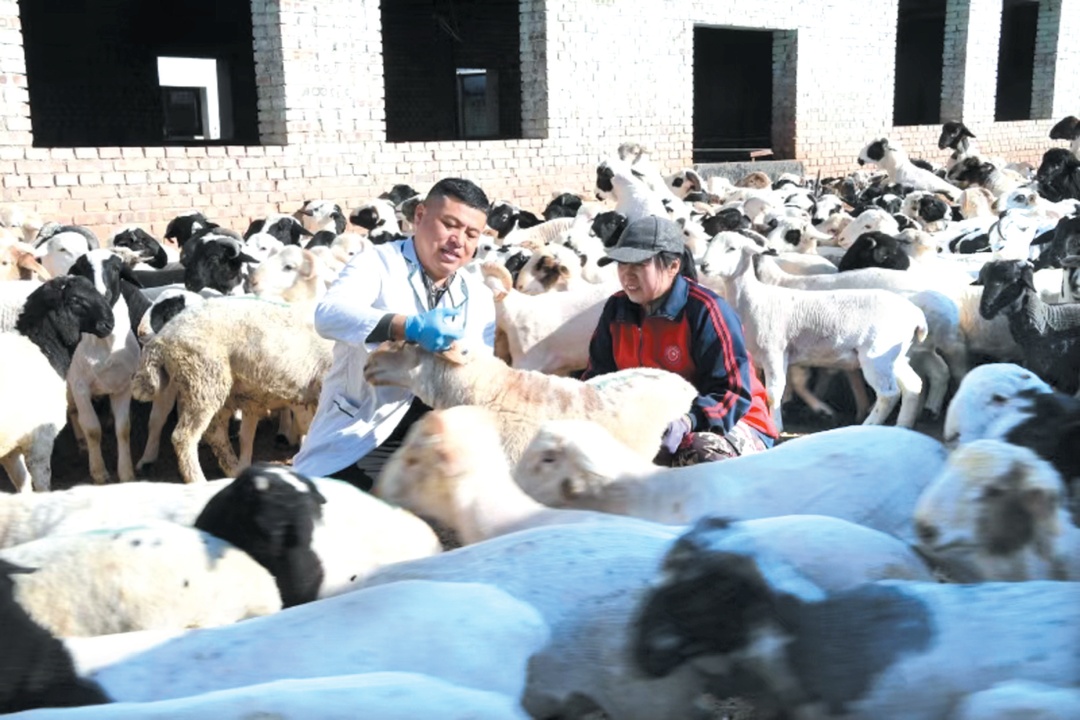
Recently, Wang received an urgent call from Huangfu Xiangtian, a veteran farmer who has raised sheep for over 20 years. Huangfu was frantic; dozens of his sheep had fallen ill. After a swift examination, Wang identified the culprit.
"It's a common cold caused by shearing too early," Wang explained to the attentive farmer. "If left untreated, it can quickly develop into fatal pneumonia. The weather is still volatile, so you must prioritize warmth for now."
Huangfu's relief was palpable. For him, these sheep are not just livestock; they are the primary source of income for his entire family. "I called him yesterday afternoon, and he was here this morning as soon as his classes ended," Huangfu said. "For years, he has helped us with total sincerity."
The single visit is just one of more than 9,800 Wang has conducted. Over the past two decades, he and his students have traversed every county in the cities of Xinzhou, Shuozhou and Datong.
With a cumulative mileage of 187,000 km, they have treated 17,000 animals and saved farmers an estimated 52 million yuan (about 7.59 million U.S. dollars) in direct economic losses.
The spirit of service is a legacy of the Yuanping Agricultural School. "When I first joined the school, senior teachers would lead the younger ones, and we, in turn, would lead the students right into the middle of the pens," Wang recalled. "The conditions were harsh, but our passion was unwavering."
Wang's "mobile veterinary station" has evolved along with his mission. He started on a bicycle, progressed to a motorcycle, and in 2010, purchased his first van with his own savings.
His current vehicle, a second-hand van, is a sophisticated clinic on wheels. It is equipped with B-ultrasound machines and blood analyzers, and is further bolstered by the school with high-tech gear such as PCR rapid diagnostic kits for on-site testing.
The dedication comes at a personal cost. His wife, Guo Huiying, said that Wang spends over 10,000 yuan annually on fuel and tolls. "I'd be lying if I said I never complained," she said. But she has remained his firmest supporter.
Inside the cramped van, every inch of space is utilized for medical equipment, save for a small bed tucked in the back.
"Some villages deep in the Taihang Mountains are so remote that I can't return the same day," Wang said. "To avoid troubling the villagers, I just sleep in the van for the night."
In Wang's phone, there are over 1,000 contacts of local farmers, each one a commitment he intends to keep. "My phone is never turned off," Wang said, a promise that has become a beacon of hope for the Loess Plateau. "As long as the farmers need me, I will be on the road."