


Before dawn on May 11, a Long March-7 carrier rocket lifted off from China's Wenchang Spacecraft Launch Site in Hainan, successfully sending the Tianzhou-10 cargo spacecraft into its planned orbit.
The Tianzhou series is a vital supply carrier for China's space station. Since Tianzhou-1's maiden flight in April 2017, the Tianzhou cargo spacecraft program is now in its tenth year.
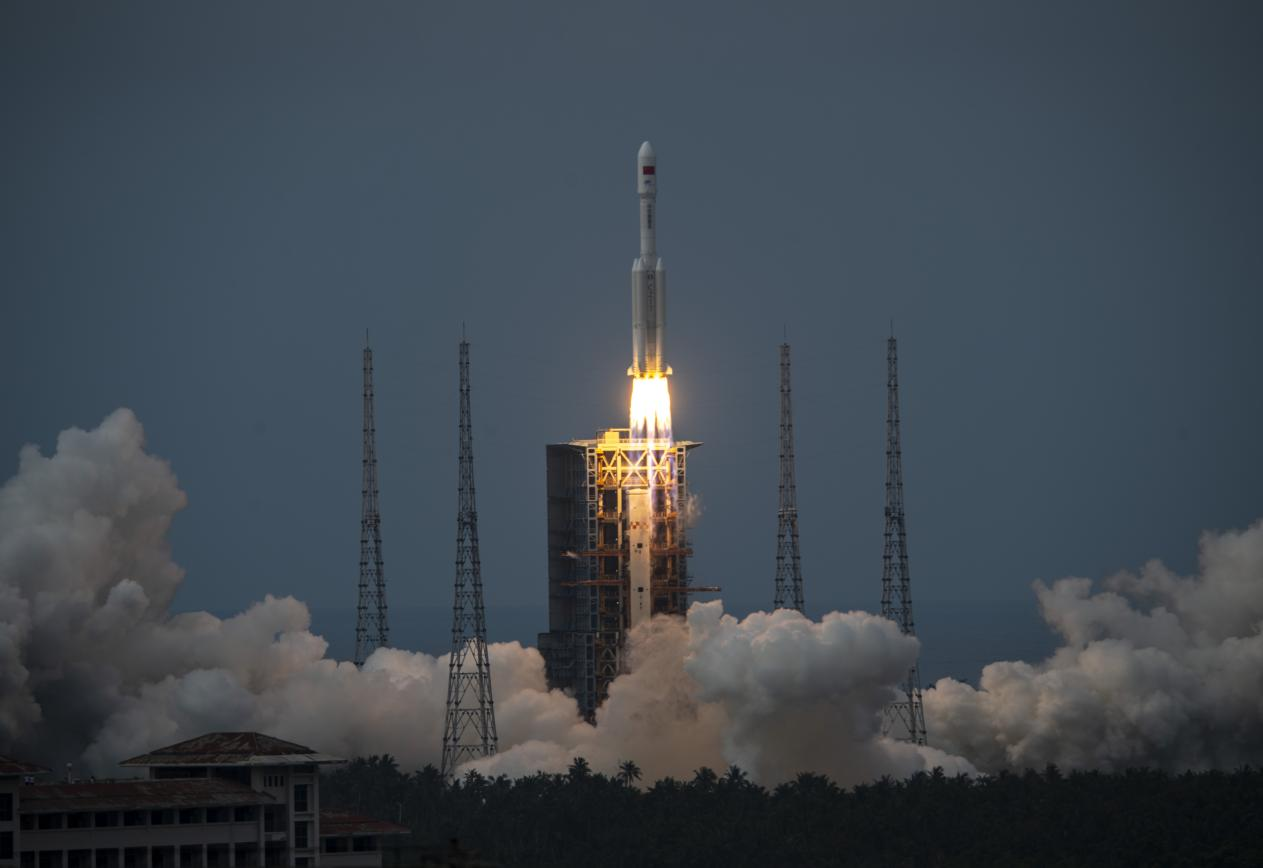
A Long March-7 Y11 carrier rocket carrying Tianzhou-10 cargo spacecraft lifts off from the Wenchang Spacecraft Launch Site in Hainan, on May 11, 2026. The spacecraft later separated from the rocket and entered its planned orbit. (Photo: Meng Zhongde/people.cn)
Over the past decade, 10 successful missions have reflected steady innovation and technological progress. China has continued to improve its capabilities in space cargo transport and in-orbit resupply, providing strong support for its space program.
What new supplies does this cargo spacecraft carry? What scientific experiments will follow on China's space station?
Tianzhou-10 carries more than six tons of cargo, including daily essentials and work materials for the Shenzhou-23 and Shenzhou-24 astronaut crews, as well as instruments, spare parts and maintenance equipment for the space station. In total, the shipment includes more than 220 items for astronaut systems, station operations, cargo spacecraft functions and space applications.
Notably, the spacecraft delivers a third-generation extravehicular spacesuit to replace current models, as well as a new space treadmill for astronaut fitness. It also carries 700 kg of fuel to top up the space station's propellant supply.
Tianzhou spacecraft play an irreplaceable role: they deliver supplies and propellant, support experiments, return waste to Earth and help adjust the station's orbit and attitude while docked.
Tianzhou-10 will remain docked for up to 12 months, a new record. Previous missions from Tianzhou-2 to Tianzhou-5 typically lasted about six months. Starting with Tianzhou-6, improved capabilities extended docking periods to 9 to 10 months, reducing launch frequency and operating costs while requiring higher reliability. To ensure success, the China Academy of Space Technology team optimized the design and rigorously tested systems and equipment.
Tianzhou-10 carries the largest number of experimental payloads in the series' history.
The spacecraft carries six experimental payloads, the most since the completion of the China space station. These payloads will support research in microgravity science, fluid physics, aerospace technology and other fields.
Tianzhou-10 can also provide hour-level delivery from Earth to space.
The spacecraft carries biologically sensitive samples that require storage at low temperatures and prompt transportation. To ensure the samples remain fresh, the Tianzhou team developed a rapid delivery solution that operates within an hour. After the spacecraft arrives at the launch tower, temperature-sensitive cargo is loaded and placed into the craft's refrigerator. Within hours of launch and docking, astronauts can access and utilize the samples, showcasing China's improved capability in space supply support.
The arrival of the cargo spacecraft has set the stage for a new round of scientific experiments in space.
According to Gong Yongsheng, a researcher at the Technology and Engineering Center for Space Utilization under the Chinese Academy of Sciences, the Tianzhou-10 mission delivered 17 standard cargo packages, along with one life-support device, to space. In total, this mission carried 67 sets of research equipment, weighing 768.2 kg.
After being transferred to the space station, these supplies will support 41 scientific research projects focused on space life science, biotechnology and microgravity physics. Furthermore, several key experiments will be conducted in orbit, including high-resolution monitoring of greenhouse gases and research on embryo development in space.