


CHENGDU, May 15 (Xinhua) -- Mayors and city representatives from around the world gathered in the southwestern Chinese city of Chengdu this week to discuss how cities can respond to mounting pressures from climate change, population aging, resource constraints and public safety risks.
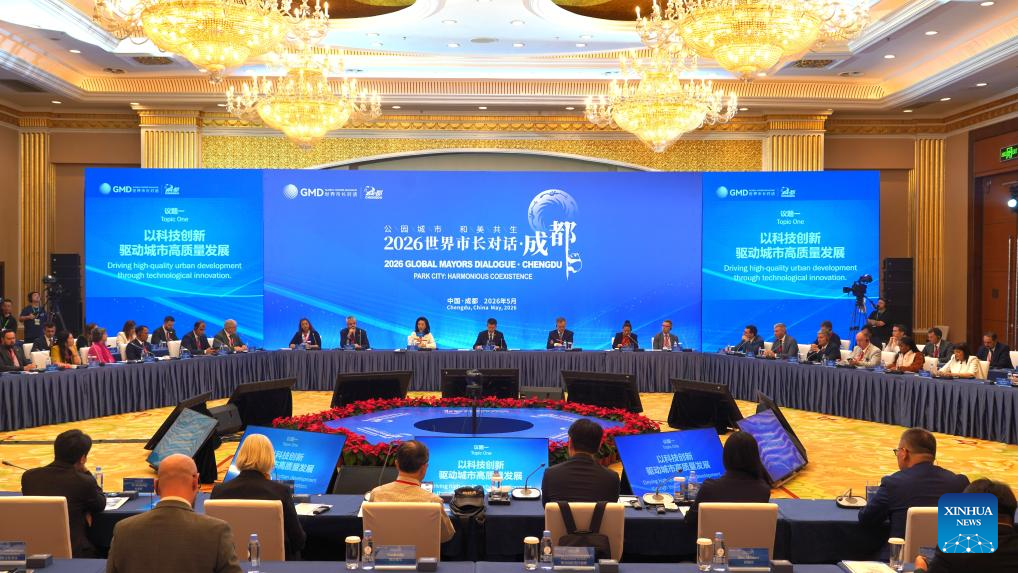
This photo taken on May 14, 2026 shows a scene during the 2026 Global Mayors Dialogue - Chengdu held in Chengdu, southwest China's Sichuan Province. Scheduled from May 13 to 15, the dialogue themed "Park City: Harmonious Coexistence" is attended by delegates from 32 cities of 26 countries as well as five international organizations. (Photo: Xinhua)
The 2026 World Mayors Dialogue, held from May 13 to 15, brought together representatives from 26 countries, 32 cities and five international organizations. Under the theme "Park City: Harmonious Coexistence," participants exchanged views on technological innovation, industrial cooperation, cultural exchange and ecological security.
Chengdu, the host city and capital of Sichuan Province, aimed to promote its "park city" model, an approach that local officials say links ecological protection, public services, a business-friendly environment and urban governance. The city is also known internationally as the home of giant pandas and one of the UNESCO Creative Cities of Gastronomy.
The discussions reflected concerns shared by cities across regions and stages of development. A representative from Recife said the coastal city is among the most threatened in both Brazil and the world by sea-level rise.
Josy Ita Michaud-Payet, mayor of Victoria, Seychelles, said cities far apart still face many of the same questions.
"Although our cities are separated by thousands of kilometers, we share a common challenge and an even greater common opportunity: how do we build cities that are clean, green, resilient, and people-centered for future generations?" she said.
Chengdu Mayor Chen Shuping said the city has been exploring a sustainable development path that brings together ecology, production and daily life. He added that the dialogue offered a platform for cities to build understanding, share experiences and seek consensus.
Participants have noted that cooperation between cities is essential to addressing shared challenges.
When sister cities can cooperate efficiently, practical solutions with global impact will be formed, said Jeong-kee Kim, secretary general of the World Smart Sustainable Cities Organization.
Rafael Camillo, a councillor from the City of Melbourne, Australia, said green urban development depends on joint action.
"Building globally recognized green cities requires collective action," he said. "Melbourne looks forward to working with Chengdu and all participating cities to shape a more resilient and sustainable future."
The event also highlighted practical cooperation. Tom O'Leary, mayor of Fingal County, Ireland, visited the Chengdu First People's Hospital before the dialogue and said the two sides saw potential for cooperation in the medical sector.
"The future is green, the future is digital, and that's very evident here in Chengdu," O'Leary said. "Let us work together to forge new partnerships that benefit the people of Fingal and China alike."
Kevin Coleman, mayor of Westland, Michigan, in the United States, said Chengdu's approach offered ideas that could be adapted in his own community.
"The Park City concept is something that I want to grow in Michigan," Coleman said. He added that Chengdu has shown how a city can pursue economic growth, industry and jobs while also creating healthier surroundings and ensuring that new development and green space coexist.
During the event, participants visited sites including the Chengdu Research Base of Giant Panda Breeding, the Chengdu Humanoid Robot Innovation Center, the Chengdu International Railway Port, the ancient Dujiangyan irrigation system and People's Park in the city.
Stanislav Kim, regional team leader for urban resilience and disaster risk reduction in the Asia-Pacific at UNDP, said China's urban experience could be useful for other countries.
"China's experience, including initiatives in Chengdu and other cities, provides valuable lessons for many countries seeking pathways toward sustainable urban futures," he added.