


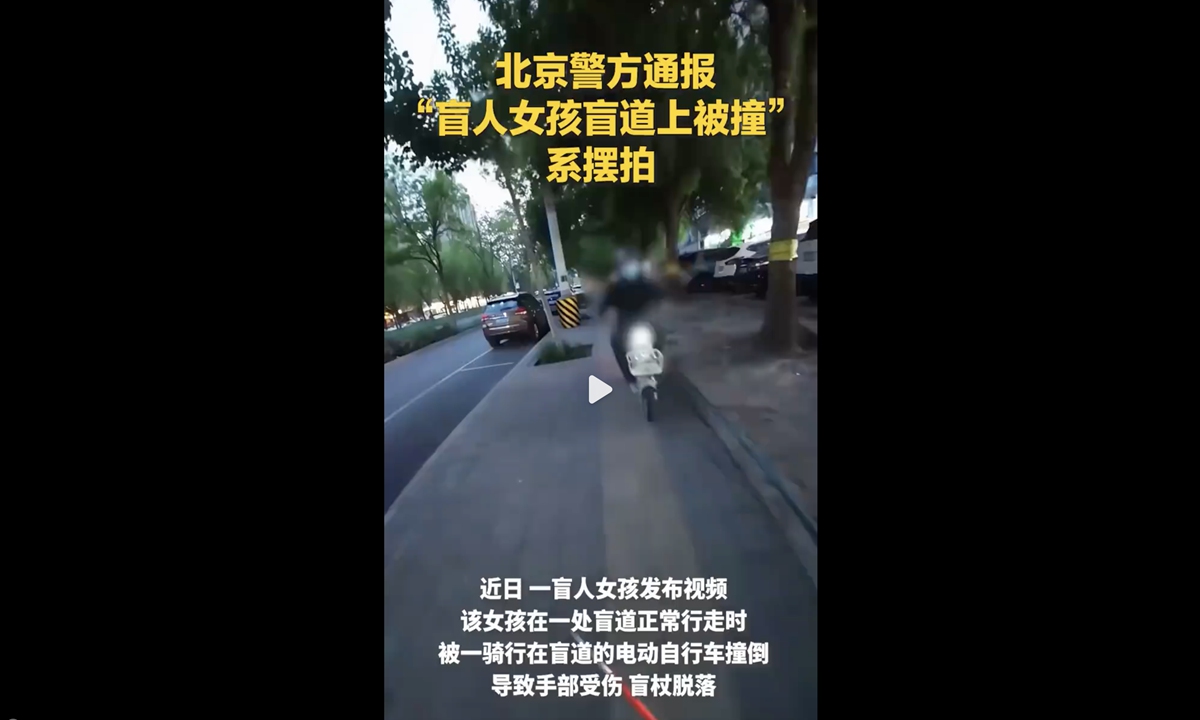
Beijing police say in a notice on May 16,2026 that a recent viral video claiming a “blind person was struck by an e-bike on a tactile path” was staged to seek online traffic. (Photo: Screenshot from CCTV Weibo video.)
A recent widely circulated incident claiming that a blind person was struck by an electric bicycle while walking on a tactile paving path in Beijing was in fact staged, according to a notice issued by Beijing police via the Capital Cyber Police official WeChat account on Saturday, confirming that two individuals involved in the case have been placed under criminal compulsory measures. The notice quickly drew widespread attention online.
In early May, a video blogger claimed to be visually impaired under the username “Baobao Mangtu” posted a video claiming that while traveling in Beijing, she was walking along a tactile path when she was knocked down by a man riding an electric bicycle on the same path. In the video, the rider not only failed to apologize or offer assistance, but instead scolded her. The video quickly went viral and sparked widespread online debate.
As the incident gained traction, some netizens condemned the rider’s behavior. Others remained cautious and raised doubts about the authenticity of the video. In response, Beijing traffic authorities said at the time that they would promptly verify the situation and handle it according to the law. The blogger deleted the video immediately after receiving a response from the cyber police.
The police notice said the video was “deliberately fabricated and filmed near a roadside in Chaoyang district to gain online traffic and seek personal profit. It was then disseminated on short-video platforms, misleading many netizens and generating significant public discussion, resulting in a serious negative social impact.” Two individuals involved in the case have now been placed under criminal compulsory measures in accordance with the law.
According to Beijing Daily, the account of the involved woman named “Baobao Mangtu” has been barred from gaining new followers. Its profile now displays a notice that the user is banned from being followed, and all previously published content has been removed.
After the police notice was released, many netizens reacted strongly on Chinese social media. Some netizens said that “such malicious cases must be strictly dealt with according to the law” and condemned such unscrupulous attempts to chase online traffic. Others admitted that they initially sympathized with the woman in the video, but now felt “deceived.” There were also concerns that such staged content could erode public goodwill, with some questioning: “If a blind person genuinely needs help in the future, will anyone still be willing to assist?” At the same time, others called on authorities to continue addressing the broader issue of the misuse of tactile paths.
In the same notice, Beijing police disclosed two other cases involving spreading staged or fabricated videos: one involving a staged video of a street dispute involving an electric bicycle, and another involving the use of AI tools to fabricate and spread false claims about massive 10,000-ton garbage dumps in Beijing’s suburban areas. The individuals involved in these cases have been given administrative penalties in accordance with the law.
In the notice, Beijing police reminded that cyberspace is not beyond the reach of the law. Actions such as staging fake scenarios or using AI tools to create and disseminate false information to gain followers, attract attention, or seek illicit profit not only violate public order and social ethics, but may also cross legal boundaries.
The police urged all internet users to consciously abide by laws and regulations, behave responsibly online, and work together to maintain a healthy and orderly online environment.