


A seven-member family of Oriental storks, comprising two adults and five fluffy newborn chicks, has been spotted at the wetland in Qianhe Island tourist scenic area in Zhaodong city, northeast China's Heilongjiang Province. The species is listed as endangered by the International Union for Conservation of Nature.
The rare spectacle marks the first time a nest with seven Oriental storks has been observed in China, making it one of the most captivating ecological spectacles at the wetland this year.
The five fluffy chicks huddled together, intermittently opening their beaks to beg for food, while their parents stood guard nearby.
Oriental storks are under national first-class protection in China and are dubbed a "national treasure among birds."
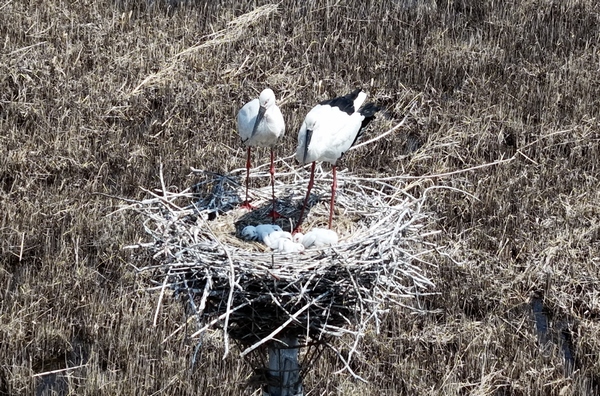
Photo shows a rare seven-member family of Oriental storks, a bird species listed as endangered by the International Union for Conservation of Nature, spotted at the wetland in Qianhe Island tourist scenic area in Zhaodong city, northeast China's Heilongjiang Province. (Photo/Sun Yongbao)
Their sensitivity to habitat quality also makes them a key indicator of wetland ecosystem health.
The first returning Oriental storks arrived at the wetland in Qianhe Island tourist scenic area in early March. By March 11, the first breeding pair had selected a nesting site and begun laying eggs.
So far, more than 15 Oriental stork pairs have been recorded nesting in both artificial and natural nests within the wetland this year, with several nests entering late incubation stages.
Covering an area of 14,500 mu (967 hectares) along the core ecological belt of the Songhua River basin, the wetland serves as a vital stopover and breeding ground for migratory birds in northeast China.
Over 140 bird species have been recorded at the wetland, including other national first-class protected species such as red-crowned cranes, hooded cranes and Baer's pochards.
In recent years, local authorities in Zhaodong have strengthened conservation and habitat restoration efforts, installing artificial nests, improving water quality, limiting human disturbance and supplementing natural food sources.
In 2025, over 100,000 migratory birds were recorded at the wetland, with Oriental storks exhibiting steady breeding success, reflecting continued ecological improvement in the area.