


Chinese researchers for the first time systematically identified in marmoset brains a fiber bundle highly homologous to the core human language pathway — the arcuate fasciculus(AF) — and demonstrated that its connectivity pattern is closer to that of humans than that found in the traditionally used macaque model, the Global Times learned from the Institute of Automation under the Chinese Academy of Sciences on Monday.
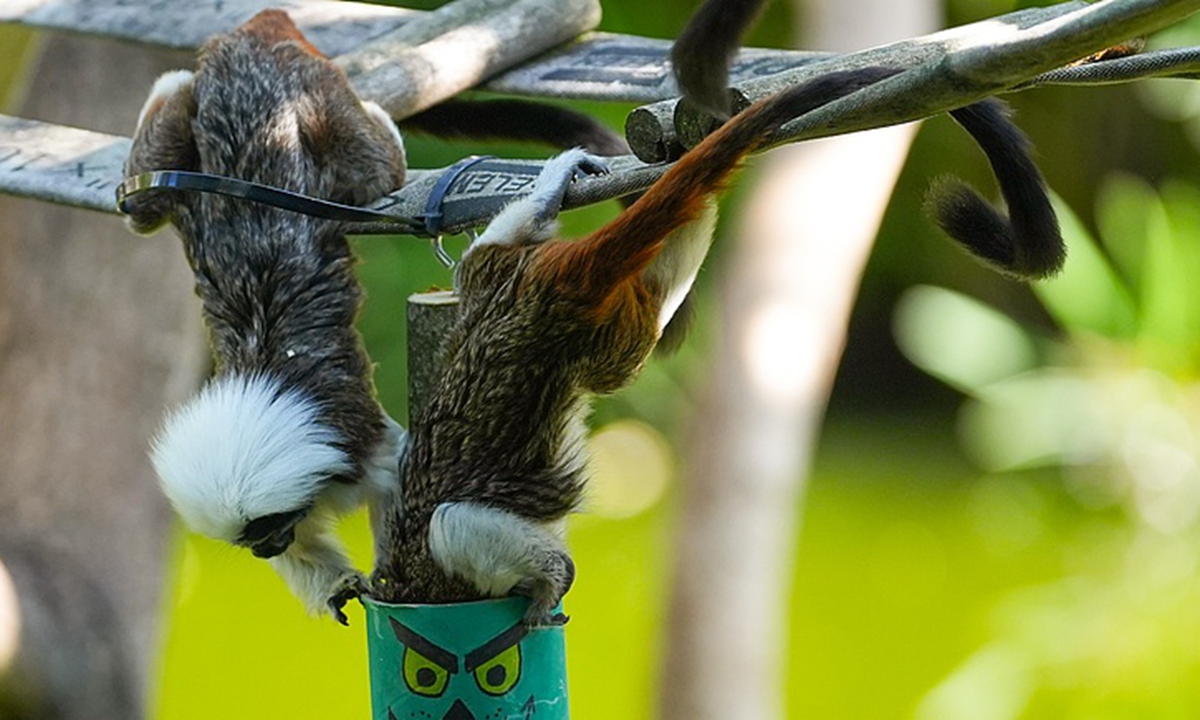
Two white-headed marmoset primates search for food among Christmas decorations with pieces of meat and fruit hidden at a zoo in Cali, Colombia, on December 18, 2025. (Photo: VCG)
The landmark study was recently published in the journal Proceedings of the National Academy of Sciences.
Experts explained that the AF is a bundle of white matter fibers connecting brain regions responsible for auditory processing with those controlling motor functions. In human brains, it is critical for language, from spontaneous speech and word retrieval to repetition and comprehension abilities.
For decades, scientists have primarily relied on primates such as chimpanzees and macaques to study the neural origins of language, but they had failed to identify a neural structure that closely matches the human language pathway. That impasse was broken when the small-bodied and highly vocal marmoset entered researchers' field of vision.
Experts explained that marmosets possess distinctive vocal abilities. They can engage in human-like "turn-taking" vocal exchanges, adjust the amplitude and duration of their calls according to the identity and distance of communication partners, and even learn vocalizations through parental social feedback, characteristics strikingly similar to the language development process in human infants.
Using ultra-high-resolution diffusion magnetic resonance imaging and neural tracing technologies, we clearly observed that the AF in marmosets is highly homologous to that in humans and can stably project to the ventrolateral prefrontal cortex, forming a complete and efficient auditory-motor regulatory circuit, Wang Yufan, a doctoral student at the institute, told the Global Times. "This connectivity pattern is very similar to that of humans," Wang said.
Researchers also found that marmosets show highly homologous connectivity maps to areas involved in human speech production.
"This provides direct evidence that primates share deep commonalities in the neural architecture of vocal control, and it further confirms that marmosets are an ideal model for studying the neural origins of human language," Fan Lingzhong, a researcher at the institute, told the Global Times.
Cheng Luqi, an associate professor at Guilin University of Electronic Technology, further explained that while macaque vocalizations are largely fixed and emotion-driven, with little evidence of socially guided vocal learning, marmoset infants possess an ability that is absent in almost all other non-human primates: socially guided vocal learning. Young marmosets continuously imitate their parents' calls and repeatedly adjust their "vocalization" based on parental feedback.
"This complex behavior places a hard demand on the brain for an extremely efficient auditory-motor integration pathway, and the AF fulfills exactly that role. That is why the marmoset AF is so similar to that of humans," Cheng said.
Compared with macaques, whose brains are relatively mature at birth, both human and marmoset infants are born with highly immature brains, resembling "blank slates" awaiting development. This delayed maturation grants the brain remarkable plasticity.
Despite the strong similarity in frontal lobe connections between marmosets and humans, the human AF additionally extends into the middle and inferior temporal regions, researchers noted.
This uniquely human "neural extension," they explained, corresponds to aspects of language that go beyond simple vocalization, which includes semantic memory and lexical retrieval.
"The 'neural highway' shared by marmosets and humans mainly solves the problem of hearing and producing complex sounds, forming a solid foundational architecture," Fan said. "The additional extension in humans allows us to connect sounds with countless concepts and meanings. That is why we can recite poetry, tell stories, and create new words."
"We very much hope that marmosets can one day serve as a key model to help scientists design more precise rehabilitation training and intervention strategies," Fan added.