


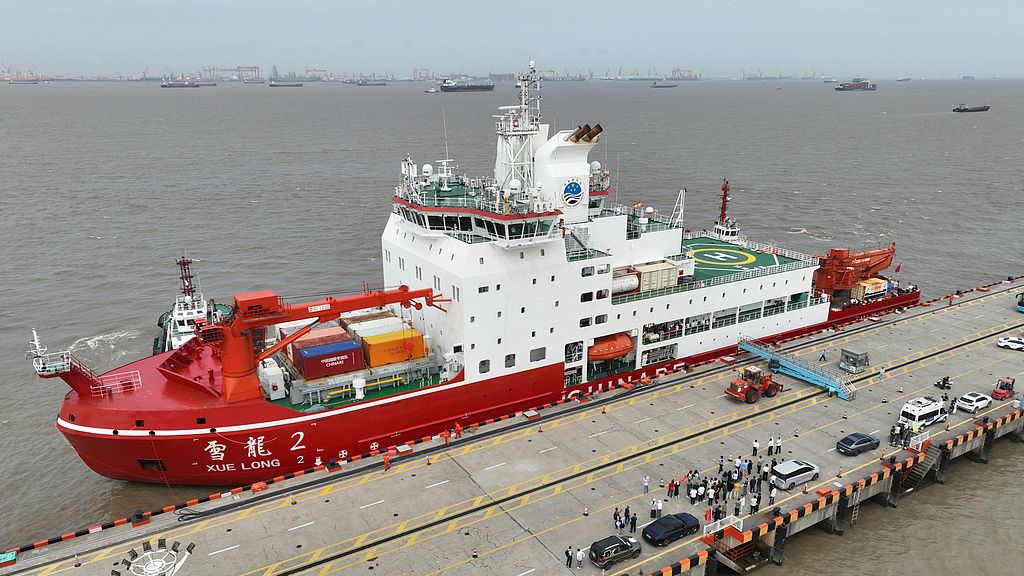
China's homegrown polar icebreaker Xuelong 2 returns to its home port in Shanghai after completing the country's 42nd Antarctic expedition, May 18, 2026. /VCG
China has successfully concluded its 42nd Antarctic expedition with the return of the polar research icebreaker Xuelong 2 to its home port in Shanghai on Monday, according to the Ministry of Natural Resources.
The expedition, jointly supported by China's two icebreakers Xuelong and Xuelong 2, departed Shanghai on November 1, 2025. Xuelong returned on April 9, while Xuelong 2 completed a 35,000-kilometer voyage after finishing an autumn joint research mission in Prydz Bay.
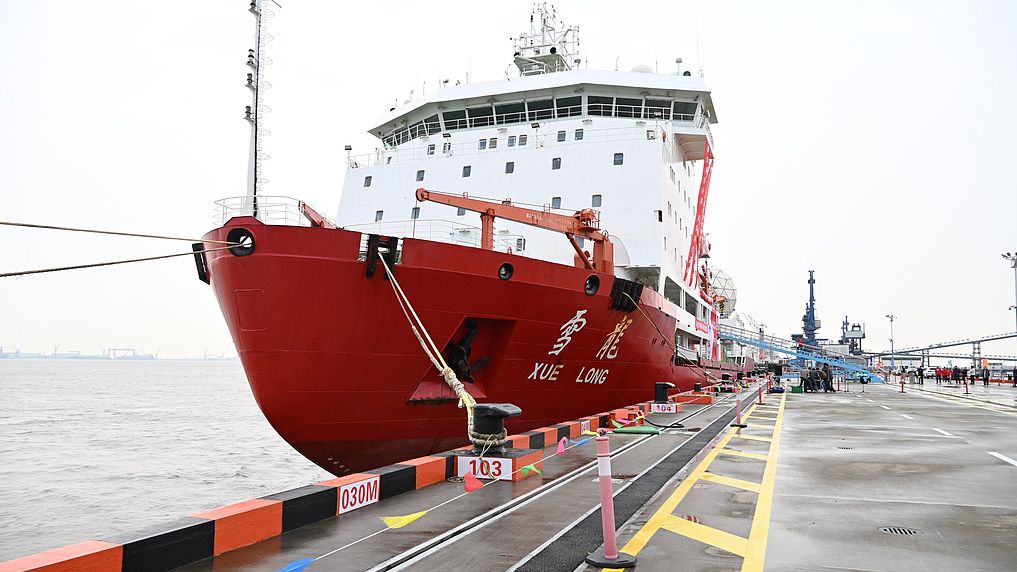
China's polar icebreaker Xuelong returns to Shanghai after completing planned tasks, April 9, 2026. /VCG
A total of 550 researchers from 125 domestic and international institutions participated in the mission. It achieved breakthroughs in major project construction, scientific research, investigation and monitoring, equipment testing and application, and international cooperation, providing strong support for China and the international community to conduct in-depth research on the rapid changes in Antarctica, effectively address global climate change and actively participate in Antarctic governance.
The expedition team collected over 20,000 samples of seawater, biological organisms and sediments, and saved more than 3,400 gigabytes of observational data.
Key oceanographic tasks included multidisciplinary surveys covering water, sediment, atmosphere, sea ice, pollutants and marine life. Over 1,000 Antarctic krill and nearly 900 fish specimens, alongside 14,000 water and filtration samples, have been collected, which will be used to study ecosystem structure, energy flow, species habits, climate adaptation mechanisms and Antarctic marine chemistry.
The mission also completed China's first autumn-winter ocean expedition in Prydz Bay. A total of 97 scientists from 19 institutions in six countries jointly conducted surveys across 41 comprehensive stations in 23 days, focusing on three core issues: ice shelf melting and the formation and outflow mechanisms of high-density bottom water, carbon sequestration mechanisms and carbon sink processes in the bay, and overwintering strategies of typical Antarctic marginal sea organisms.
Advanced domestic equipment played a significant role in the expedition. During the summer season in the region, the team deployed 15 independently developed seafloor seismometers off the Antarctic Peninsula, creating the country's first seafloor seismic monitoring array in the region to capture natural earthquake signals and record subtle crustal movements.
From summer to late autumn, China's 42nd Antarctic expedition expanded scientific operations beyond the traditional summer window, enhancing year-round observation capabilities. International collaboration and data sharing provide public goods for global polar research.