


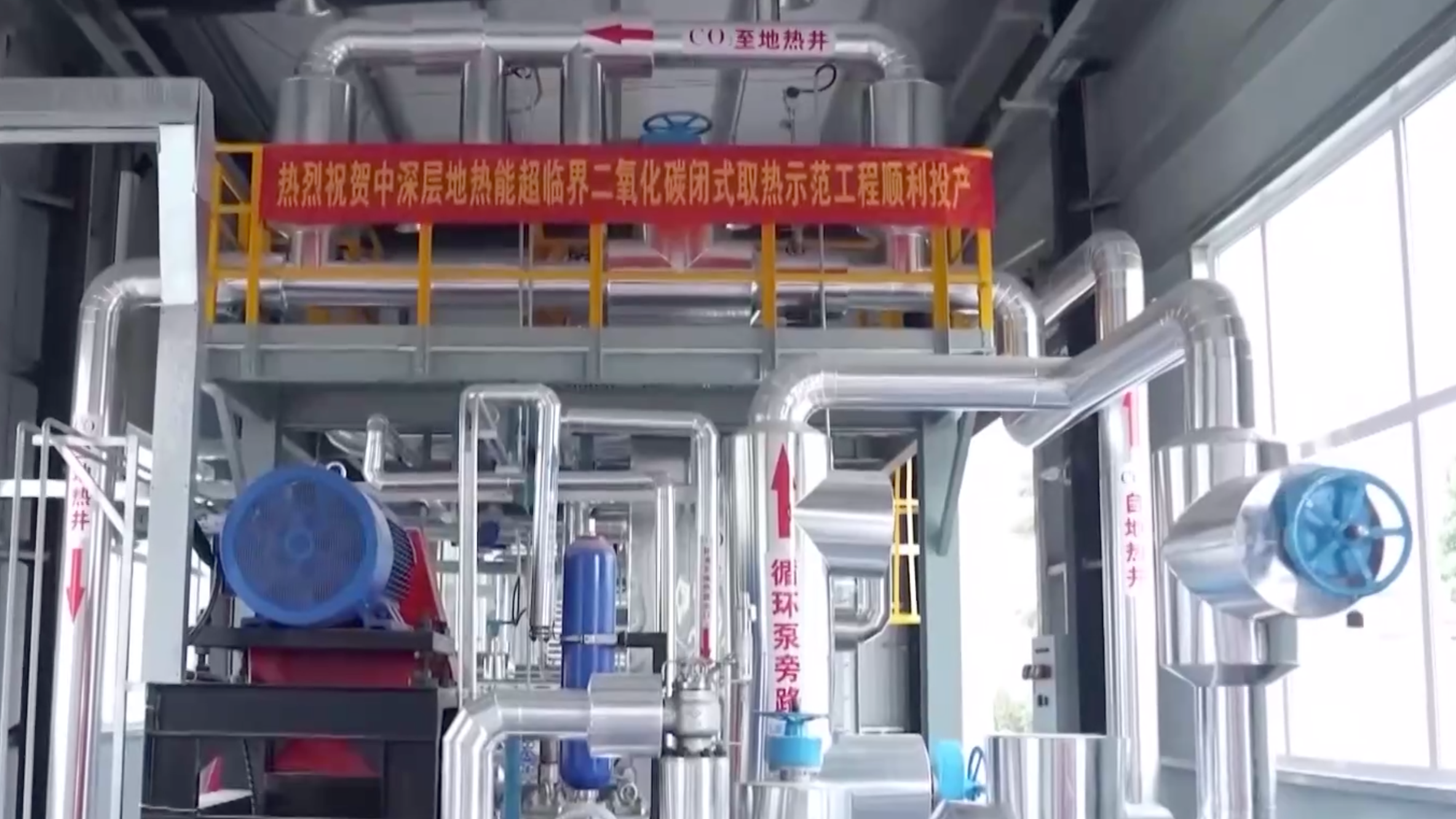
China's first geothermal heating project using supercritical carbon dioxide technology begins operations in Zhengzhou, central China's Henan Province. (Photo: CMG)
China's first geothermal heating project using supercritical carbon dioxide (CO2) technology has officially begun operations in Zhengzhou, central China's Henan Province, marking a breakthrough in the country's efforts to improve the efficiency of geothermal energy development, according to China Huaneng Group.
The project extracts underground heat by circulating supercritical CO2 through geothermal wells reaching depths of approximately 2,500 meters.
As the system starts operating, supercritical CO2 is injected deep underground through pipelines, where it absorbs geothermal heat before returning to the surface to transfer the energy to residential heating systems.
Unlike conventional geothermal projects that typically use water as the heat-transfer medium, the new system uses supercritical CO2. It has higher density and lower flow resistance, which improves heat extraction efficiency by around 20% while reducing heating energy consumption by roughly 10%.
The project is also designed to minimize environmental impact. The system does not consume groundwater, avoids contamination of underground geological formations and reduces disturbance to the surrounding subsurface environment.
Once fully operational, the facility is expected to provide winter heating for more than 18,000 square meters of residential housing. It is projected to replace approximately 288 tonnes of standard coal annually and reduce CO2 emissions by about 750 tonnes per year.