


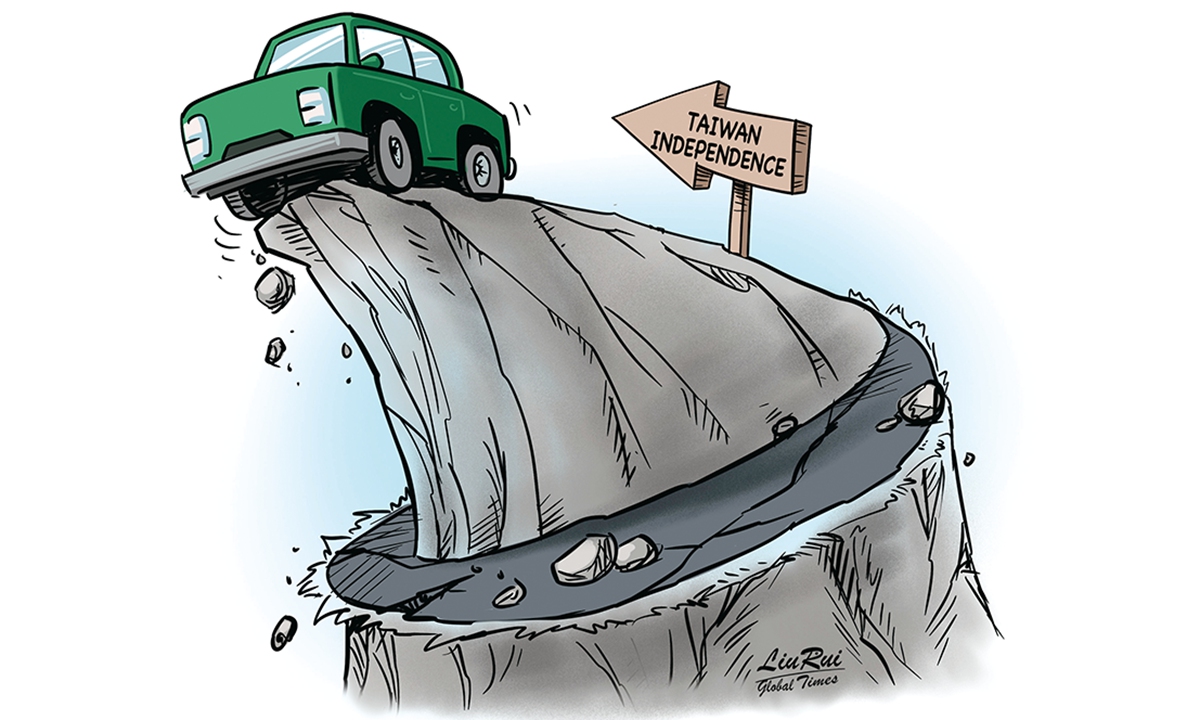
Illustration: Liu Rui/GT
Following the China-US summit, one thing has become clear: The initiative and dominance over cross-Straits relations do not lie in the Democratic Progressive Party's (DPP) empty political rhetoric, but are firmly held by the Chinese mainland.
In a media interview aired on May 15, President Donald Trump stated that US policy regarding the Taiwan region remains unchanged. Trump said he is not looking to have somebody go independent, nor is he looking to have somebody say, "'Let's go independent because the United States is backing us." The US has no intention of seeking war and will not "travel 9,500 miles to fight a war" over Taiwan. These remarks have virtually shattered the long-standing political illusion of "relying on the US to seek independence" - a narrative that the DPP has relied on and peddled repeatedly for over 30 years.
In the past, the DPP has instilled a dangerous perception among residents on the island: that the mainland "cannot fight" and "dare not fight" because Taiwan has the US as its "backing." Against such narratives, its slogan of "resisting the Chinese mainland and protecting Taiwan" was packaged as a political "sacred cow," and "relying on the US to seek independence" was portrayed as a realistic and viable path. Some radical politicians even dared to openly stage the so-called "Republic of Taiwan" performances, taking provocations against the mainland and dragging Taiwan into peril as their political capital.
Yet this time, the US has left little room for "Taiwan independence" separatists to console themselves. Instead of continuing to offer "ambiguous support" as the DPP had craved, the US has directly made its stance clear, pointing out the core of the issue: Washington does not want to be dragged down by the "Taiwan independence" forces, and is even less willing to risk bearing the costs of war for them. This means that the most crucial card in the DPP's fantasies - the belief that "the US will ultimately step in to protect the Taiwan region" - is rapidly losing its validity.
This explains why the green camp on the island has fallen into panic and silence. Those who once loudly championed the so-called "Taiwan subjectivity" and frequently instigated "Taiwan independence" provocations have suddenly begun to lower their voices, or even remain silent. They understand all too well that once the US begins to view "Taiwan independence" as a problem rather than a bargaining chip, the foundation of the DPP's political narrative of "relying on the US to seek independence" will crumble. They are terrified of saying the wrong thing at this juncture, which would not only displease the US but also invite condemnation from more than 1.4 billion Chinese people.
What's even more intriguing is that, faced with external pressure, the Lai authorities quickly issued a "five-point statement," attempting to de-escalate the situation with claims of "defending the status quo" and "there is no 'Taiwan independence' issue." However, the real question is: If they truly have no intention of promoting "Taiwan independence," why have they hesitated to remove the DPP's "Taiwan independence platform"?
This is the question being raised by an increasing number of residents in the Taiwan region. Since Trump's statements have drawn a red line for the DPP authorities, and since cross-Straits peace and "Taiwan independence" are clearly incompatible, if the DPP truly wants to prove it's not engaging in "concealing its Taiwan independence agenda by using pretexts" or "pragmatic Taiwan independence," the most direct action should be: remove the "Taiwan independence platform." Otherwise, no matter how eloquent the rhetoric, it's nothing more than a cover-up.
Ultimately, Taiwan's current predicament stems from the DPP's long-standing prioritization of ideological manipulation over reality, betting Taiwan's security on the will of the US, and its binding of the island's residents' future to the dangerous path of "relying on the US to seek independence." Now that the US has made its position clear, it has essentially torn away the last layer of packaging for this path. For the DPP, the real issue is no longer how to explain "Taiwan independence," but whether to continue clinging to the illusion of "Taiwan independence" and rushing forward. If it continues, it will only face deeper isolation, stronger pressure, and a more dangerous situation. In short, "Taiwan independence" is a dead end.
Following the meeting between the Chinese and US leaders, the situation has become very clear: "Taiwan independence" is the biggest source of risk for Taiwan and the chief disruptor of peace across the Taiwan Straits. If the DPP still cannot see this, then the lessons to come will only become more severe. May 20 marks the two-year anniversary of Lai's inauguration. He has done almost everything wrong to damage cross-Straits relations. What will he say on May 20? Let's wait and see.